296 posters, 7 videos, 13 audios, 14 topics, 10 sessions, 1,019 authors, 260 institutions
ePostersLive by SciGen Technologies S.A. All rights reserved.
RCOphth Annual Congress 2026
18 - 21 May, 2026 | Manchester Central, Manchester

P111
From Hospital to Community: Expanding Glaucoma Care Through Community Optometry
Poster Presenter
Authors
Part of Topic
Glaucoma
Audio
From Hospital to Community: Expanding Glaucoma Care through Community Optometry
Authors: Amy Hughes, Tom Mackley and Anna Bhan, Primary Eyecare Services England
Introduction
- Community Glaucoma Services enable monitoring of patients with glaucoma and glaucoma related diagnoses in community optometry practices.
- These services are designed to support patients with low risk conditions such as ocular hypertension, suspected glaucoma, or stable early chronic open angle glaucoma (COAG).
- Services vary in specialist oversight and may include monitoring by accredited optometrists under a management plan for low risk diagnoses or include glaucoma specialist or hospital oversight of management decisions.
- A previous evaluation of a pilot community glaucoma service demonstrated strong clinical safety and efficacy, high levels of patient satisfaction, and meaningful reductions in patient travel and associated carbon emissions.
- This service evaluation builds on earlier work by presenting a multi centre analysis of community glaucoma monitoring services over a full twelve month period, offering a more comprehensive assessment of service activity, outcomes, patient experience, and environmental impact.
Methods
- A retrospective service evaluation was conducted utilising routinely collected demographic, geographic, clinical and outcome service data from patients seen in a Primary Eyecare Services provided Community Glaucoma Service between January and December 2025.
- Fifteen NHS Hospital Trusts employed the Community Glaucoma Services included in this evaluation.
- Primary outcome measures were outcomes and recall periods for patients seen under a pathway where patients were monitored to a management plan with the option to discharge.
- Secondary outcomes were travel saved in both distance and carbon reduction in patients travelling to a community optometry practice rather than hospital, and reported patient experience.
- In twelve pathways, accredited optometrists monitored patients to a management plan, with eight permitting discharge.
- Outcomes and recall periods are reported for patients seen within these eight pathways.
- Where patients attended more than one monitoring appointment during the evaluation period, the outcome from the most recent appointment is reported.
- The remaining pathways employed asynchronous virtual review processes or did not permit patient discharge and were excluded from the primary outcomes analysis.
- All patient episodes, including those managed via asynchronous virtual review or pathways without discharge options, were included in the travel and patient experience analyses.
- Carbon savings were calculated assuming car travel and segmented by fuel type, using NHS England’s Healthy Outcomes of Travel Tool datasets
Results
Activity, demographics and pathway type
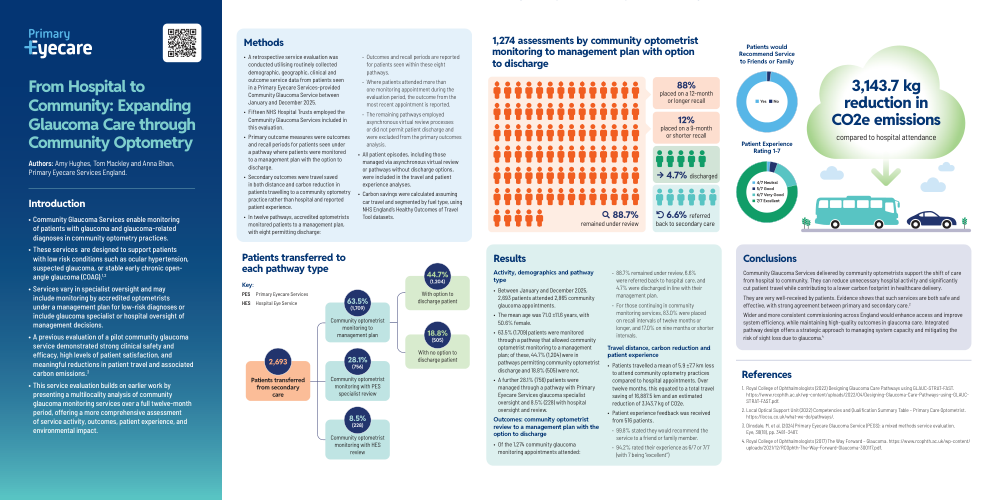
- Between January and December 2025, 2,693 patients attended 2,865 community glaucoma appointments.
- The mean age was 71.0 ± 11.6 years, with 50.6% female.
- 63.5% (1,709) patients were monitored through a pathway that allowed community optometrist monitoring to a management plan; of these, 44.7% (1,204) were in pathways permitting community optometrist discharge and 18.8% (505) were not.
- A further 28.1% (756) patients were managed through a pathway with Primary Eyecare Services glaucoma specialist oversight and 8.5% (228) with hospital oversight and review.
Outcomes: community optometrist review to a management plan with the option to discharge
- Of the 1,274 community glaucoma monitoring appointments attended:
- 88.7% remained under review, 6.6% were referred back to hospital care, and 4.7% were discharged in line with their management plan.
- For those continuing in community monitoring services, 83.0% were placed on recall intervals of twelve months or longer, and 17.0% on nine months or shorter intervals.
Travel distance, carbon reduction and patient experience
- Patients travelled a mean of 5.9 ± 7.7 km less to attend community optometry practices compared to hospital appointments. Over twelve months, this equated to a total travel saving of 16,887.5 km and an estimated reduction of 3,143.7 kg of CO2e.
- Patient experience feedback was received from 516 patients.
- 99.8% stated they would recommend the service to a friend or family member.
- 94.2% rated their experience as 6 out of 7 or 7 out of 7, with 7 being excellent.
Conclusions
Community Glaucoma Services delivered by community optometrists support the shift of care from hospital to community. They can reduce unnecessary hospital activity and significantly cut patient travel while contributing to a lower carbon footprint in healthcare delivery.
They are very well received by patients. Evidence shows that such services are both safe and effective, with strong agreement between primary and secondary care.
Wider and more consistent commissioning across England would enhance access and improve system efficiency, while maintaining high quality outcomes in glaucoma care. Integrated pathway design offers a strategic approach to managing system capacity and mitigating the risk of sight loss due to glaucoma.
References
- Royal College of Ophthalmologists (2022) Designing Glaucoma Care Pathways using GLAUC STRAT FAST. https://www.rcophth.ac.uk/wp-content/uploads/2022/04/Designing-Glaucoma-Care-Pathways-using-GLAUCSTRAT-FAST.pdf
- Local Optical Support Unit (2022) Competencies and Qualification Summary Table, Primary Care Optometrist. https://locsu.co.uk/what-we-do/pathways/
- Dinsdale, M. et al. (2024) Primary Eyecare Glaucoma Service (PEGS): a mixed methods service evaluation. Eye, 38(18), pp. 3481 to 3487
- Royal College of Ophthalmologists (2017) The Way Forward, Glaucoma. https://www.rcophth.ac.uk/wp-content/uploads/2021/12/RCOphth-The-Way-Forward-Glaucoma-300117.pdf