296 posters, 7 videos, 13 audios, 14 topics, 10 sessions, 1,019 authors, 260 institutions
ePostersLive by SciGen Technologies S.A. All rights reserved.
RCOphth Annual Congress 2026
18 - 21 May, 2026 | Manchester Central, Manchester

P101
The financial impact of coding inaccuracies in eye casualty
Poster Presenter
Part of Topic
Emergency ophthalmology
The Financial Impact of Coding Inaccuracies in Eye Casualty
Kavita Aggarwal, Audrey Shwe-Tin, Stella Hornby, Ella Barnett
Introduction
◦ There is an aging population and increased demand for healthcare resources with a target of over 2.6 million extra patient encounters expected annually by 20291. For the additional patients, NHS expenditure also had to grow. It went from £131.8 billion to £161.1 billion in 2010 to 2023/242.
◦ Oxford University NHS Foundation Trust had 14,284 A&E attendances in July 20253 of which around 3% of all A&E attendances are due to ophthalmology 4.
◦ In the current NHS system, clinical coding plays a vital role as a tool for audit, benchmarking and surveillance. Any activity is then translated into chargeable income for the department.
◦ Inaccurate coding results in financial deficits for NHS trusts which directly impacts the maintenance and development of services, equipment and staff.
Aims and Methods
◦ Evaluate the lost revenue from coding inaccuracy in Oxford University Hospital eye casualty.
◦ Single centre retrospective audit looking at patients attending eye casualty from May 2024 - May 2025. Data was obtained from coding sheets, Medisoft and the Trust audit tool Orbit.
◦ Oxford trainee survey on coding confidence, accessibility and knowledge.
Results
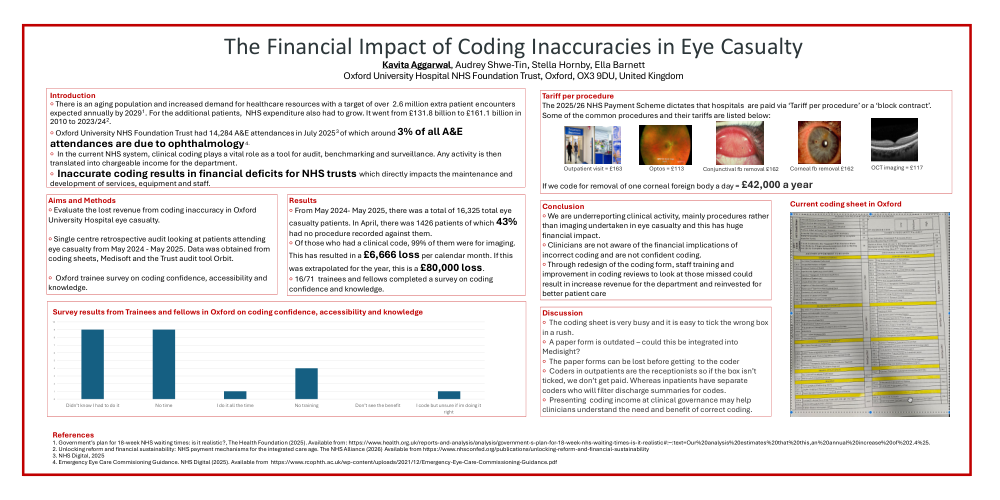
◦ From May 2024- May 2025, there was a total of 16,325 total eye casualty patients. In April, there was 1426 patients of which 43% had no procedure recorded against them.
◦ Of those who had a clinical code, 99% of them were for imaging. This has resulted in a £6,666 loss per calendar month. If this was extrapolated for the year, this is a £80,000 loss.
◦ 16/71 trainees and fellows completed a survey on coding confidence and knowledge.
Conclusion
◦ We are underreporting clinical activity, mainly procedures rather than imaging undertaken in eye casualty and this has huge financial impact.
◦ Clinicians are not aware of the financial implications of incorrect coding and are not confident coding.
◦ Through redesign of the coding form, staff training and improvement in coding reviews to look at those missed could result in increase revenue for the department and reinvested for better patient care
Discussion
◦ The coding sheet is very busy and it is easy to tick the wrong box in a rush.
◦ A paper form is outdated – could this be integrated into Medisight?
◦ The paper forms can be lost before getting to the coder
◦ Coders in outpatients are the receptionists so if the box isn’t ticked, we don’t get paid. Whereas inpatients have separate coders who will filter discharge summaries for codes.
◦ Presenting coding income at clinical governance may help clinicians understand the need and benefit of correct coding.