296 posters, 7 videos, 13 audios, 14 topics, 10 sessions, 1,019 authors, 260 institutions
ePostersLive by SciGen Technologies S.A. All rights reserved.
RCOphth Annual Congress 2026
18 - 21 May, 2026 | Manchester Central, Manchester

P100
Teaching High-Acuity, Low-Occurrence Procedures: Development of a Simple Model for Lateral Canthotomy
Poster Presenter
Part of Topic
Emergency ophthalmology
INTRODUCTION
Orbital compartment syndrome (OCS) is a sight‑threatening emergency caused by rapid rises in intra‑orbital pressure, most commonly from retrobulbar haemorrhage after trauma. Without urgent decompression, irreversible vision loss can occur within 90–120 minutes (1)
Lateral canthotomy and cantholysis (LCC) is the definitive bedside treatment and a mandated competency within RCEM and RCOphth curricula (2,3)
Despite this, LCC remains a High‑Acuity, Low‑Occurrence (HALO) procedure: rarely encountered yet requiring immediate, confident execution. Only 37% of UK emergency physicians feel prepared to perform LCC independently, with 91% citing limited training (4).
Existing simulation options have significant limitations: porcine and human cadaveric models are costly, single‑use, and logistically complex (5,6) . Commercial synthetic trainers may cost over £290 (7). Low‑fidelity designs lack whole‑face topography and often struggle to replicate the mechanical distinction between canthotomy and cantholysis (8).
Agar‑based globes have shown promise in corneal foreign body training by replicating realistic globe resistance, but have not been adapted for LCC (9).
Aim: To design, deliver, and evaluate a low‑cost, whole‑face LCC simulation model that addresses these limitations and provides an accessible, high‑yield training tool for emergency medicine clinicians
METHODS
A prospective service evaluation conducted within a single Emergency Department in a suburban district general hospital in the UK
Participants attended a 1‑hour structured workshop including overview of OCS and LCC , demonstration and supervised practice
Evaluation comprised of a Pre‑ and post‑training self‑assessment (5‑point Likert scale, five domains) and a questionnaire with qualitiative feedback
Model Construction: Total material cost <£5 per unit with reset time <2 minutes between users.
RESULTS
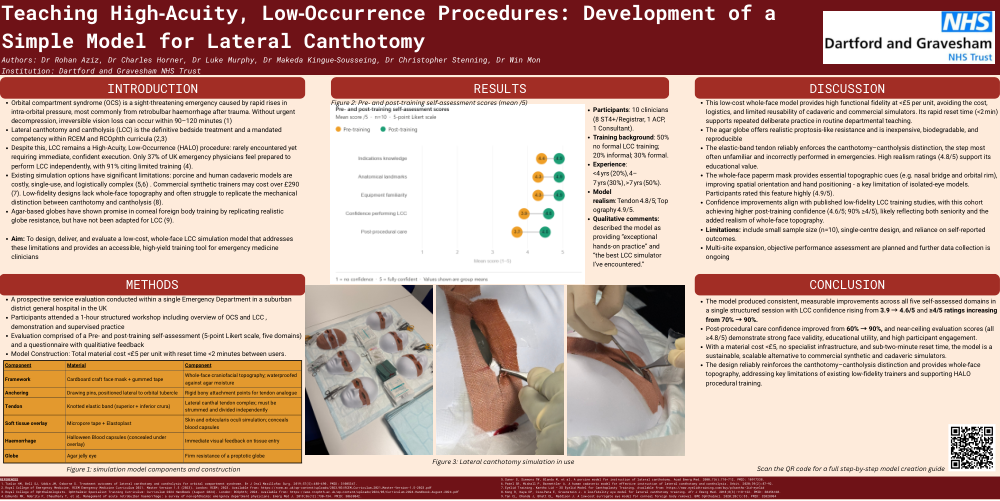
Participants: 10 clinicians (8 ST4+/Registrar, 1 ACP, 1 Consultant).
Training background: 50% no formal LCC training; 20% informal; 30% formal.
Experience: <4 yrs (20%), 4–7 yrs (30%), >7 yrs (50%).
Model realism: Tendon 4.8/5; Topography 4.9/5.
Qualitative comments: described the model as providing “exceptional hands‑on practice” and “the best LCC simulator I’ve encountered.”
DISCUSSION
This low‑cost whole‑face model provides high functional fidelity at <£5 per unit, avoiding the cost, logistics, and limited reusability of cadaveric and commercial simulators. Its rapid reset time (<2 min) supports repeated deliberate practice in routine departmental teaching.
The agar globe offers realistic proptosis‑like resistance and is inexpensive, biodegradable, and reproducible
The elastic‑band tendon reliably enforces the canthotomy–cantholysis distinction, the step most often unfamiliar and incorrectly performed in emergencies. High realism ratings (4.8/5) support its educational value.
The whole‑face paperm mask provides essential topographic cues (e.g. nasal bridge and orbital rim), improving spatial orientation and hand positioning - a key limitation of isolated‑eye models. Participants rated this feature highly (4.9/5).
Confidence improvements align with published low‑fidelity LCC training studies, with this cohort achieving higher post‑training confidence (4.6/5; 90% ≥4/5), likely reflecting both seniority and the added realism of whole‑face topography.
Limitations: include small sample size (n=10), single‑centre design, and reliance on self‑reported outcomes.
Multi‑site expansion, objective performance assessment are planned and further data collection is ongoing
CONCLUSION
The model produced consistent, measurable improvements across all five self‑assessed domains in a single structured session with LCC confidence rising from 3.9 → 4.6/5 and ≥4/5 ratings increasing from 70% → 90%.
Post‑procedural care confidence improved from 60% → 90%, and near‑ceiling evaluation scores (all ≥4.8/5) demonstrate strong face validity, educational utility, and high participant engagement.
With a material cost <£5, no specialist infrastructure, and sub‑two‑minute reset time, the model is a sustainable, scalable alternative to commercial synthetic and cadaveric simulators.
The design reliably reinforces the canthotomy–cantholysis distinction and provides whole‑face topography, addressing key limitations of existing low‑fidelity trainers and supporting HALO procedural training.