197 posters, 15 videos, 1 topics, 31 sessions, 509 authors
ePostersLive by SciGen Technologies S.A. All rights reserved.
2026 AO Annual Meeting
Conference ePosters

P34
Risk Factor Assessment of Transcrestal Maxillary Sinus Floor Elevation
Part of Topic
Risk Factor Assessment of Transcrestal Maxillary Sinus Floor Elevation
Abstract:
Objective:To assess the risk factors of transcrestal maxillary sinus floor elevation and provide a basis for clinical decision - making.
Methods:The risk factors were evaluated from aspects including bone defect type (horizontal, vertical, mixed), the height of bone to be elevated, maxillary sinus floor morphology, sinus membrane status (assessed by imaging), and maxillary sinus ostium condition. Each factor was classified into three levels of difficulty: easy, medium, and difficult.
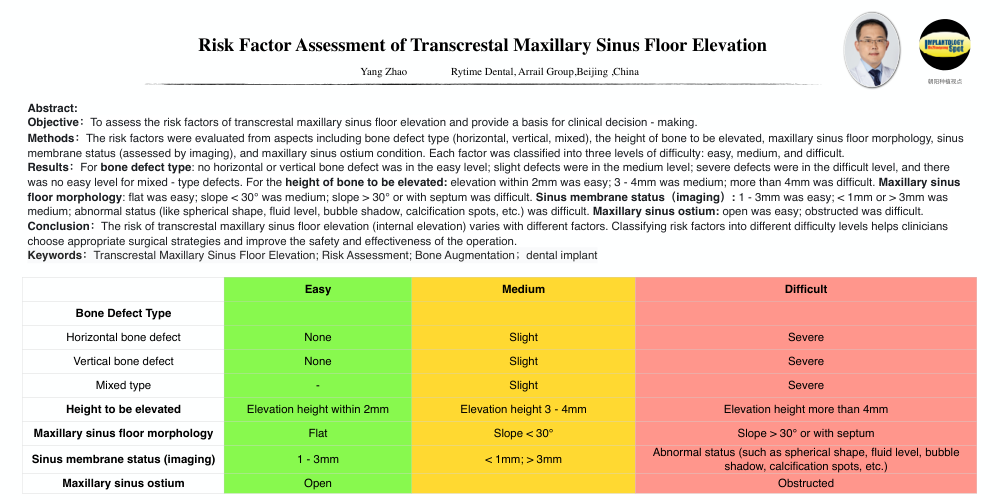
Results:For bone defect type: no horizontal or vertical bone defect was in the easy level; slight defects were in the medium level; severe defects were in the difficult level, and there was no easy level for mixed - type defects. For the height of bone to be elevated: elevation within 2mm was easy; 3 - 4mm was medium; more than 4mm was difficult. Maxillary sinus floor morphology: flat was easy; slope < 30° was medium; slope > 30° or with septum was difficult. Sinus membrane status(imaging): 1 - 3mm was easy; < 1mm or > 3mm was medium; abnormal status (like spherical shape, fluid level, bubble shadow, calcification spots, etc.) was difficult. Maxillary sinus ostium: open was easy; obstructed was difficult.
Conclusion:The risk of transcrestal maxillary sinus floor elevation (internal elevation) varies with different factors. Classifying risk factors into different difficulty levels helps clinicians choose appropriate surgical strategies and improve the safety and effectiveness of the operation.
Keywords:Transcrestal Maxillary Sinus Floor Elevation; Risk Assessment; Bone Augmentation;dental implant