197 posters, 15 videos, 1 topics, 31 sessions, 509 authors
ePostersLive by SciGen Technologies S.A. All rights reserved.
2026 AO Annual Meeting
Conference ePosters

P191
Evaluation of Reports Completeness of Dental Patient-reported Outcomes in Periodontitis Treatments
Poster Presenter
Part of Topic
Evaluation of the Completeness of Dental Patient-reported Outcomes in Periodontitis Treatments
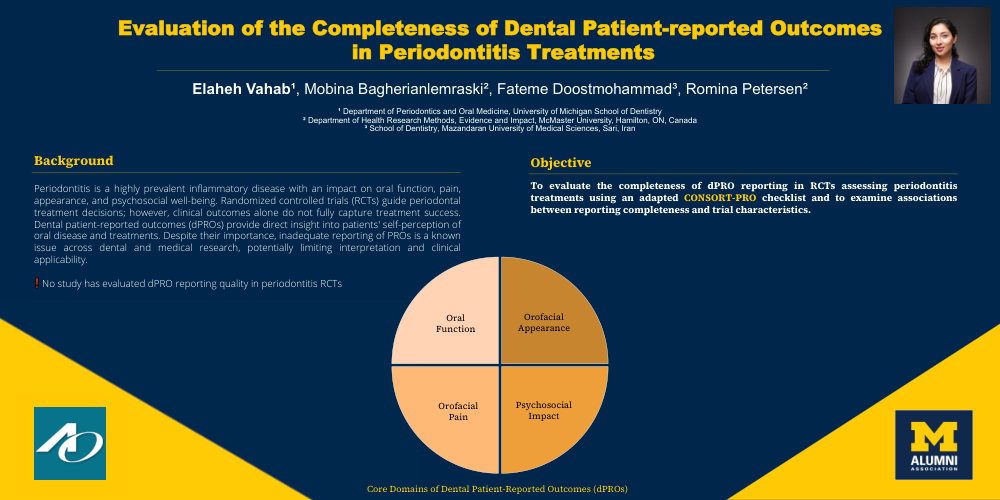
Background: Periodontitis is a highly prevalent inflammatory disease with an impact on oral function, pain, appearance, and psychosocial well-being. Randomized controlled trials (RCTs) guide periodontal treatment decisions; however, clinical outcomes alone do not fully capture treatment success. Dental patient-reported outcomes (dPROs) provide direct insight into patients' self-perception of oral disease and treatments. Despite their importance, inadequate reporting of PROs is a known issue across dental and medical research, potentially limiting interpretation and clinical applicability. No study has evaluated dPRO reporting quality in periodontitis RCTs
Aim: To evaluate the completeness of dPRO reporting in RCTs assessing periodontitis treatments using an adapted CONSORT-PRO checklist and to examine associations between reporting completeness and trial characteristics.
Study Design & Selection
We conducted a registered meta-epidemiological study (OSF) following established guidelines for methodological research. A comprehensive search of the Cochrane Central Register of Controlled Trials (CENTRAL) was performed to identify randomized controlled trials (RCTs) published between 2003 and 2023 that evaluated treatments for periodontitis and reported at least one dental patient-reported outcome (dPRO) as a primary or secondary outcome. Study selection was conducted independently and in duplicate using a standardized screening process, with conflicts resolved by consensus or third-reviewer arbitration.
Assessment & Analysis
For each included RCT, pairs of trained reviewers independently extracted data and assessed risk of bias using the Cochrane RoB 2.0 tool. Reporting completeness of dPROs was evaluated using an adapted CONSORT-PRO checklist, generating a percent completeness score for each trial. We summarized reporting completeness across studies and used bivariate regression models to examine associations between reporting quality and trial characteristics, including whether dPROs were primary or secondary outcomes and overall risk of bias.
Study Sample & Overall Reporting
From 2,802 records, 49 randomized controlled trials met inclusion criteria. Most studies were published after 2014 (82%), and over half (53%) designated dPROs as primary outcomes. Orofacial pain was the most frequently measured domain (94%). Despite the growing inclusion of dPROs, overall reporting completeness according to the adapted CONSORT-PRO checklist was low, with a mean completion of 42%. Trials that identified dPROs as primary outcomes demonstrated significantly higher reporting completeness (51%) compared with trials where dPROs were secondary outcomes (32%, p < 0.0001).
Reporting Quality & Bias Associations Reporting deficiencies were not random. Trials with dPROs as secondary outcomes had 19 percentage points lower reporting completeness compared to those with primary dPROs. Additionally, studies with high risk of bias showed 18 percentage points lower reporting completeness than low-risk trials (p < 0.001). While nearly all studies reported who completed the dPRO (96%), critical elements were rarely addressed, only 4% of trials identified dPRO status in the title or abstract, and fewer than 15% reported statistical methods for handling missing data. These findings indicate that poorer methodological quality is associated with weaker patient-reported outcome reporting