197 posters, 15 videos, 1 topics, 31 sessions, 509 authors
ePostersLive by SciGen Technologies S.A. All rights reserved.
2026 AO Annual Meeting
Conference ePosters

P159
Sorption and Solubility of 3D-Printed Restorative Materials
Poster Presenter
Authors
Mina Sagen, Silvio Uhlig, Lene Grutle, Heidi Holm, Aida Mulic
Part of Topic
Introduction and Objective
Three-dimensional (3D) printing enables the fabrication of dental restorations from photosensitive resins that polymerize during and after production. Polymerization protocols may vary and affect material properties.
This study aimed to evaluate and compare the water sorption and solubility of two 3D-printed resin-based materials subjected to different post-production polymerization protocols, using a milled resin-based material as control.
Materials and Methods
Two resins for 3D-printing of indirect restorations—Saremco Print CROWNTEC (Saremco; n = 15) and FREEPRINT temp (DETAX; n = 15)—and one milling resin, Temp Premium Flexible (Zirkonzahn; n = 5), were used to fabricate circular disc-shaped specimens according to ISO 4049:2019: Dentistry – Polymer-based restorative materials.
3D-printing was performed using a digital light processing printer (Asiga Max UV). After printing, the specimens were randomly assigned to one of three post-production polymerization protocols using the Otoflash G171 polymerization unit: (1) 4000 flashes + nitrogen (N2), (2) 2000 flashes + N2, (3) 4000 flashes without N2. All specimens were subsequently polished, and the volume (V, mm³) of each specimen was calculated.
For the evaluation of water sorption (Wsp) and solubility (Wsl), specimens were dried to a constant mass (m₁), immersed in distilled water at 37 °C for 7 days, blotted dry, and weighed (m₂). The specimens were then redried to constant mass (m₃).
Wsp and Wsl were calculated to the nearest 0.1 µg/mm³ using the following formulas:
Wsp= (m2−m3)/V
Wsl= (m1−m3)/V
Statistical significance (p<0.05) was assessed using Welch’s t-test.
Results
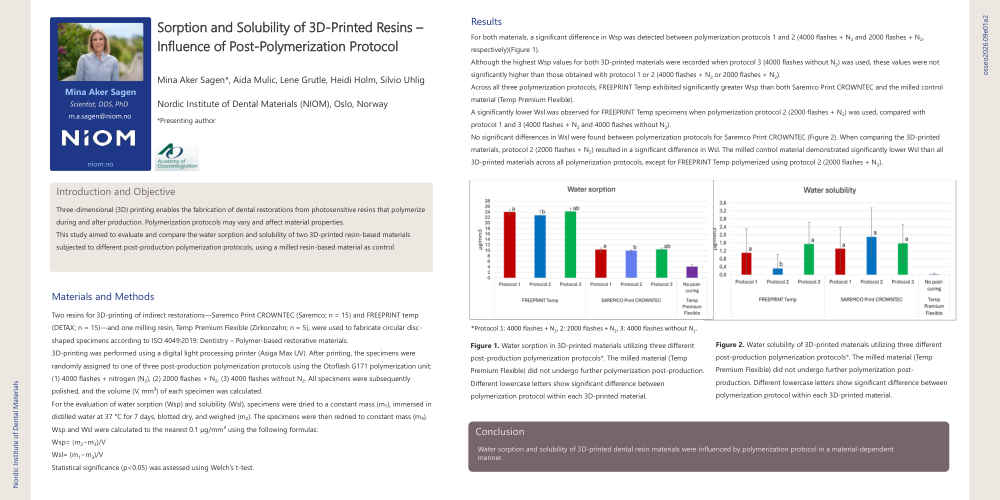
For both materials, a significant difference in Wsp was detected between polymerization protocols 1 and 2 (4000 flashes + N2 and 2000 flashes + N2, respectively)(Figure 1).
Although the highest Wsp values for both 3D-printed materials were recorded when protocol 3 (4000 flashes without N2) was used, these values were not significantly higher than those obtained with protocol 1 or 2 (4000 flashes + N2 or 2000 flashes + N2).
Across all three polymerization protocols, FREEPRINT Temp exhibited significantly greater Wsp than both Saremco Print CROWNTEC and the milled control material (Temp Premium Flexible).
A significantly lower Wsl was observed for FREEPRINT Temp specimens when polymerization protocol 2 (2000 flashes + N2) was used, compared with protocol 1 and 3 (4000 flashes + N2 and 4000 flashes without N2).
No significant differences in Wsl were found between polymerization protocols for Saremco Print CROWNTEC (Figure 2). When comparing the 3D-printed materials, protocol 2 (2000 flashes + N2) resulted in a significant difference in Wsl. The milled control material demonstrated significantly lower Wsl than all 3D-printed materials across all polymerization protocols, except for FREEPRINT Temp polymerized using protocol 2 (2000 flashes + N2).
Conclusion
Water sorption and solubilityof 3D-printed dental resin materials were influenced by polymerizationprotocol in a material-dependent manner