226 posters, 5 topics, 20 sessions, 598 authors, 292 institutions
ePostersLive by SciGen Technologies S.A. All rights reserved.
Obstetric Anaesthesia Annual Scientific Meeting 2026
14-15 May 2026 | Liverpool Convention Centre

7163823
Audit into Timing of Administration of Surgical Antibiotic Prophylaxis in Caesarean Section
Poster Presenter
Authors
Affiliations
Part of Topic
Service Evaluation
Audit into Timing of Administration of Surgical Antibiotic Prophylaxis in Caesarean Section Dr Michael Stackhouse (CT2) & Dr Ieva Dowling (Consultant Anaesthetist)
Introduction
Local guidelines at Nottingham University Hospitals (NUH) state antibiotic prophylaxis for all Casesarean sections should be administered prior to skin incision, unless preterm, with the caveat that it should not delay start time in Category 1 C-sections. This is supported by NICE and WHO guidance, which states the same. These antibiotics should be single-dose penicillin, or first- or second- generation cephalosporins. Unlike NUH guidance or WHO guidance, current NICE guidance specifies that Co-Amoxiclav should not be given before skin incision, however this guidance is from 2011, while WHO guidance has been updated in 2021.
Method
To assess our compliance to our local guidance, we reviewed 150 C-sections at Nottingham City Hospital (NCH), between 25th November and 29th December 2025 We used Badgernet to identify appropriate patients, then reviewed our Digital Health Records to find anaesthetic charts and Nervecentre prescription charts to assess if appropriate prophylactic antibiotics were given, and when they were administered. We separated Cat-1 C-sections from Cat 2-4 C-sections, due to the caveat around preventing delays in Cat 1 C-sections, and identified specifically which C-sections were pre-term. We also assessed which antibiotic was given, and whether a second dose was given if blood loss was greater than 1.5L.
Results and Conclusion
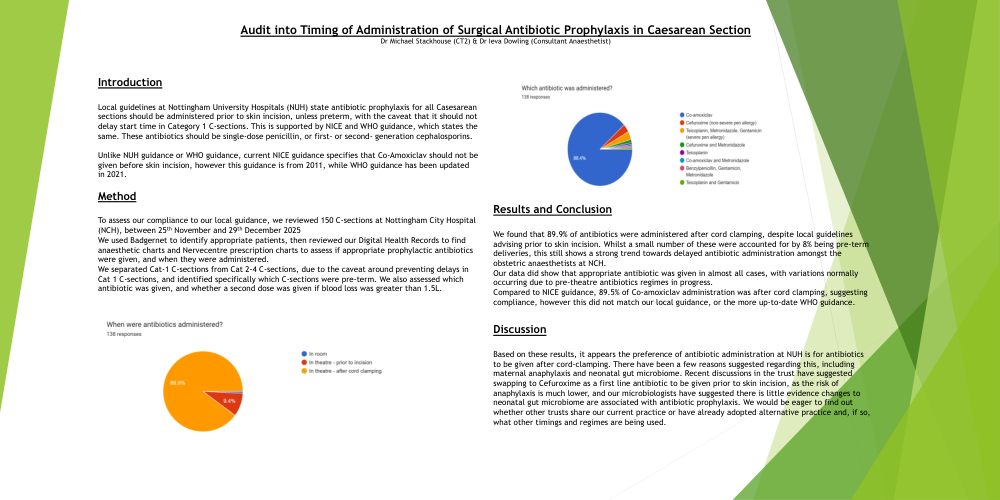
We found that 89.9% of antibiotics were administered after cord clamping, despite local guidelines advising prior to skin incision. Whilst a small number of these were accounted for by 8% being pre-term deliveries, this still shows a strong trend towards delayed antibiotic administration amongst the obstetric anaesthetists at NCH. Our data did show that appropriate antibiotic was given in almost all cases, with variations normally occurring due to pre-theatre antibiotics regimes in progress. Compared to NICE guidance, 89.5% of Co-amoxiclav administration was after cord clamping, suggesting compliance, however this did not match our local guidance, or the more up-to-date WHO guidance.
Discussion
Based on these results, it appears the preference of antibiotic administration at NUH is for antibiotics to be given after cord-clamping. There have been a few reasons suggested regarding this, including maternal anaphylaxis and neonatal gut microbiome. Recent discussions in the trust have suggested swapping to Cefuroxime as a first line antibiotic to be given prior to skin incision, as the risk of anaphylaxis is much lower, and our microbiologists have suggested there is little evidence changes to neonatal gut microbiome are associated with antibiotic prophylaxis. We would be eager to find out whether other trusts share our current practice or have already adopted alternative practice and, if so, what other timings and regimes are being used.