226 posters, 5 topics, 20 sessions, 598 authors, 292 institutions
ePostersLive by SciGen Technologies S.A. All rights reserved.
Obstetric Anaesthesia Annual Scientific Meeting 2026
14-15 May 2026 | Liverpool Convention Centre

7163808
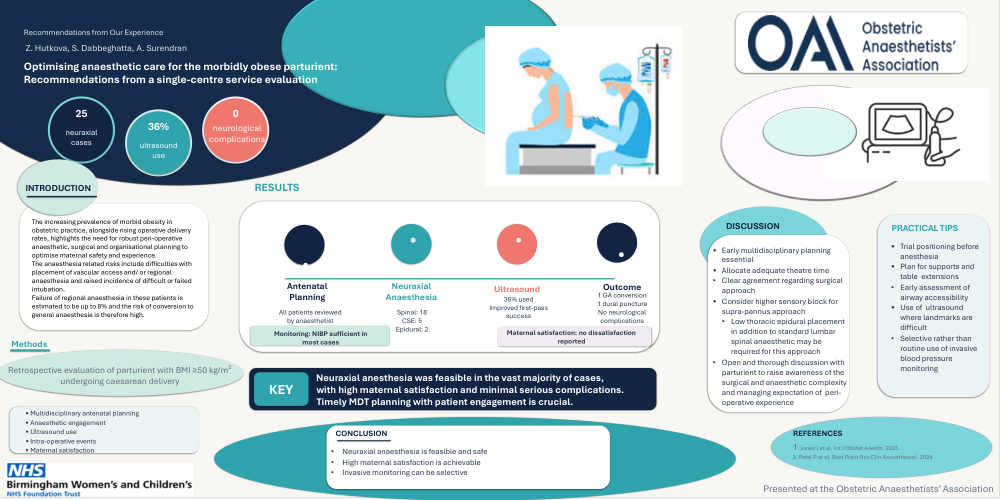
Optimising anaesthetic care for the morbidly obese parturient: recommendations from a single-centre service evaluation
Poster Presenter
Part of Topic
Service Evaluation
Optimising anaesthetic care for the morbidly obese parturient:
Recommendations from a single-centre service evaluation
Authors: Hutkova, S. Dabbeghatta, A. Surendran
Introduction:
The increasing prevalence of morbid obesity in obstetric practice, alongside rising operative delivery rates, highlights the need for robust peri-operative anaesthetic, surgical and organisational planning to optimise maternal safety and experience.
The anaesthesia related risks include difficulties with placement of vascular access and/ or regional anaesthesia and raised incidence of difficult or failed intubation.
Failure of regional anaesthesia in these patients is estimated to be up to 8% and the risk of conversion to general anaesthesia is therefore high.
Methrods:
Retrospective evaluation of parturient with BMI ≥50 kg/m²
undergoing caesarean delivery
• Multidisciplinary antenatal planning
• Anaesthetic engagement
• Ultrasound use
• Intra-operative events
• Maternal satisfaction
Results:
Antenatal Planning: All patients reviewed by anaesthetist
Neuraxial Anaesthesia: Spinal: 18, CSE: 5, Epidural: 2
Ultrasound: 36% used, Improved first-pass success
Outcome: 1 GA conversion, 1 dural puncture, No neurological complications
Maternal satisfaction: no dissatisfaction reported
Monitoring: NIBP sufficient in most cases
Key: Neuraxial anesthesia was feasible in the vast majority of cases with high maternal satisfaction and minimal serious complications. Timely MDT planning with patient engagement is crucial.
Conclusion:
•Neuraxial anaesthesia is feasible and safe
•High maternal satisfaction is achievable
•Invasive monitoring can be selective
Discusison:
• Early multidisciplinary planning essential
• Allocate adequate theatre time
• Clear agreement regarding surgical approach
• Consider higher sensory block for supra-pannus approach
•Low thoracic epidural placement in addition to standard lumbar spinal anaesthetic may be required for this approach
•Open and thorough discussion with parturient to raise awareness of the surgical and anaesthetic complexity and managing expectation of peri-operative experience
Practical tips:
• Trial positioning before anesthesia
• Plan for supports and table extensions
•Early assessment of airway accessibility
• Use of ultrasound where landmarks are difficult
•Selective rather than routine use of invasive blood pressure monitoring
References:
1. Jones J et al. Int J Obstet Anesth. 2025
2. Patel P et al. Best Pract Res Clin Anaesthesiol. 2024