226 posters, 5 topics, 20 sessions, 598 authors, 292 institutions
ePostersLive by SciGen Technologies S.A. All rights reserved.
Obstetric Anaesthesia Annual Scientific Meeting 2026
14-15 May 2026 | Liverpool Convention Centre

7162503
Noradrenaline for neuraxial anaesthesia--induced hypotension in severe peripartum cardiomyopathy
Poster Presenter
Authors
Affiliations
health education and improvement wales, University Hospital of Wales
Part of Topic
Case report
Vasopressor Choice in Neuraxial Anaesthesia for Caesarean Delivery in Severe Left Ventricular Dysfunction: A Case Report
Background
Hypotension following neuraxial anaesthesia is common and typically managed with phenylephrine. In patients with severely reduced left ventricular ejection fraction (LVEF), pure α-agonists may:
• Increase afterload
• Reduce cardiac output
• Trigger reflex bradycardia
• Worsen haemodynamic instability
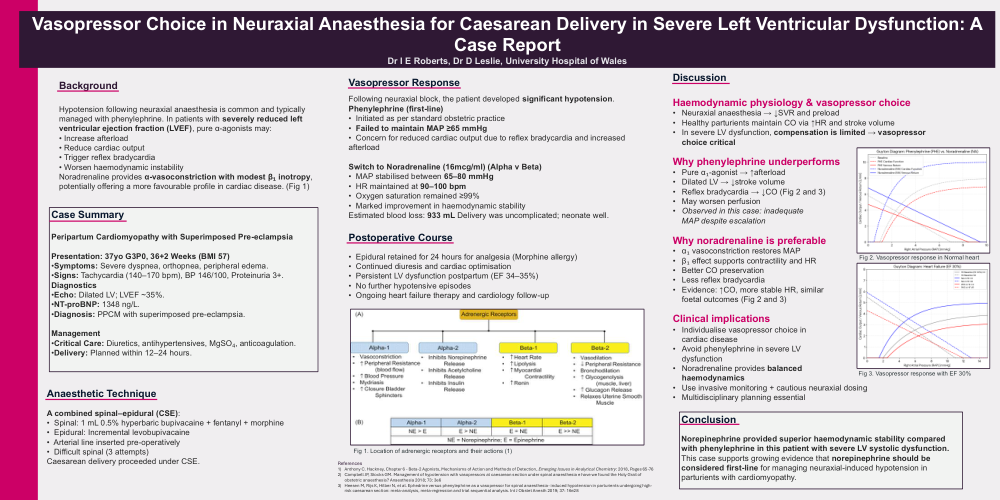
Noradrenaline provides α-vasoconstriction with modest β1 inotropy, potentially offering a more favourable profile in cardiac disease. (Fig 1)
Dr I E Roberts, Dr D Leslie, University Hospital of Wales
Vasopressor Response
Following neuraxial block, the patient developed significant hypotension. Phenylephrine (first-line)
• Initiated as per standard obstetric practice
• Failed to maintain MAP ≥65 mmHg
• Concern for reduced cardiac output due to reflex bradycardia and increased afterload
Switch to Noradrenaline (16mcg/ml) (Alpha v Beta) • MAP stabilised between 65–80 mmHg
• HR maintained at 90–100 bpm
• Oxygen saturation remained ≥99%
• Marked improvement in haemodynamic stability
Estimated blood loss: 933 mL Delivery was uncomplicated; neonate well.
Postoperative Course
• Epidural retained for 24 hours for analgesia (Morphine allergy) • Continued diuresis and cardiac optimisation
• Persistent LV dysfunction postpartum (EF 34–35%)
• No further hypotensive episodes
• Ongoing heart failure therapy and cardiology follow-up
Discussion
Haemodynamic physiology & vasopressor choice
-
Neuraxial anaesthesia → ↓SVR and preload
-
Healthy parturients maintain CO via ↑HR and stroke volume
-
In severe LV dysfunction, compensation is limited → vasopressor
choice critical
Why phenylephrine underperforms
-
Pure α1-agonist → ↑afterload
-
Dilated LV → ↓stroke volume
-
Reflex bradycardia → ↓CO (Fig 2 and 3)
-
May worsen perfusion
-
Observed in this case: inadequate
MAP despite escalation
Why noradrenaline is preferable
• α1 vasoconstriction restores MAP
• β1 effect supports contractility and HR
• Better CO preservation
• Less reflex bradycardia
• Evidence: ↑CO, more stable HR, similarfoetal outcomes (Fig 2 and 3)
Clinical implications
-
Individualise vasopressor choice in cardiac disease
-
Avoid phenylephrine in severe LV dysfunction
-
Noradrenaline provides balanced haemodynamics
-
Fig 2. Vasopressor response in Normal heart
Case Summary
Peripartum Cardiomyopathy with Superimposed Pre-eclampsia
Presentation: 37yo G3P0, 36+2 Weeks (BMI 57)
•Symptoms: Severe dyspnea, orthopnea, peripheral edema. •Signs: Tachycardia (140–170 bpm), BP 146/100, Proteinuria 3+. Diagnostics
•Echo: Dilated LV; LVEF ~35%.
•NT-proBNP: 1348 ng/L.
•Diagnosis: PPCM with superimposed pre-eclampsia.
Management
•Critical Care: Diuretics, antihypertensives, MgSO4, anticoagulation. •Delivery: Planned within 12–24 hours.
Anaesthetic Technique
A combined spinal–epidural (CSE):
• Spinal: 1 mL 0.5% hyperbaric bupivacaine + fentanyl + morphine • Epidural: Incremental levobupivacaine
• Arterial line inserted pre-operatively
• Difficult spinal (3 attempts)
Caesarean delivery proceeded under CSE.