226 posters, 5 topics, 20 sessions, 598 authors, 292 institutions
ePostersLive by SciGen Technologies S.A. All rights reserved.
Obstetric Anaesthesia Annual Scientific Meeting 2026
14-15 May 2026 | Liverpool Convention Centre

7162491
Maternity critical care| high dependency unit (HDU) Report - 2024. The Rotunda Hospital, Dublin
Poster Presenter
Part of Topic
Service Evaluation
Introduction:
The High Dependency Unit (HDU) at the Rotunda Hospital provides specialised care for women experiencing critical illness. Functioning at Level 2 critical care capacity, the unit offers advanced medical and nursing interventions short of respiratory support. This typically includes the use of invasive cardiovascular monitoring and the administration of vasoactive medications when required.
When patients require escalation to Level 3 care, such as mechanical ventilation or renal replacement therapy, support from the Mater Misericordiae University Hospital’s Department of Critical Care ensures timely transfer to an appropriate ICU setting.
Methods:
A retrospective study of all patients admitted to the HDU in 2024. Data was extracted from the electronic patient record. Data included patient demographics, admission diagnoses and medical interventions undertaken. The annual report is used to guide future funding allocation, resource management and workforce development.
Results:
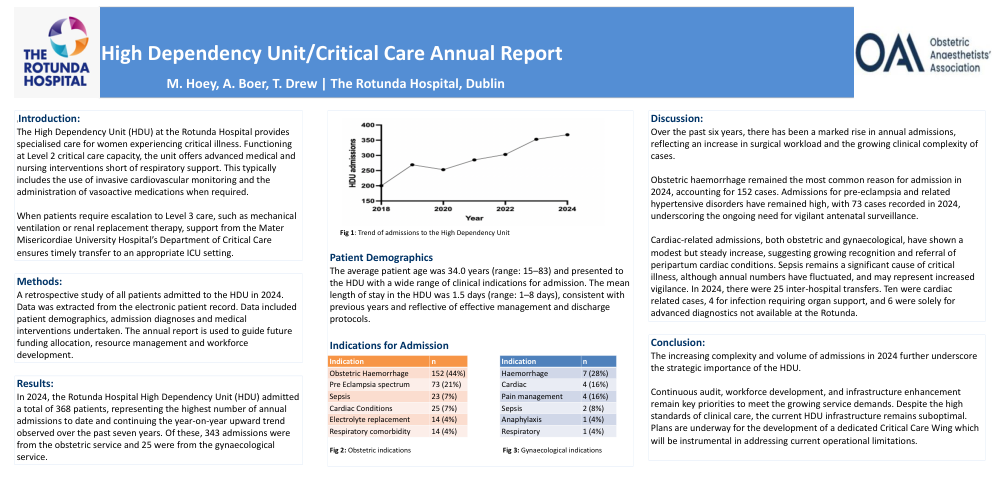
In 2024, the Rotunda Hospital High Dependency Unit (HDU) admitted a total of 368 patients, representing the highest number of annual admissions to date and continuing the year-on-year upward trend observed over the past seven years. Of these, 343 admissions were from the obstetric service and 25 were from the gynaecological service.
Patient Demographics
The average patient age was 34.0 years (range: 15–83) and presented to the HDU with a wide range of clinical indications for admission. The mean length of stay in the HDU was 1.5 days (range: 1–8 days), consistent with previous years and reflective of effective management and discharge protocols.
Discussion:
Over the past six years, there has been a marked rise in annual admissions, reflecting an increase in surgical workload and the growing clinical complexity of cases.
Obstetric haemorrhage remained the most common reason for admission in 2024, accounting for 152 cases. Admissions for pre-eclampsia and related hypertensive disorders have remained high, with 73 cases recorded in 2024, underscoring the ongoing need for vigilant antenatal surveillance.
Cardiac-related admissions, both obstetric and gynaecological, have shown a modest but steady increase, suggesting growing recognition and referral of peripartum cardiac conditions. Sepsis remains a significant cause of critical illness, although annual numbers have fluctuated, and may represent increased vigilance. In 2024, there were 25 inter-hospital transfers. Ten were cardiac related cases, 4 for infection requiring organ support, and 6 were solely for advanced diagnostics not available at the Rotunda.
Conclusion:
The increasing complexity and volume of admissions in 2024 further underscore the strategic importance of the HDU.
Continuous audit, workforce development, and infrastructure enhancement remain key priorities to meet the growing service demands. Despite the high standards of clinical care, the current HDU infrastructure remains suboptimal. Plans are underway for the development of a dedicated Critical Care Wing which will be instrumental in addressing current operational limitations.