226 posters, 5 topics, 20 sessions, 598 authors, 292 institutions
ePostersLive by SciGen Technologies S.A. All rights reserved.
Obstetric Anaesthesia Annual Scientific Meeting 2026
14-15 May 2026 | Liverpool Convention Centre

7160479
Optimising analgesia after caesarean birth: a retrospective audit
Poster Presenter
Authors
Affiliations
Part of Topic
Service Evaluation
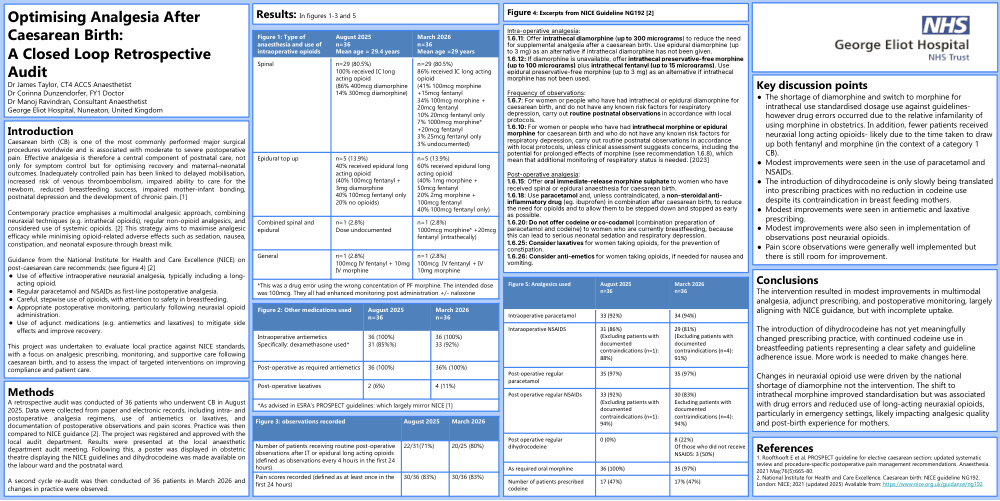
Optimising Analgesia After Caesarean Birth: A Closed Loop Retrospective Audit Dr James Taylor, CT4 ACCS Anaesthetist Dr Corinna Dunzendorfer, FY1 Doctor Dr Manoj Ravindran, Consultant Anaesthetist George Eliot Hospital, Nuneaton, United Kingdom
Introduction Caesarean birth (CB) is one of the most commonly performed major surgical procedures worldwide and is associated with moderate to severe postoperative pain. Effective analgesia is therefore a central component of postnatal care, not only for symptom control but for optimising recovery and maternal–neonatal outcomes. Inadequately controlled pain has been linked to delayed mobilisation, increased risk of venous thromboembolism, impaired ability to care for the newborn, reduced breastfeeding success, impaired mother-infant bonding, postnatal depression and the development of chronic pain. [1] Contemporary practice emphasises a multimodal analgesic approach, combining neuraxial techniques (e.g. intrathecal opioids), regular non-opioid analgesics, and considered use of systemic opioids. [2] This strategy aims to maximise analgesic efficacy while minimising opioid-related adverse effects such as sedation, nausea, constipation, and neonatal exposure through breast milk. Guidance from the National Institute for Health and Care Excellence (NICE) on post-caesarean care recommends: (see figure 4) [2] ● Use of effective intraoperative neuraxial analgesia, typically including a longacting opioid. ● Regular paracetamol and NSAIDs as first-line postoperative analgesia. ● Careful, stepwise use of opioids, with attention to safety in breastfeeding. ● Appropriate postoperative monitoring, particularly following neuraxial opioid administration. ● Use of adjunct medications (e.g. antiemetics and laxatives) to mitigate side effects and improve recovery. This project was undertaken to evaluate local practice against NICE standards, with a focus on analgesic prescribing, monitoring, and supportive care following caesarean birth, and to assess the impact of targeted interventions on improving compliance and patient care.
Methods A retrospective audit was conducted of 36 patients who underwent CB in August 2025. Data were collected from paper and electronic records, including intra- and postoperative analgesia regimens, use of antiemetics or laxatives, and documentation of postoperative observations and pain scores. Practice was then compared to NICE guidance [2]. The project was registered and approved with the local audit department. Results were presented at the local anaesthetic department audit meeting. Following this, a poster was displayed in obstetric theatre displaying the NICE guidelines and dihydrocodeine was made available on the labour ward and the postnatal ward. A second cycle re-audit was then conducted of 36 patients in March 2026 and changes in practice were observed.
Results: In figures 1-3 and 5
Figure 1: Type of anaesthesia and use of intraoperative opioids August 2025 n=36 Mean age = 29.4 years March 2026 n=36 Mean age =29 years Spinal n=29 (80.5%) 100% received IC long acting opioid (86% 400mcg diamorphine 14% 300mcg diamorphine) n=29 (80.5%) 86% received IC long acting opioid (41% 100mcg morphine +15mcg fentanyl 34% 100mcg morphine + 20mcg fentanyl 10% 20mcg fentanyl only 7% 1000mcg morphine* +20mcg fentanyl 3% 25mcg fentanyl only 3% undocumented) Epidural top up n=5 (13.9%) 40% received epidural long acting opioid (40% 100mcg fentanyl + 3mg diamorphine 40% 100mcg fentanyl only 20% no opioids) n=5 (13.9%) 60% received epidural long acting opioid (40% 1mg morphine + 50mcg fentanyl 20% 2mg morphine + 100mcg fentanyl 40% 100mcg fentanyl only) Combined spinal and epidural n=1 (2.8%) Dose undocumented n=1 (2.8%) 1000mcg morphine* +20mcg fentanyl (intrathecally) General n=1 (2.8%) 100mcg IV fentanyl + 10mg IV morphine n=1 (2.8%) 100mcg IV fentanyl + IV 10mg morphine *This was a drug error using the wrong concentation of PF morphine. The intended dose was 100mcg. They all had enhanced monitoring post administration +/- naloxone
Figure 2: Other medications used August 2025 n=36 March 2026 n=36 Intraoperative antiemetics Specifically: dexamethasone used* 36 (100%) 31 (85%%) 36 (100%) 33 (92%) Post-operative as required antiemetics 36 (100%) 36% (100%) Post-operative laxatives 2 (6%) 4 (11%) *As advised in ESRA’s PROSPECT guidelines: which largely mirror NICE [1]
Figure 3: observations recorded August 2025 March 2026 Number of patients receiving routine post-operative observations after IT or epidural long acting opioids (defined as observations every 4 hours in the first 24 hours). 22/31(71%) 20/25 (80%) Pain scores recorded (defined as at least once in the first 24 hours) 30/36 (83%) 30/36 (83%)
Figure 4: Excerpts from NICE Guideline NG192 [2]
Intra-operative analgesia: 1.6.11: Offer intrathecal diamorphine (up to 300 micrograms) to reduce the need for supplemental analgesia after a caesarean birth. Use epidural diamorphine (up to 3 mg) as an alternative if intrathecal diamorphine has not been given. 1.6.12: If diamorphine is unavailable, offer intrathecal preservative-free morphine (up to 100 micrograms) plus intrathecal fentanyl (up to 15 micrograms). Use epidural preservative-free morphine (up to 3 mg) as an alternative if intrathecal morphine has not been used. Frequency of observations: 1.6.7: For women or people who have had intrathecal or epidural diamorphine for caesarean birth, and do not have any known risk factors for respiratory depression, carry out routine postnatal observations in accordance with local protocols. 1.6.10: For women or people who have had intrathecal morphine or epidural morphine for caesarean birth and who do not have any known risk factors for respiratory depression, carry out routine postnatal observations in accordance with local protocols, unless clinical assessment suggests concerns, including the potential for prolonged effects of morphine (see recommendation 1.6.8), which mean that additional monitoring of respiratory status is needed. [2023] Post-operative analgesia: 1.6.15: Offer oral immediate-release morphine sulphate to women who have received spinal or epidural anaesthesia for caesarean birth. 1.6.18: Use paracetamol and, unless contraindicated, a non-steroidal antiinflammatory drug (eg. ibuprofen) in combination after caesarean birth, to reduce the need for opioids and to allow them to be stepped down and stopped as early as possible. 1.6.20: Do not offer codeine or co-codamol (combination preparation of paracetamol and codeine) to women who are currently breastfeeding, because this can lead to serious neonatal sedation and respiratory depression. 1.6.25: Consider laxatives for women taking opioids, for the prevention of constipation. 1.6.26: Consider anti-emetics for women taking opioids, if needed for nausea and vomiting
Figure 5: Analgesics used August 2025 n=36 March 2026 n=36 Intraoperative paracetamol 33 (92%) 34 (94%) Intaraoperative NSAIDS 31 (86%) (Excluding patients with documented contraindications (n=1): 88%) 29 (81%) (Excluding patients with documented contraindications (n=4): 91%) Post-operative regular paracetamol 35 (97%) 35 (97%) Post operative regular NSAIDs 33 (92%) (Excluding patients with documented contraindications (n=1): 94%) 30 (83%) Excluding patients with documented contraindications (n=4): 94%) Post operative regular dihydrocodeine 0 (0%) 8 (22%) Of those who did not receive NSAIDS: 3 (50%) As required oral morphine 36 (100%) 35 (97%) Number of patients prescribed codeine 17 (47%) 17% (47%)
Key discussion points ● The shortage of diamorphine and switch to morphine for intrathecal use standardised dosage use against guidelineshowever drug errors occurred due to the relative infamilarity of using morphine in obstetrics. In addition, fewer patients received neuraxial long acting opioids- likely due to the time taken to draw up both fentanyl and morphine (in the context of a category 1 CB). ● Modest improvements were seen in the use of paracetamol and NSAIDs. ● The introduction of dihydrocodeine is only slowly being translated into prescribing practices with no reduction in codeine use despite its contraindication in breast feeding mothers. ● Modest improvements were seen in antiemetic and laxative prescribing. ● Modest improvements were also seen in implementation of observations post neuraxial opioids. ● Pain score observations were generally well implemented but there is still room for improvement.
Conclusions The intervention resulted in modest improvements in multimodal analgesia, adjunct prescribing, and postoperative monitoring, largely aligning with NICE guidance, but with incomplete uptake. The introduction of dihydrocodeine has not yet meaningfully changed prescribing practice, with continued codeine use in breastfeeding patients representing a clear safety and guideline adherence issue. More work is needed to make changes here. Changes in neuraxial opioid use were driven by the national shortage of diamorphine not the intervention. The shift to intrathecal morphine improved standardisation but was associated with drug errors and reduced use of long-acting neuraxial opioids, particularly in emergency settings, likely impacting analgesic quality and post-birth experience for mothers
References 1. Roofthooft E et al. PROSPECT guideline for elective caesarean section: updated systematic review and procedure‐specific postoperative pain management recommendations. Anaesthesia. 2021 May;76(5):665-80. 2. National Institute for Health and Care Excellence. Caesarean birth: NICE guideline NG192. London: NICE; 2021 (updated 2025) Available from: https://www.nice.org.uk/guidance/ng192