226 posters, 5 topics, 20 sessions, 598 authors, 292 institutions
ePostersLive by SciGen Technologies S.A. All rights reserved.
Obstetric Anaesthesia Annual Scientific Meeting 2026
14-15 May 2026 | Liverpool Convention Centre

7160405
The role of MDT planning and simulation-based rehearsal in the anaesthetic management of a BMI 82kg|m² parturient
Poster Presenter
Authors
Affiliations
Part of Topic
Case report
Introduction
Extreme maternal obesity is associated with increased obstetric, anaesthetic, and perioperative risk. The MBRRACE-UK 2025 report found that 64% of women who died during pregnancy or within six weeks postpartum were obese, highlighting the importance of meticulous risk management in this population (1).
Our patient, with a BMI of 82 kg/m², lived in a geographically remote area and received antenatal care at her local unit. However, the complexity of her care necessitated transfer to our tertiary centre, located four hours away, for delivery. This introduced additional challenges in coordination, communication, and contingency planning across two geographically distant sites, particularly in the event of emergency or out-of-hours delivery.
The literature supports the use of multidisciplinary simulation in high-risk anaesthesia to identify latent safety threats, improve team performance, and reduce patient harm (2). In this case, high-fidelity simulation formed a central component of the planning process and was instrumental in facilitating safe, coordinated perioperative care.
Case
We present the case of a 37-year-old grand multiparous woman (G5P4) with four previous uncomplicated vaginal deliveries. At booking, her BMI was 82 kg/m² (weight 258 kg; height 172 cm). Her comorbidities included asthma, obstructive sleep apnoea, fibromyalgia, hypermobility with recurrent joint dislocations, polycystic ovary syndrome, and newly diagnosed hypertension. She also smoked up to 60 cigarettes daily until 35 weeks' gestation.
Following extensive antenatal multidisciplinary team (MDT) discussions, a plan was made for elective caesarean delivery at 37+2 weeks. The breadth of MDT involvement was extensive, including consultant obstetricians, consultant anaesthetists, critical care, neonatology, theatre staff, ambulance services, community midwives, hospital matrons, moving and handling and the regional maternal medicine network.
Planning encompassed anaesthetic and surgical technique, specialist equipment, theatre location, patient positioning, skin management, maternal and foetal monitoring, and perioperative transfer logistics.
Given the significant risks associated with emergency delivery, particularly out of hours, the patient was admitted two weeks before her planned delivery. Although this period was complicated by multiple self-discharges, early admission allowed optimisation, familiarisation, and refinement of the perioperative plan
Simulation and Human Factors
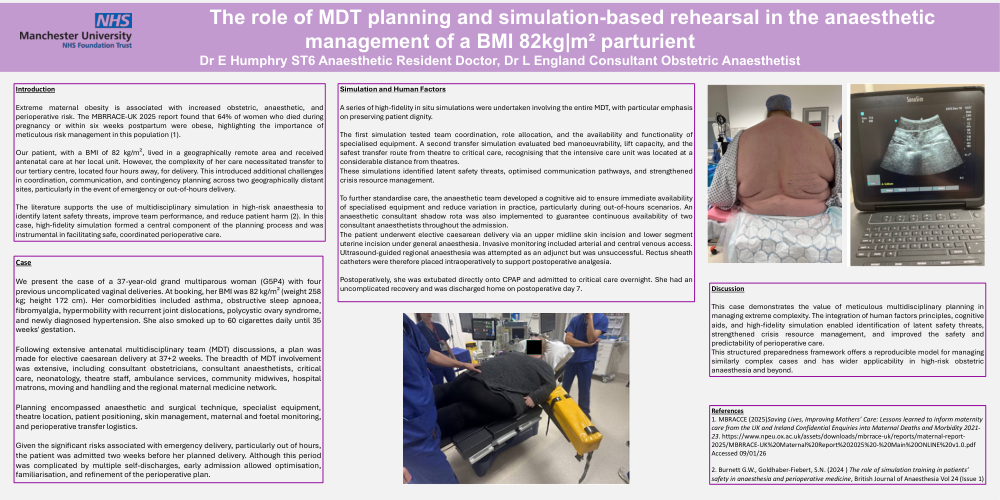
A series of high-fidelity in situ simulations were undertaken involving the entire MDT, with particular emphasis on preserving patient dignity.
The first simulation tested team coordination, role allocation, and the availability and functionality of specialised equipment. A second transfer simulation evaluated bed manoeuvrability, lift capacity, and the safest transfer route from theatre to critical care, recognising that the intensive care unit was located at a considerable distance from theatres.
These simulations identified latent safety threats, optimised communication pathways, and strengthened crisis resource management.
To further standardise care, the anaesthetic team developed a cognitive aid to ensure immediate availability of specialised equipment and reduce variation in practice, particularly during out-of-hours scenarios. An anaesthetic consultant shadow rota was also implemented to guarantee continuous availability of two consultant anaesthetists throughout the admission.
The patient underwent elective caesarean delivery via an upper midline skin incision and lower segment uterine incision under general anaesthesia. Invasive monitoring included arterial and central venous access. Ultrasound-guided regional anaesthesia was attempted as an adjunct but was unsuccessful. Rectus sheath catheters were therefore placed intraoperatively to support postoperative analgesia.
Postoperatively, she was extubated directly onto CPAP and admitted to critical care overnight. She had an uncomplicated recovery and was discharged home on postoperative day 7.
Discussion
This case demonstrates the value of meticulous multidisciplinary planning in managing extreme complexity. The integration of human factors principles, cognitive aids, and high-fidelity simulation enabled identification of latent safety threats, strengthened crisis resource management, and improved the safety and predictability of perioperative care.
This structured preparedness framework offers a reproducible model for managing similarly complex cases and has wider applicability in high-risk obstetric anaesthesia and beyond.