226 posters, 5 topics, 20 sessions, 598 authors, 292 institutions
ePostersLive by SciGen Technologies S.A. All rights reserved.
Obstetric Anaesthesia Annual Scientific Meeting 2026
14-15 May 2026 | Liverpool Convention Centre

7158787
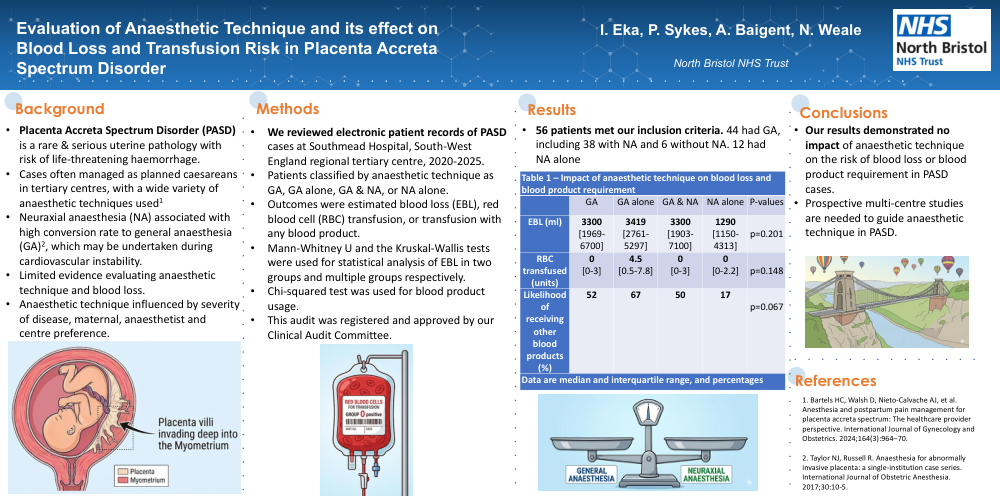
Evaluation of anaesthetic technique and its effect on blood loss and transfusion risk in Placenta Accreta Spectrum Disorder
Poster Presenter
Authors
Affiliations
Part of Topic
Service Evaluation
Evaluation of Anaesthetic Technique and its effect on Blood Loss and Transfusion Risk in Placenta Accreta Spectrum Disorder
I. Eka, P. Sykes, A. Baigent, N. Weale
North Bristol NHS Trust
Background
•Placenta Accreta Spectrum Disorder (PASD) is a rare & serious uterine pathology with risk of life-threatening haemorrhage.
•Cases often managed as planned caesareans in tertiary centres, with a wide variety of anaesthetic techniques used1
•Neuraxial anaesthesia (NA) associated with high conversion rate to general anaesthesia (GA)2, which may be undertaken during cardiovascular instability.
•Limited evidence evaluating anaesthetic technique and blood loss.
•Anaesthetic technique influenced by severity of disease, maternal, anaesthetist and centre preference.
Methods
•We reviewed electronic patient records of PASD cases at Southmead Hospital, South-West England regional tertiary centre, 2020-2025.
•Patients classified by anaesthetic technique as GA, GA alone, GA & NA, or NA alone.
•Outcomes were estimated blood loss (EBL), red blood cell (RBC) transfusion, or transfusion with any blood product.
•Mann-Whitney U and the Kruskal-Wallis tests were used for statistical analysis of EBL in two groups and multiple groups respectively.
•Chi-squared test was used for blood product usage.
•This audit was registered and approved by our Clinical Audit Committee.
Results
•56 patients met our inclusion criteria. 44 had GA, including 38 with NA and 6 without NA. 12 had NA alone
Conclusions
•Our results demonstrated no impact of anaesthetic technique on the risk of blood loss or blood product requirement in PASD cases.
•Prospective multi-centre studies are needed to guide anaesthetic technique in PASD.
References
1. Bartels HC, Walsh D, Nieto‐Calvache AJ, et al. Anesthesia and postpartum pain management for placenta accreta spectrum: The healthcare provider perspective. International Journal of Gynecology and Obstetrics. 2024;164(3):964–70.
2. Taylor NJ, Russell R. Anaesthesia for abnormally invasive placenta: a single-institution case series. International Journal of Obstetric Anesthesia. 2017;30:10-5.