226 posters, 5 topics, 20 sessions, 598 authors, 292 institutions
ePostersLive by SciGen Technologies S.A. All rights reserved.
Obstetric Anaesthesia Annual Scientific Meeting 2026
14-15 May 2026 | Liverpool Convention Centre

7158683
Highlighting recovery or spotlighting progression? A service evaluation of neuraxial recovery
Poster Presenter
Authors
Affiliations
Part of Topic
Service Evaluation
Highlighting recovery or spotlighting progression?
A service evaluation of neuraxial recovery in obstetric anaesthesia
Murray L, Swales D, Harrison H
Department of Anaesthesia, Jessop Wing, Sheffield Teaching Hospitals NHS Foundation Trust
Introduction
Although serious neurological lesions such as vertebral canal haematoma are rare after obstetric regional analgesia/anaesthesia, early detection is crucial to avoid permanent harm.
The 2020 Association of Anaesthetists/OAA consensus safety guideline regarding neurological monitoring associated with obstetric neuraxial block recommended prompt escalation of care and review by an anaesthetist if a woman was unable to straight leg raise at four hours.[1]
The idea of defining local neuraxial recovery times (specific to a unit) to support development of a local safety protocol has been raised [2] and was the driver for this service evaluation.
Methods
To assess time to recovery after neuraxial regional anaesthesia, we applied a wristband to all eligible, consenting obstetric patients in recovery following neuraxial anaesthesia for a peripartum theatre intervention during the data collection period.
The time and type of last neuraxial anaesthetic intervention was recorded and patients were then asked to document on the wristband the time at which they were first able to straight leg raise before it was removed for data retrieval.
Results
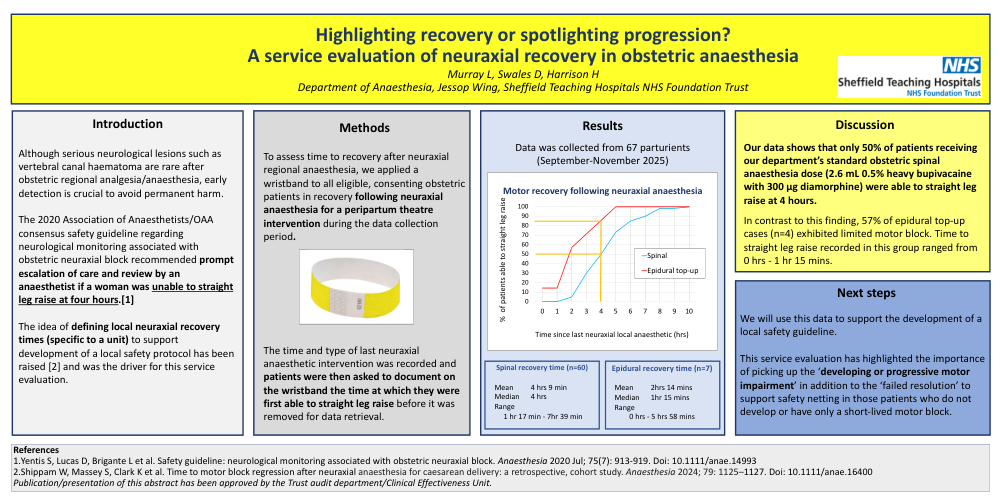
Data was collected from 67 parturients (September-November 2025)
Spinal recovery time (n=60)
Mean 4 hrs 9 min
Median 4 hrs
Range
1 hr 17 min - 7hr 39 min
Epidural recovery time (n=7)
Mean 2hrs 14 mins
Median 1hr 15 mins
Range
0 hrs - 5 hrs 58 mins
Discussion
Our data shows that only 50% of patients receiving our department’s standard obstetric spinal anaesthesia dose (2.6 mL 0.5% heavy bupivacaine with 300 μg diamorphine) were able to straight leg raise at 4 hours.
In contrast to this finding, 57% of epidural top-up cases (n=4) exhibited limited motor block. Time to straight leg raise recorded in this group ranged from 0 hrs - 1 hr 15 mins.
Next steps
We will use this data to support the development of a local safety guideline.
This service evaluation has highlighted the importance of picking up the ‘developing or progressive motor impairment’ in addition to the ‘failed resolution’ to support safety netting in those patients who do not develop or have only a short-lived motor block.
References
1.Yentis S, Lucas D, Brigante L et al. Safety guideline: neurological monitoring associated with obstetric neuraxial block. Anaesthesia 2020 Jul; 75(7): 913-919. Doi: 10.1111/anae.14993
2.Shippam W, Massey S, Clark K et al. Time to motor block regression after neuraxial anaesthesia for caesarean delivery: a retrospective, cohort study. Anaesthesia 2024; 79: 1125–1127. Doi: 10.1111/anae.16400
Publication/presentation of this abstract has been approved by the Trust audit department/Clinical Effectiveness Unit.