226 posters, 5 topics, 20 sessions, 598 authors, 292 institutions
ePostersLive by SciGen Technologies S.A. All rights reserved.
Obstetric Anaesthesia Annual Scientific Meeting 2026
14-15 May 2026 | Liverpool Convention Centre

7158027
Implementation of the 2020 UK safety guideline on neurological monitoring after obstetric neuraxial block: An OAA national survey
Poster Presenter
Authors
Affiliations
Part of Topic
Surveys
Implementation of the 2020 UK safety guideline on neurological monitoring after obstetric neuraxial block: An OAA national survey
E Tyson, D Baily, G Jayasooriya
Kingston & Richmond NHS Foundation Trust
Introduction
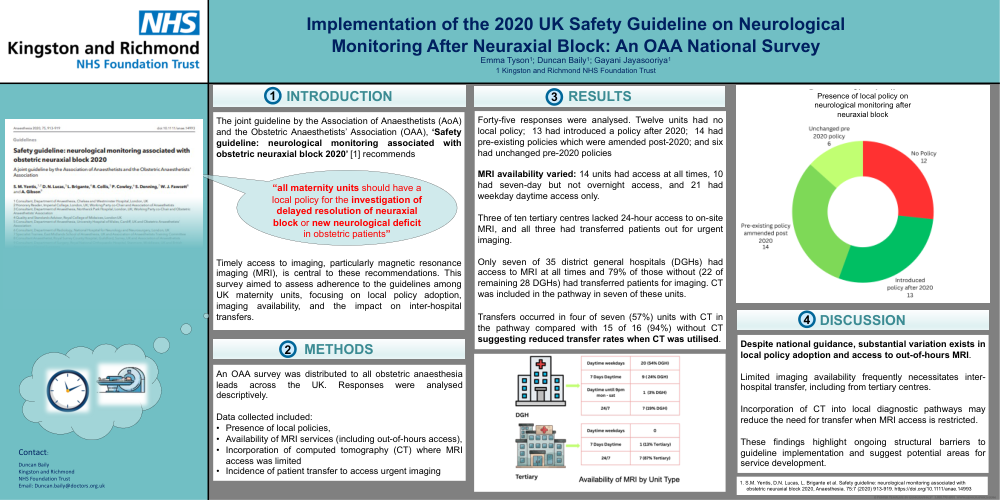
The joint guideline by the Association of Anaesthetists (AoA) and the Obstetric Anaesthetists’ Association (OAA),‘Safety guideline: neurological monitoring associated with obstetric neuraxial block 2020’[1] recommends all maternity units should have a local policy for the investigation of delayed resolution of neuraxial block or new neurological deficit in obstetric patients. Timely access to imaging, particularly magnetic resonance imaging (MRI), is central to these recommendations. This survey aimed to assess adherence to the guidelines among UK maternity units, focusing on local policy adoption, imaging availability, and the impact on inter-hospital transfers.
Methods
An OAA survey was distributed to all obstetric anaesthesia leads across the UK. Responses were analysed descriptively. Data collected included; presence of local policies, availability of MRI services (including out-of-hours access), incorporation of computed tomography (CT) where MRI access was limited, and incidence of patient transfer to access urgent imaging.
Results
Forty-five responses were analysed. Twelve units had no local policy, 13 had introduced a policy after 2020, 14 had pre-existing policies which were amended post-2020, and six had unchanged pre-2020 policies. MRI availability varied: 14 units had access at all times, 10 had seven-day but not overnight access, and 21 had weekday daytime access only. Three of ten tertiary centres lacked 24-hour access to on-site MRI, and all three had transferred patients out for urgent imaging. Only seven of 35 district general hospitals (DGHs) had access to MRI at all times and 79% of those without (22 of remaining 28 DGHs) had transferred patients for imaging. CT was included in the pathway in seven of these units. Transfers occurred in four of seven (57%) units with CT in the pathway compared with 15 of 16 (94%) without CT, suggesting reduced transfer rates when CT was utilised.
Discussion
Despite national guidance, substantial variation exists in local policy adoption and access to out-of-hours MRI. Limited imaging availability frequently necessitates inter-hospital transfer, including from tertiary centres. Incorporation of CT into local diagnostic pathways may reduce the need for transfer when MRI access is restricted. These findings highlight ongoing structural barriers to guideline implementation and suggest potential areas for service development.