301 posters, 50 videos, 13 topics, 13 sessions, 734 authors, 193 institutions
ePostersLive by SciGen Technologies S.A. All rights reserved.
ISMICS 2026 Annual Meeting
10 - 13 June, 2026 | Miami, Florida

P77
Integration Of Minimal Invasive Extracorporeal Circulation With Minimally Invasive Cardiac Surgery
Poster Presenter
Authors
Ahmed Wahba, Aziza Tavakkalova, Fetoh Alaaeldin, Ahmed E. Elkafoury, Amir Bastawisy
Affiliations
Department of Cardiothoracic Surgery, Faculty of Medicine, Port Said University, Port Said, Egypt, Medical School, Central Asian University, Tashkent, Uzbekistan, Lecturer of Cardiothoracic Surgery, Faculty of Medicine, Mansoura University, Mansoura, Egypt, Department of Cardiac Surgery, Mahalla Heart Center, El-Mahalla El-Kubra, Egypt, Department of Cardiothoracic Surgery, Faculty of Medicine, Port-Said University, Port-Said, Egypt
Part of Topic
Education, Imaging and Facilitating Technologies
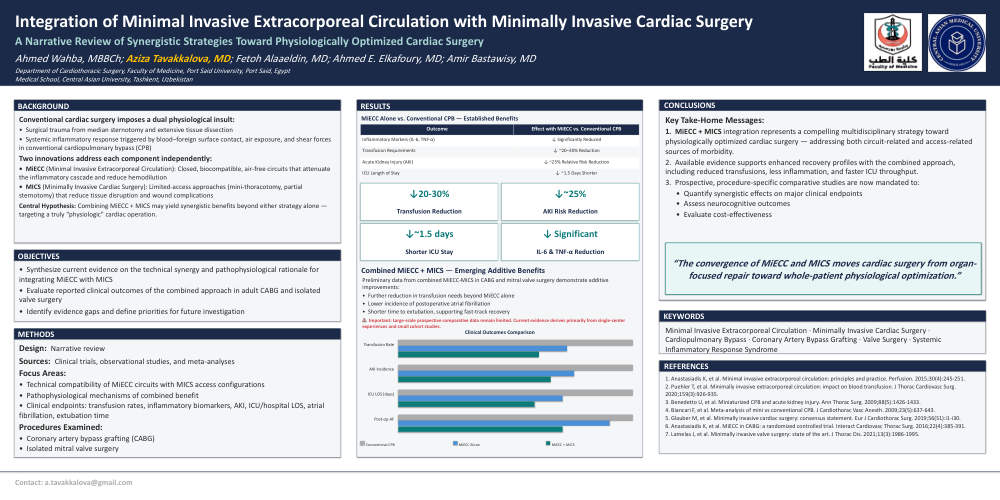
Background: The evolution toward "more physiologic" cardiac surgery targets reduction of both surgical trauma and the systemic sequelae of cardiopulmonary bypass (CPB). Minimal Invasive Extracorporeal Circulation (MiECC) incorporates biocompatible closed circuits to attenuate the inflammatory cascade, while Minimally Invasive Cardiac Surgery (MICS) limits mechanical access. Their integration represents a paradigm shift aimed at synergistically improving patient outcomes in adult cardiac surgery.
Methods: This narrative review synthesizes current evidence from clinical trials, observational studies, and meta-analyses. Literature was evaluated to examine the technical synergy, pathophysiological rationale, and reported clinical outcomes of combining MiECC with MICS, primarily in coronary artery bypass grafting (CABG) and isolated valve procedures.
Results: Evidence confirms that MiECC alone, versus conventional CPB, significantly reduces inflammatory markers (e.g., IL-6, TNF-α), transfusion rates (approximately 20-30%), acute kidney injury (relative risk reduction ~25%), and ICU length of stay (by ~1.5 days). Preliminary data from combined MiECC-MICS applications in CABG and mitral valve surgery suggest additive benefits, including further reductions in transfusion needs, postoperative atrial fibrillation, and time to extubation, though large-scale comparative data remain limited.
Conclusions: The integration of MiECC and MICS forms a compelling multidisciplinary strategy toward physiologically optimized cardiac surgery. Available data support enhanced recovery profiles, justifying this combined approach. Prospective, procedure-specific comparative studies are now mandated to definitively quantify synergistic effects on major clinical endpoints, neurocognitive outcomes, and cost-effectiveness.
Keywords: Minimal Invasive Extracorporeal Circulation; Minimally Invasive Cardiac Surgery; Cardiopulmonary Bypass; Coronary Artery Bypass Grafting; Valve Surgery; Systemic Inflammatory Response Syndrome.