301 posters, 50 videos, 13 topics, 13 sessions, 734 authors, 193 institutions
ePostersLive by SciGen Technologies S.A. All rights reserved.
ISMICS 2026 Annual Meeting
10 - 13 June, 2026 | Miami, Florida

D70
Totally Endoscopic Aortic Valve Replacement With The DafodilTmBioprosthesis
Poster Presenter
Authors
Part of Topic
Valve � Surgical Valves
BACKGROUND:The expansion of transcatheter aortic valve replacement (TAVR) into lower-risk and younger populations has renewed interest in durable, less invasive surgical alternatives. Current guidelines continue to favor surgical aortic valve replacement (SAVR) for low-risk patients, particularly those under 65 years. Totally endoscopic SAVR with a bioprosthesis with favorable hemodynamics might be an alternative to TAVI as well as conventional SAVR. We report our 5-year single center experience with endoscopic SAVR (endo- SAVR) with the use of the DaffodilTM pericardial bioprosthesis. Between 2020 and 2025, 245 patients underwent SAVR of which 99 were totally endoscopic.
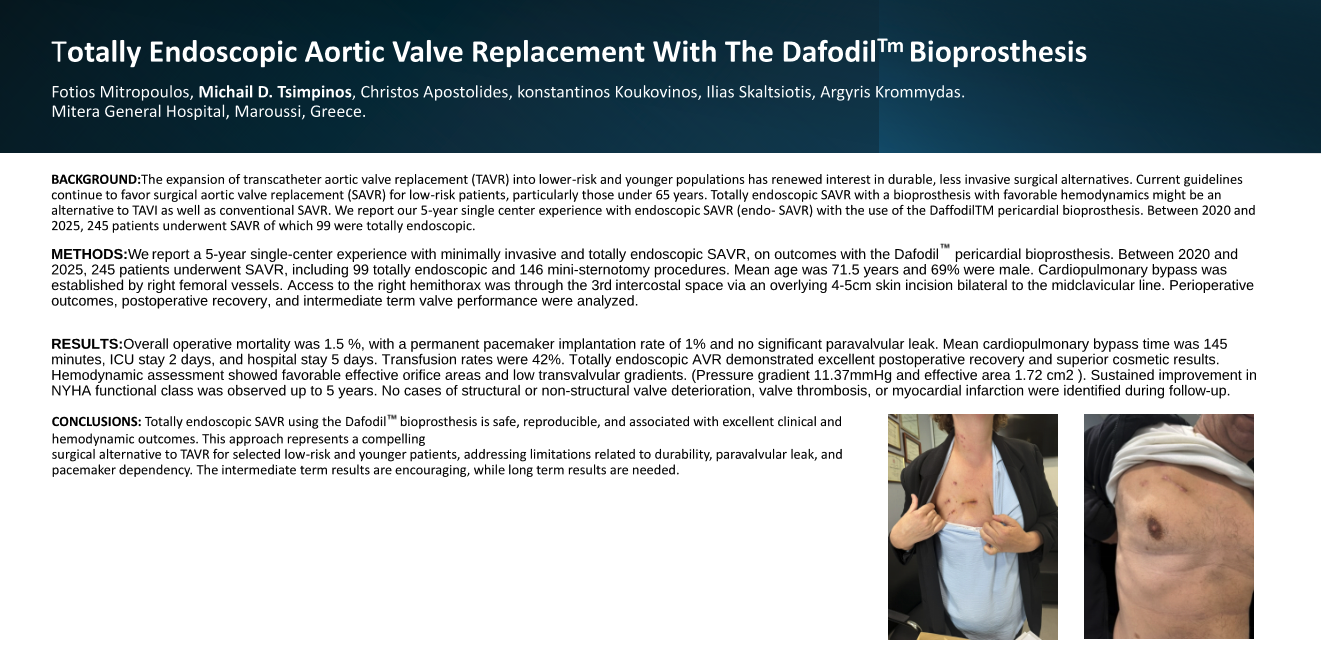
METHODS:We report a 5-year single-center experience with minimally invasive and totally endoscopic SAVR, on outcomes with the Dafodil™ pericardial bioprosthesis. Between 2020 and 2025, 245 patients underwent SAVR, including 99 totally endoscopic and 146 mini-sternotomy procedures. Mean age was 71.5 years and 69% were male. Cardiopulmonary bypass was established by right femoral vessels. Access to the right hemithorax was through the 3rd intercostal space via an overlying 4-5cm skin incision bilateral to the midclavicular line. Perioperative outcomes, postoperative recovery, and intermediate term valve performancewer analyzed.
RESULTS:Overall operative mortality was 1.5 %, with a permanent pacemaker implantation rate of 1% and no significant paravalvular leak. Mean cardiopulmonary bypass time was 145 minutes, ICU stay 2 days, and hospital stay 5 days. Transfusion rates were 42%. Totally endoscopic AVR demonstrated excellent postoperative recovery and superior cosmetic results. Hemodynamic assessment showed favorable effective orifice areas and low transvalvular gradients. (Pressure gradient 11.37mmHg and effective area 1.72 cm2 ). Sustained improvement in NYHA functional class was observed up to 5 years. No cases of structural or non-structural valve deterioration, valve thrombosis, or myocardial infarction were identified during follow-up.
CONCLUSIONS: Totally endoscopic SAVR using the Dafodil™ bioprosthesis is safe, reproducible, and associated with excellent clinical and hemodynamic outcomes. This approach represents a compelling surgical alternative to TAVR for selected low-risk and younger patients, addressing limitations related to durability, paravalvular leak, and pacemaker dependency. The intermediate term results are encouraging, while long term results are needed.