301 posters, 50 videos, 13 topics, 13 sessions, 734 authors, 193 institutions
ePostersLive by SciGen Technologies S.A. All rights reserved.
ISMICS 2026 Annual Meeting
10 - 13 June, 2026 | Miami, Florida

D56
Minimally Invasive Changes: Course Of Ejection Fraction Changes In Robotic Heart Surgery
Poster Presenter
Part of Topic
Valve � Surgical Valves
Minimally Invasive Changes: Course of Ejection Fraction Changes in Robotic Heart Surgery
Jeffrey Ding, Kei Kobayashi, Andrea Amabile, Yizhan Guo, Neha Devineni, Martin Winter, Ariana Jackson, David West, Irsa Hasan, Ibrahim Sultan, Johannes Bonatti
Background: Robotic cardiac surgery has become an established method with outcomes equal to, if not surpassing, open procedures. While procedure times, includiAng aortic cross-clamp and cardiopulmonary bypass times, are typically longer, little information is available on left ventricular function after robotic heart surgery. We evaluated the perioperative left ventricular ejection fraction (LVEF) changes up to 1 year following robotic cardiac surgery and determined factors influencing this course.
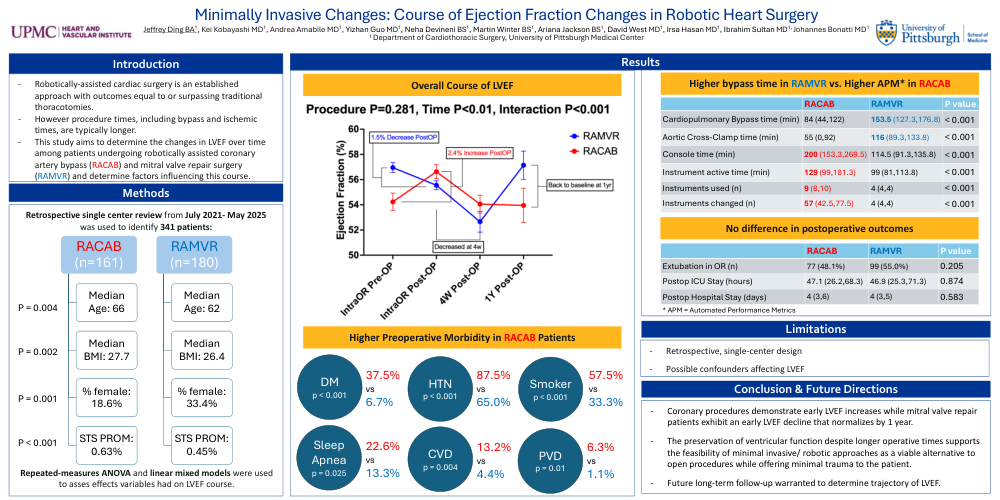
Methods: LVEF was measured preoperatively, immediately after the procedure, at 4 weeks, and at 1 year in patients who underwent robotic assisted coronary artery bypass (RACABG, n=161) or robotic assisted mitral valve repair (RAMVR, n=180) from July 2021 to May 2025. Repeated-measures ANOVA and linear mixed models were used to assess the effects of clinical and operative variables on LVEF trajectory.
Results: The mean age was 65.3±9.1 years for RACABG and 60.7±12.5 years for RAMVR, with 19.3% and 33.9% female, respectively. The preoperative LVEF was 54.2±8.7% for RACABG and 57.0±5.0% for RAMVR, with total procedure time of 327.0±104.6min and 312.0±102.0min, respectively. LVEF changed significantly over time (p<0.001) and showed a significant time-procedure interaction (p<0.001), while overall group means were similar (54.8% vs. 55.6%, p=0.28). LVEF increased immediately postoperatively in RACABG (+2.4%) and decreased in MVR (-1.5%). Notably, both groups demonstrated a transient dip in LVEF at the 4 weeks, with recovery to baseline at 1 year (p=1.0 vs. baseline). The overall course of LVEF is shown in Figure 1. Besides procedure type (p<0.001), no demographic, comorbidity related, or intraoperative factor was significantly related to the change in LVEF from baseline to 4 weeks.
Conclusion: Robotically assisted CABG and MVR preserve ventricular function. Despite longer operative times, neither procedure results in clinically relevant impairment of left ventricular function. Coronary procedures demonstrate early hyperdynamic changes, while mitral valve repair patients exhibit an early LVEF decline that normalizes by 1 year. No other peri-operative factors influenced the change between baseline and 4 weeks postoperatively.