301 posters, 50 videos, 13 topics, 13 sessions, 734 authors, 193 institutions
ePostersLive by SciGen Technologies S.A. All rights reserved.
ISMICS 2026 Annual Meeting
10 - 13 June, 2026 | Miami, Florida

P141
Sutureless Savr Maintains Survival Advantage Over Tavr: A 707-patient Real-world Survival Analysis
Poster Presenter
Part of Topic
Valve - Transcatheter Therapies
Background / Objective:
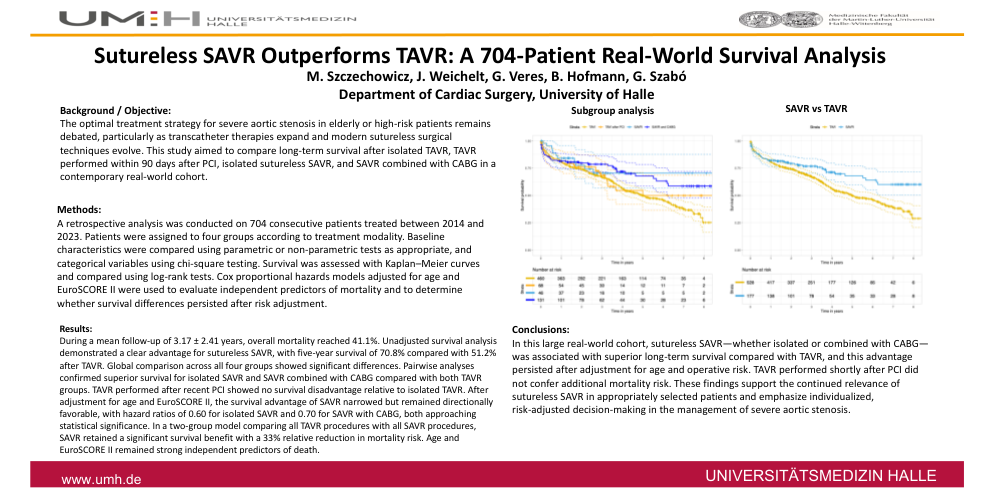
The optimal treatment strategy for severe aortic stenosis in elderly or high‑risk patients remains debated, particularly as transcatheter therapies expand and modern sutureless surgical techniques evolve. This study aimed to compare long‑term survival after isolated TAVR, TAVR performed within 90 days after PCI, isolated sutureless SAVR, and SAVR combined with CABG in a contemporary real‑world cohort.
Methods:
A retrospective analysis was conducted on 704 consecutive patients treated between 2014 and 2023. Patients were assigned to four groups according to treatment modality. Baseline characteristics were compared using parametric or non‑parametric tests as appropriate, and categorical variables using chi‑square testing. Survival was assessed with Kaplan–Meier curves and compared using log‑rank tests. Cox proportional hazards models adjusted for age and EuroSCORE II were used to evaluate independent predictors of mortality and to determine whether survival differences persisted after risk adjustment.
Results:
During a mean follow‑up of 3.17 ± 2.41 years, overall mortality reached 41.1%. Unadjusted survival analysis demonstrated a clear advantage for sutureless SAVR, with five‑year survival of 70.8% compared with 51.2% after TAVR. Global comparison across all four groups showed significant differences. Pairwise analyses confirmed superior survival for isolated SAVR and SAVR combined with CABG compared with both TAVR groups. TAVR performed after recent PCI showed no survival disadvantage relative to isolated TAVR. After adjustment for age and EuroSCORE II, the survival advantage of SAVR narrowed but remained directionally favorable, with hazard ratios of 0.60 for isolated SAVR and 0.70 for SAVR with CABG, both approaching statistical significance. In a two‑group model comparing all TAVR procedures with all SAVR procedures, SAVR retained a significant survival benefit with a 33% relative reduction in mortality risk. Age and EuroSCORE II remained strong independent predictors of death.
Conclusions:
In this large real‑world cohort, sutureless SAVR—whether isolated or combined with CABG—was associated with superior long‑term survival compared with TAVR, and this advantage persisted after adjustment for age and operative risk. TAVR performed shortly after PCI did not confer additional mortality risk. These findings support the continued relevance of sutureless SAVR in appropriately selected patients and emphasize individualized, risk‑adjusted decision‑making in the management of severe aortic stenosis.