477 posters, 14 topics, 2,065 authors, 1,055 institutions
ePostersLive by SciGen Technologies S.A. All rights reserved.
The Joint EBJIS-MSIS 2026 Conference
17 - 19 September, 2026 | Porto, Portugal

EP064
Bullous Pemphigoid associated with periprosthetic knee infection by candida. A case report.
Poster Presenter
Authors
Jes?s Cernadas Mart?nez, V?ctor Otero Naveiro, Alejandro L?pez-Pardo Pardo, Mar?a Jos? Garc?a Pais, Laura de la torre Saavedra, Patricia P?rez Feal, Luc?a Lastra Quintela, Luc?a Gallego Saavedra
Affiliations
Hospital universitario Lucus Augusti, Lugo, Spain, Hospital universitario Lucus Augusti
Part of Topic
Case Report
AIM
To present a case of localized bullous pemphigoid in the context of periprosthetic joint infection due to Candida parapsilosis.
METHODS
A 79-year-old male with a history of liver transplantation presented with fistulation seven months after right total knee arthroplasty. A first-stage revision surgery was performed, and an antibiotic-loaded cement articulated spacer was implanted. Microbiological cultures isolated Candida parapsilosis, and antifungal therapy was initiated. Wound closure was challenging and required negative pressure therapy.
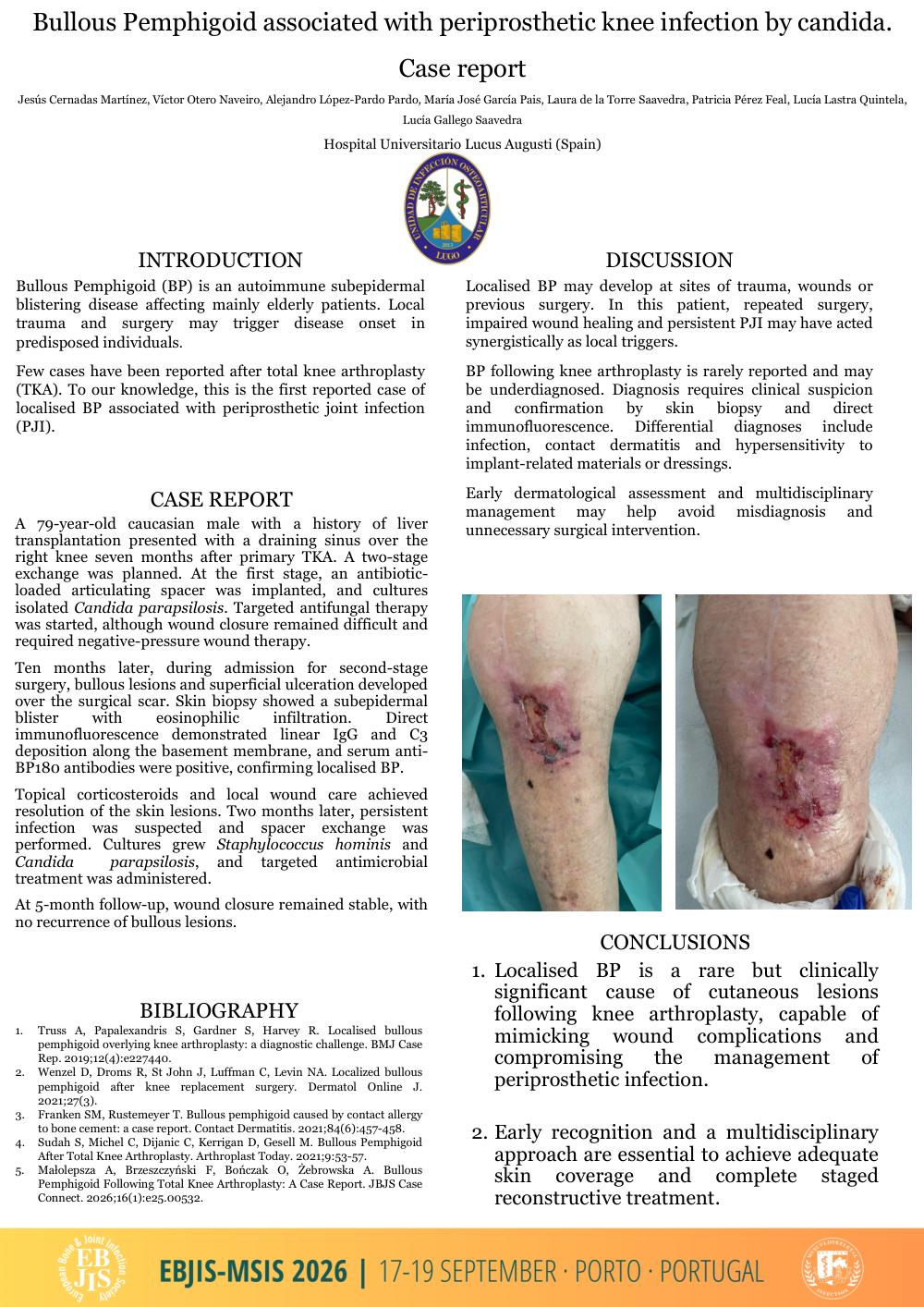
Ten months later, the patient was admitted for the second-stage procedure but developed bullous lesions and superficial ulceration over the surgical scar. Skin biopsy revealed a subepidermal blister with eosinophilic infiltration, and direct immunofluorescence showed linear IgG and C3 deposits along the basement membrane. Serum testing was positive for anti-BP180 antibodies, confirming the diagnosis of localized bullous pemphigoid.
RESULTS
The patient was treated with topical corticosteroids, achieving a favorable response. Two months later, he underwent reoperation; due to suspected persistent infection, spacer exchange was performed. Intraoperative cultures were positive for Staphylococcus hominis and Candida parapsilosis, and targeted antimicrobial therapy was administered. No cutaneous relapse was observed after 5 months of follow-up.
CONCLUSIONS
Localized bullous pemphigoid is a rare variant confined to a single anatomical area, usually triggered by local factors such as surgery or radiotherapy. To our knowledge, this is the first reported case associated with periprosthetic joint infection.
In this patient, arthroplasty, repeated surgery, impaired wound healing and persistent infection likely acted synergistically as local triggers, promoting antigen exposure and autoimmune activation.
Postoperative bullous lesions may be misinterpreted as wound complications or infection-related changes. Early biopsy and immunofluorescence are essential for accurate diagnosis, enabling prompt treatment without delaying orthopaedic management.