477 posters, 14 topics, 2,065 authors, 1,055 institutions
ePostersLive by SciGen Technologies S.A. All rights reserved.
The Joint EBJIS-MSIS 2026 Conference
17 - 19 September, 2026 | Porto, Portugal

EP062
DAIR with medial gastrocnemius pedicled flap for treating wound complication after total knee arthroplasty
Poster Presenter
Authors
Patr?cia Caiano, Jos? Rodrigues, Gon?alo Fernandes, Jo?o Pires, Sara Ramos, V?tor Hugo Pinheiro
Affiliations
Coimbra Health Care Unit | Orthopedics and Traumatology Department, Coimbra, Portugal, Coimbra Health Care Unit | Department of Plastic and Reconstructive Surgery and Burns Unit, Coimbra, Portugal, Coimbra Health Care Unit | Orthopedics and Traumatology Department
Part of Topic
Case Report
DAIR with medial gastrocnemius pedicled flap for treating wound complication after total knee arthroplasty DAIR and Orthoplastic Reconstruction for Acute Periprosthetic Knee Infection With Severe Soft-Tissue Compromise
Introduction
Early wound complications after total knee arthroplasty (TKA) are a known risk factor for periprosthetic joint infection (PJI) and stand as a suggestive criterion in the EBJIS definition of PJI. We report a polymicrobial PJI following early soft tissue compromise, highlighting management challenges and the need for multidisciplinary care
Case report
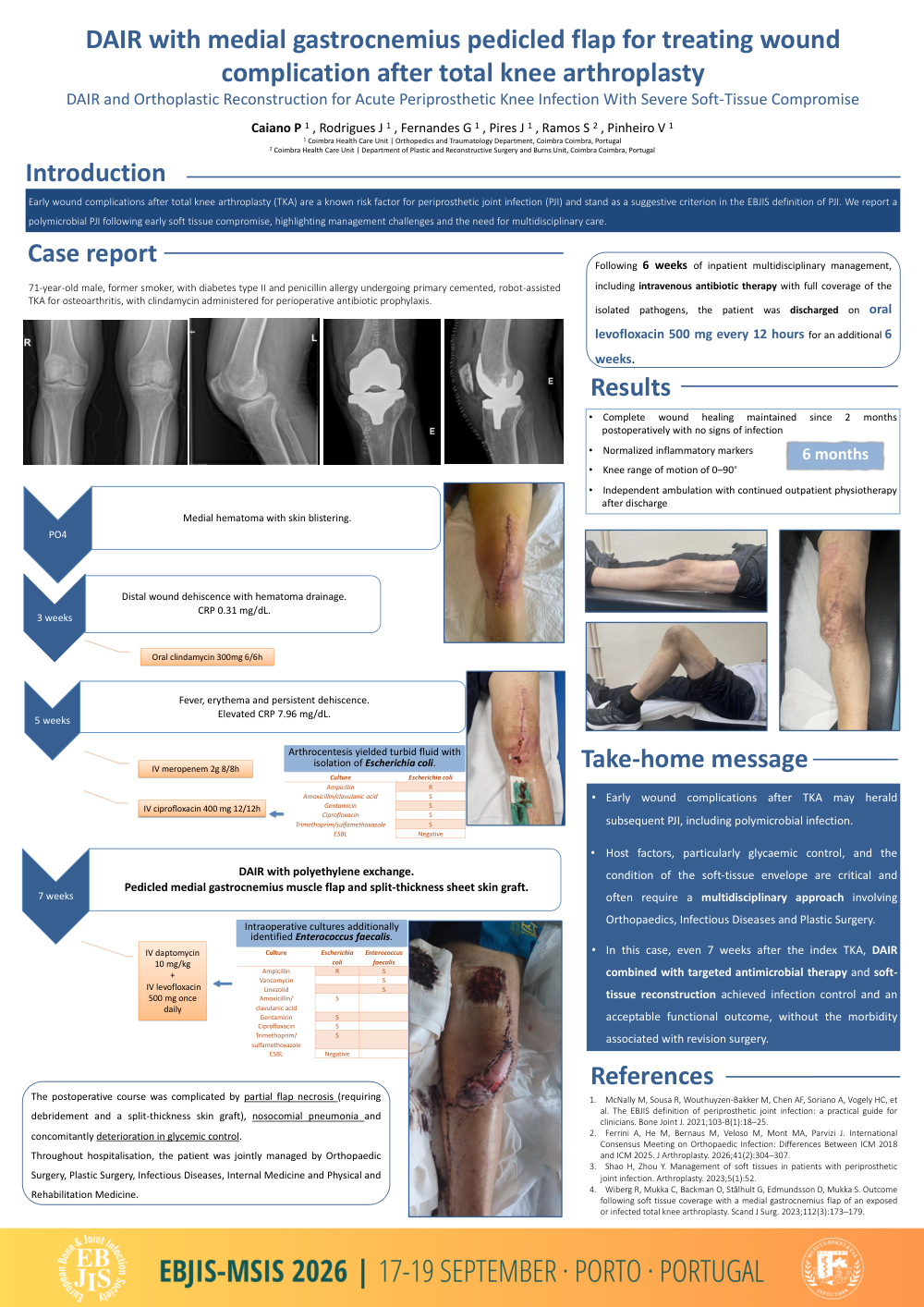
71-year-old male, former smoker, with diabetes type II and penicillin allergy undergoing primary cemented, robot-assisted TKA for osteoarthritis, with clindamycin administered for perioperative antibiotic prophylaxis.
On postoperative day 4, the patient developed a medial hematoma with skin blistering. At 3 weeks, distal wound dehiscence with hematoma drainage occurred, without clear signs of infection and with low CRP (0.31 mg/dL). Initial management included clindamycin and local wound care, with transient improvement.
At 6 weeks, patient presented with fever, erythema, persistent dehiscence and elevated CRP (7.96 mg/dL). Arthrocentesis yielded turbid fluid with isolation of Escherichia coli. Glycemic control deteriorated during this period, requiring therapeutic adjustment. Empirical antibiotic therapy with meropenem was initiated and later tailored according to susceptibility testing.
At 7 weeks, DAIR (debridement, antibiotics, and implant retention) with polyethylene exchange was performed. Significant soft tissue compromise required pedicled medial gastrocnemius muscle flap and split-thickness sheet skin graft.
Intraoperative cultures additionally identified Enterococcus faecalis, confirming polymicrobial infection and prompting escalation of antimicrobial therapy, including daptomycin and fluoroquinolones.
The postoperative course was complicated by partial flap necrosis (requiring surgical revision) and nosocomial pneumonia.
Following 6 weeks of inpatient multidisciplinary management, including intravenous antibiotic therapy with full or partial coverage of the isolated pathogens, the patient was discharged on oral levofloxacin 500 mg every 12 hours for an additional 6 weeks.
Results
At 6 months: complete wound healing maintained since 2 months postoperatively with no signs of infection; normalized inflammatory markers; knee range of motion of 0–90°; independent ambulation with continued outpatient physiotherapy after discharge.
Take-home message
Early wound complications after TKA may herald subsequent PJI, including polymicrobial infection.
Host factors, particularly glycaemic control, and the condition of the soft-tissue envelope are critical and often require a multidisciplinary approach involving Orthopaedics, Infectious Diseases and Plastic Surgery.
In this case, even 7 weeks after the index TKA, DAIR combined with targeted antimicrobial therapy and softtissue reconstruction achieved infection control and an acceptable functional outcome, without the morbidity associated with revision surgery.