477 posters, 14 topics, 2,065 authors, 1,055 institutions
ePostersLive by SciGen Technologies S.A. All rights reserved.
The Joint EBJIS-MSIS 2026 Conference
17 - 19 September, 2026 | Porto, Portugal

PP59
Periprosthetic Joint Infection Salvage: A 10-Year Multi-Institutional Analysis of Above-Knee Amputation versus Knee Fusion
Poster Presenter
Authors
Mason Masters, Austin Franklin, Yida Liu, Garen Collett, Scott Nodzo, Antonia Chen
Affiliations
Department of Orthopaedic Surgery, University of Texas Southwestern Medical Center, Dallas, United States, Department of Orthopaedic Surgery, University of Texas Southwestern Medical Center, Dallas, United States; University of Texas Southwestern Medical School, Dallas, United States, University of Texas Southwestern Medical School
Part of Topic
Prosthetic Joint Infections
Introduction:
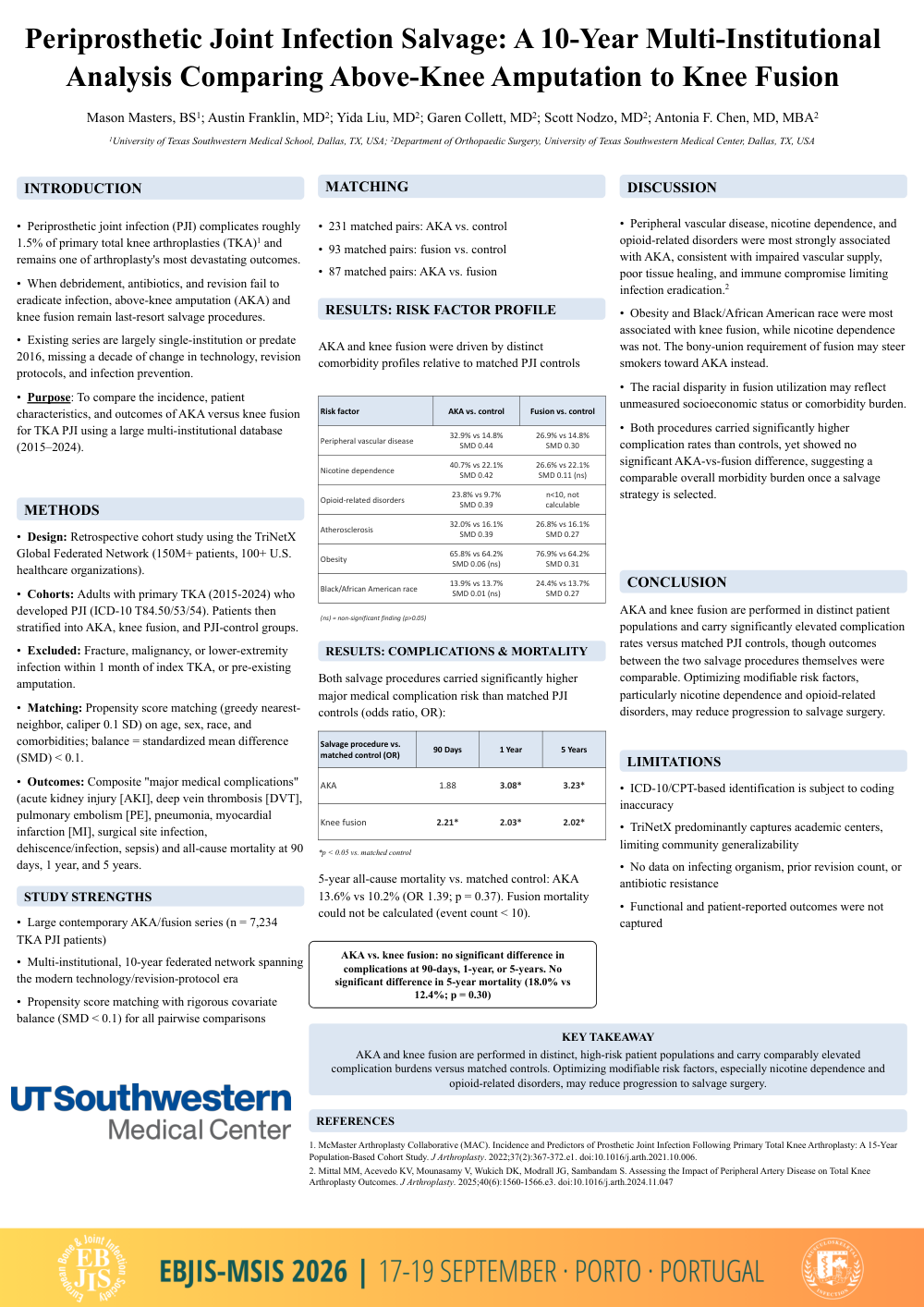
Periprosthetic joint infection (PJI) is a severe complication following total knee arthroplasty (TKA). When conservative treatment and revisions fail, above-knee amputations (AKA) and knee fusions serve as salvage procedures. Current data on the incidence and risk factors surrounding these procedures is limited, with most studies predating 2016. This study aims to provide a large, multi-institutional analysis on the incidence and risk factors surrounding AKA and knee fusion following PJI over the past decade.
Methods:
The TriNetX Global Federal Network was utilized to identify primary TKA patients with subsequent PJI between 1/1/2015-12/31/2024. Patients with fractures, malignancies, and lower limb infections within one month of index TKA were excluded. Patients were divided into AKA or fusion groups using ICD-10/CPT codes, with PJI patients not requiring AKA/fusion as controls. Propensity score matching was performed for outcome comparisons using demographic data and comorbidities. Outcomes included postoperative complications and were reported as odds ratios (OR) with 95% confidence intervals (CI).
Results:
Of the 7,234 TKA patients with PJI, 231 (3.2%) underwent AKA and 94 (1.3%) underwent fusion. The most significant factors associated with AKA were nicotine dependence (p<0.0001, SMD 0.42) and opioid related disorders (p<0.0001; SMD 0.39). The most significant factors associated with fusion were obesity (p=0.009; SMD 0.31) and Black/African American race (p=0.005; SMD 0.27). Peripheral vascular disease was significantly associated with both AKA (p<0.0001; SMD 0.44) and fusion (p=0.002; SMD 0.30).
There were significant differences in 90-day postoperative major medical complications in AKA (38.7% vs 19.3%; OR 2.62; 95% CI 1.72-2.73; p<0.0001) and fusion (35.2% vs 18.2%; OR 2.45; 95% CI 1.15-3.28; p=0.011) compared to matched controls. There were no significant differences in 1-year postoperative acute kidney injury, cardiopulmonary complications, or infection in AKA versus fusion, and no significant difference in 5-year mortality (AKA 18.0%, fusion 12.4%, p=0.296).
Conclusions:
Over the last decade, AKA was performed more than twice as often as knee fusion for salvage following TKA PJI. Nicotine and opioid use were associated with AKA while African American race and obesity were associated with knee fusion. Peripheral vascular disease was strongly associated with both. Compared with the control group, AKA and knee fusion were associated with higher major medical complications within the 90-day postoperative period. This study represents one of the largest and most recent analyses of salvage procedures following TKA PJI, and may help guide patient counseling and comorbidity optimization when considering AKA or knee fusion.