477 posters, 14 topics, 2,065 authors, 1,055 institutions
ePostersLive by SciGen Technologies S.A. All rights reserved.
The Joint EBJIS-MSIS 2026 Conference
17 - 19 September, 2026 | Porto, Portugal

EP427
Long-term Quality-of-Life following Periprosthetic Joint Infection: A Systematic Review and Meta-Analysis
Poster Presenter
Authors
Affiliations
Department Of Trauma Surgery, University Hospital Regensburg, Franz-josef-strau?-allee 11, 93053 Regensburg, Germany, University Hospital Regensburg, Research Unit for Microbial Disease Prevention, Institute of Virology, Helmholtz Center Munich, Munich, Germany, University Hospital Regensburg, Germany
Part of Topic
Prosthetic Joint Infections
Background
· Periprosthetic joint infection (PJI) substantially affects patients’ mobility, pain, and quality of life (QoL) (1)
· Objective: Assessing long-term QoL following successful PJI treatment
· Explore differences by infected joint and treatment strategy.
Methods
· Systematic review and meta-analysis of 28 studies
· Evaluation of study reliability (MINORS & ROBINS-I)
· QoL trajectories and differences by joint location and treatment strategy were assessed using random-effects models
Results
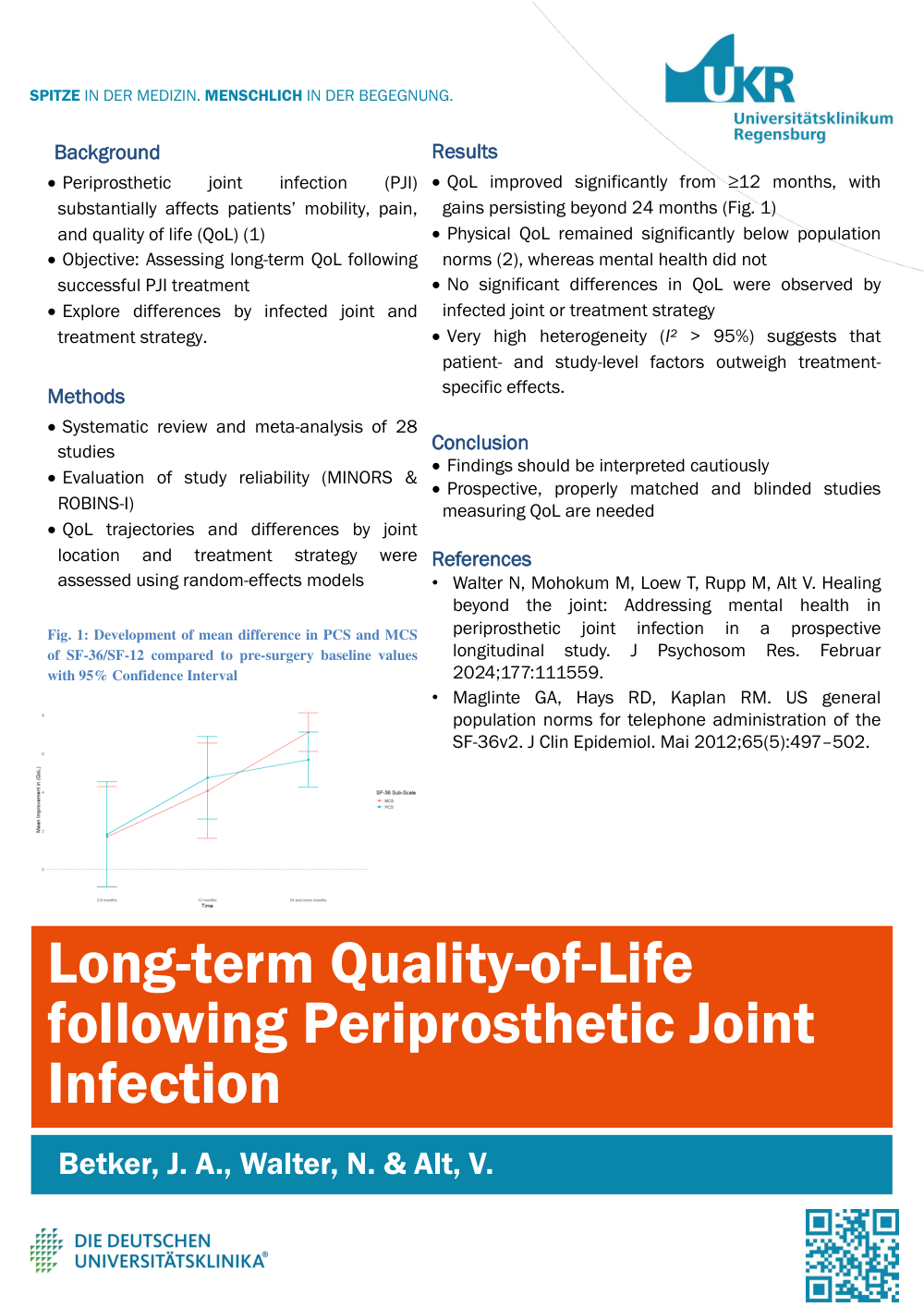
· QoL improved significantly from ≥12 months, with gains persisting beyond 24 months (Fig. 1)
· Physical QoL remained significantly below population norms (2), whereas mental health did not
· No significant differences in QoL were observed by infected joint or treatment strategy
· Very high heterogeneity (I² > 95%) suggests that patient- and study-level factors outweigh treatment-specific effects.
Conclusion
· Findings should be interpreted cautiously
· Prospective, properly matched and blinded studies measuring QoL are needed
References
• Walter N, Mohokum M, Loew T, Rupp M, Alt V. Healing beyond the joint: Addressing mental health in periprosthetic joint infection in a prospective longitudinal study. J Psychosom Res. Februar 2024;177:111559.
• Maglinte GA, Hays RD, Kaplan RM. US general population norms for telephone administration of the SF-36v2. J Clin Epidemiol. Mai 2012;65(5):497–502.