477 posters, 14 topics, 2,065 authors, 1,055 institutions
ePostersLive by SciGen Technologies S.A. All rights reserved.
The Joint EBJIS-MSIS 2026 Conference
17 - 19 September, 2026 | Porto, Portugal

EP416
Ninety-Day Adverse Events Following Systemic Antibiotic Treatment for Early, Delayed, and Late Periprosthetic Joint Infection After Total Knee Arthroplasty
Poster Presenter
Authors
Shlok V Patel, Arjun Dinesh, Khaled A Elmenawi, Shujaa T Khan, Anabelle Visperas, Bethany Lehman, Nicolas Piuzzi
Affiliations
Cleveland Clinic Department of Orthopaedic Surgery, Cleveland, United States, Cleveland Clinic, Cleveland Clinic Department of Infectious Diseases, Cleveland, United States
Part of Topic
Prosthetic Joint Infections
Title
Ninety-Day Adverse Events Following Systemic Antibiotic Treatment for Early, Delayed, and Late Periprosthetic Joint Infection After Total Knee Arthroplasty
Background
- Systemic antibiotics are essential for the treatment of periprosthetic joint infection (PJI) following total knee arthroplasty (TKA), but their short-term adverse-event burden remains incompletely characterized.
- Most PJI literature focuses on infection eradication, reoperation, and implant retention, while antibiotic-associated renal, hepatic, hematologic, gastrointestinal, allergic, and cardiac complications receive less attention.
- This study evaluated 90-day adverse events following systemic antibiotic treatment for TKA PJI and compared adverse-event profiles according to infection timing.
Methods
- A retrospective descriptive cohort study was performed using a federated, de-identified global electronic health record network.
- Adults undergoing TKA who subsequently developed PJI were identified using procedural and diagnosis codes.
- To improve diagnostic specificity, inclusion required:
- ≥2 PJI diagnosis codes
- Systemic antibiotic exposure within 1 month of the first PJI diagnosis.
- PJI was stratified by timing after the index TKA:
- Early: <3 months
- Delayed: 3 months to 1 year
- Late: >1 year
- The primary analysis assessed 90-day adverse events after systemic antibiotic exposure, including:
- C. difficile testing and diagnosis-coded infection
- Acute kidney injury
- Elevated AST/ALT
- Elevated BUN/creatinine
- Hematologic abnormalities
- Allergic reactions
- Toxic liver disease
- Cardiac events including long-QT syndrome/torsades de pointes
- For each outcome, patients with that event before systemic antibiotic use were excluded from the corresponding at-risk population.
- As a secondary analysis, adverse-event rates were compared across early, delayed, and late PJI groups using Pearson chi-square testing.
Results
- 4,128 patients met inclusion criteria:
- 1,443 early PJI
- 997 delayed PJI
- 1,688 late PJI.
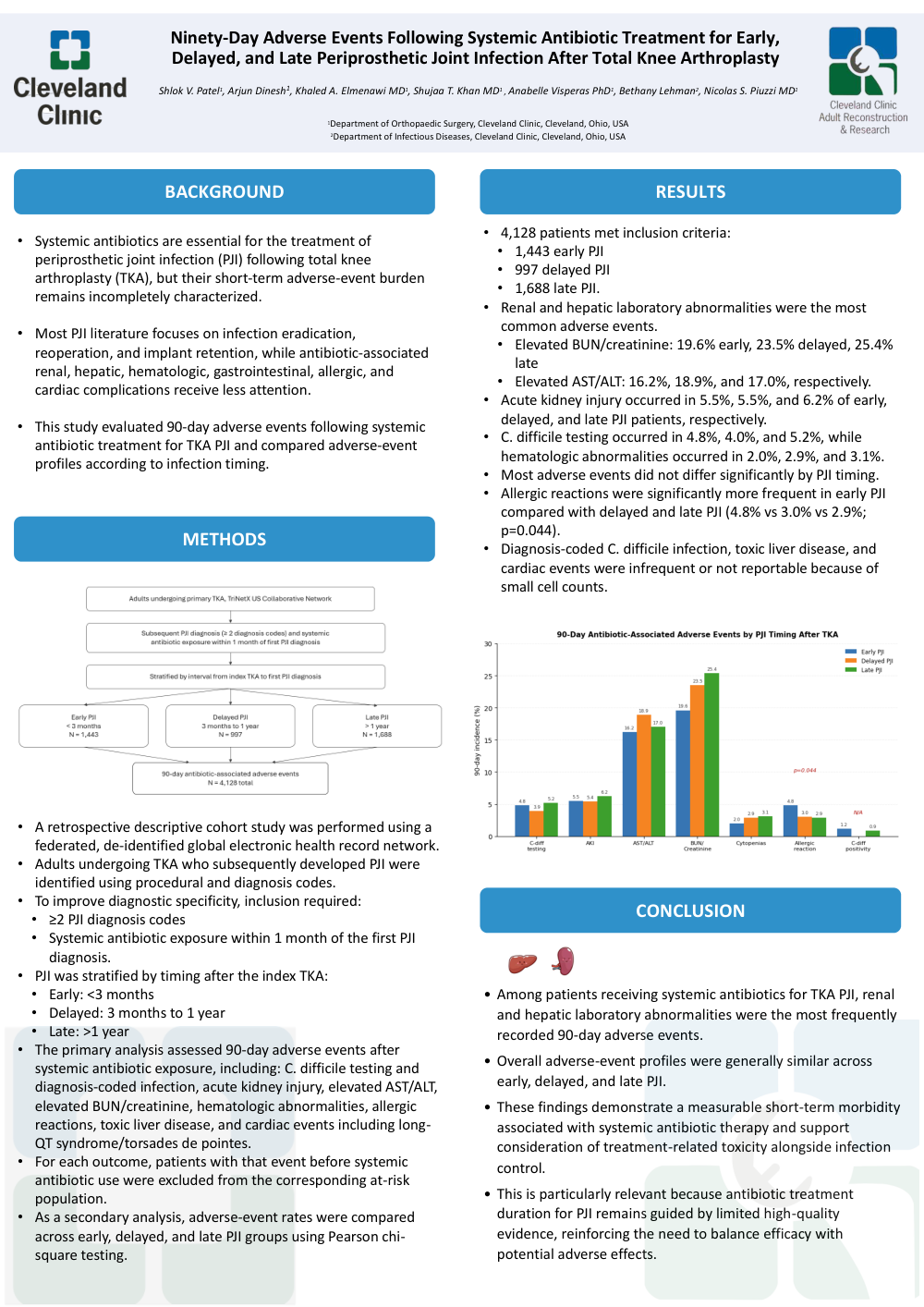
- Renal and hepatic laboratory abnormalities were the most common adverse events.
- Elevated BUN/creatinine: 19.6% early, 23.5% delayed, 25.4% late
- Elevated AST/ALT: 16.2%, 18.9%, and 17.0%, respectively.
- Acute kidney injury occurred in 5.5%, 5.5%, and 6.2% of early, delayed, and late PJI patients, respectively.
- C. difficile testing occurred in 4.8%, 4.0%, and 5.2%, while hematologic abnormalities occurred in 2.0%, 2.9%, and 3.1%.
- Most adverse events did not differ significantly by PJI timing.
- Allergic reactions were significantly more frequent in early PJI compared with delayed and late PJI (4.8% vs 3.0% vs 2.9%; p=0.044).
- Diagnosis-coded C. difficile infection, toxic liver disease, and cardiac events were infrequent or not reportable because of small cell counts.
Conclusion
- Among patients receiving systemic antibiotics for TKA PJI, renal and hepatic laboratory abnormalities were the most frequently recorded 90-day adverse events.
- Overall adverse-event profiles were generally similar across early, delayed, and late PJI, although allergic reactions were more frequent in early PJI.
- These findings demonstrate a measurable short-term morbidity associated with systemic antibiotic therapy and support consideration of treatment-related toxicity alongside infection control.
- This is particularly relevant because antibiotic treatment duration for PJI remains guided by limited high-quality evidence, reinforcing the need to balance efficacy with potential adverse effects.