477 posters, 14 topics, 2,065 authors, 1,055 institutions
ePostersLive by SciGen Technologies S.A. All rights reserved.
The Joint EBJIS-MSIS 2026 Conference
17 - 19 September, 2026 | Porto, Portugal

EP379
Adjunctive Hyperbaric Oxygen Therapy for Periprosthetic Joint Infections
Poster Presenter
Authors
Alvin Tieu, Abdulaziz AlDakhil, Calvin Thompson, Wesley Edwards, George Grammatopoulus, Simon Garceau, Tom Schmidt-Braekling, Hesham Abdelbary
Affiliations
Department of Anesthesiology and Pain Medicine, University of Ottawa, Ottawa, Canada; Department of Hyperbaric Medicine, The Ottawa Hospital, Ottawa, Canada, Department of Orthopedic Surgery, University of Ottawa, Ottawa, Canada; Prince Sultan Military Medical City, Riyadh, Saudi Arabia, Department of Orthopedic Surgery, University of Ottawa, Ottawa, Canada, Department of Orthopedic Surgery, University of Ottawa, Ottawa, Canada; Ottawa Hospital Research Institute, Ottawa, Canada, The Ottawa Hospital
Part of Topic
Prosthetic Joint Infections
Adjunctive Hyperbaric Oxygen Therapy for Periprosthetic Joint Infections
Tieu A, AlDakhil A, Thompson C, Edwards W, Grammatopoulos G, Garceau S, Schmidt-Braekling T, Abdelbary H. Department of Anesthesiology and Pain Medicine, University of Ottawa; Department of Hyperbaric Medicine, The Ottawa Hospital; Orthopedic Surgery, University of Ottawa; Prince Sultan Military Medical City, Riyadh, Saudi Arabia; The Ottawa Hospital Research Institute, Ottawa, Ontario, Canada.
INTRODUCTION. Periprosthetic joint infection (PJI) is a devastating complication associated with reduced quality of life, increased mortality and substantial healthcare resources, often requiring prolonged hospitalisation and multiple complex surgeries. In the United States, annual PJI-related costs are projected to reach $1.85 billion by 2030. Hyperbaric oxygen therapy (HBOT) delivers 100% oxygen at elevated atmospheric pressure, enhancing oxygen delivery to ischaemic tissue - chronic wounds and osteomyelitis, both contributing to PJI morbidity. HBOT also holds immunomodulatory properties and enhances antibiotic efficacy against biofilm. It has been used as an adjunct for hardware-related infection elsewhere. No studies have investigated its utility in PJI management. This study aimed to evaluate HBOT as an adjuvant therapy for PJI.
METHODS. Retrospective review of PJI cases treated with HBOT from 2016-2025 using our centre's Hyperbaric Medicine Unit Database. PJI was defined by ICM 2018 criteria; host and wound status were staged by the McPherson system; outcomes were reported per MSIS definitions. Primary outcome: clinical impact of HBOT on infection control, surgical revisions and safety. Secondary outcome: inflammatory biomarker response; temporal trends in CRP and ESR relative to clinical events. Statistics: Student's t-test or one-way ANOVA with Tukey's post hoc test. Data are mean +/- SEM.
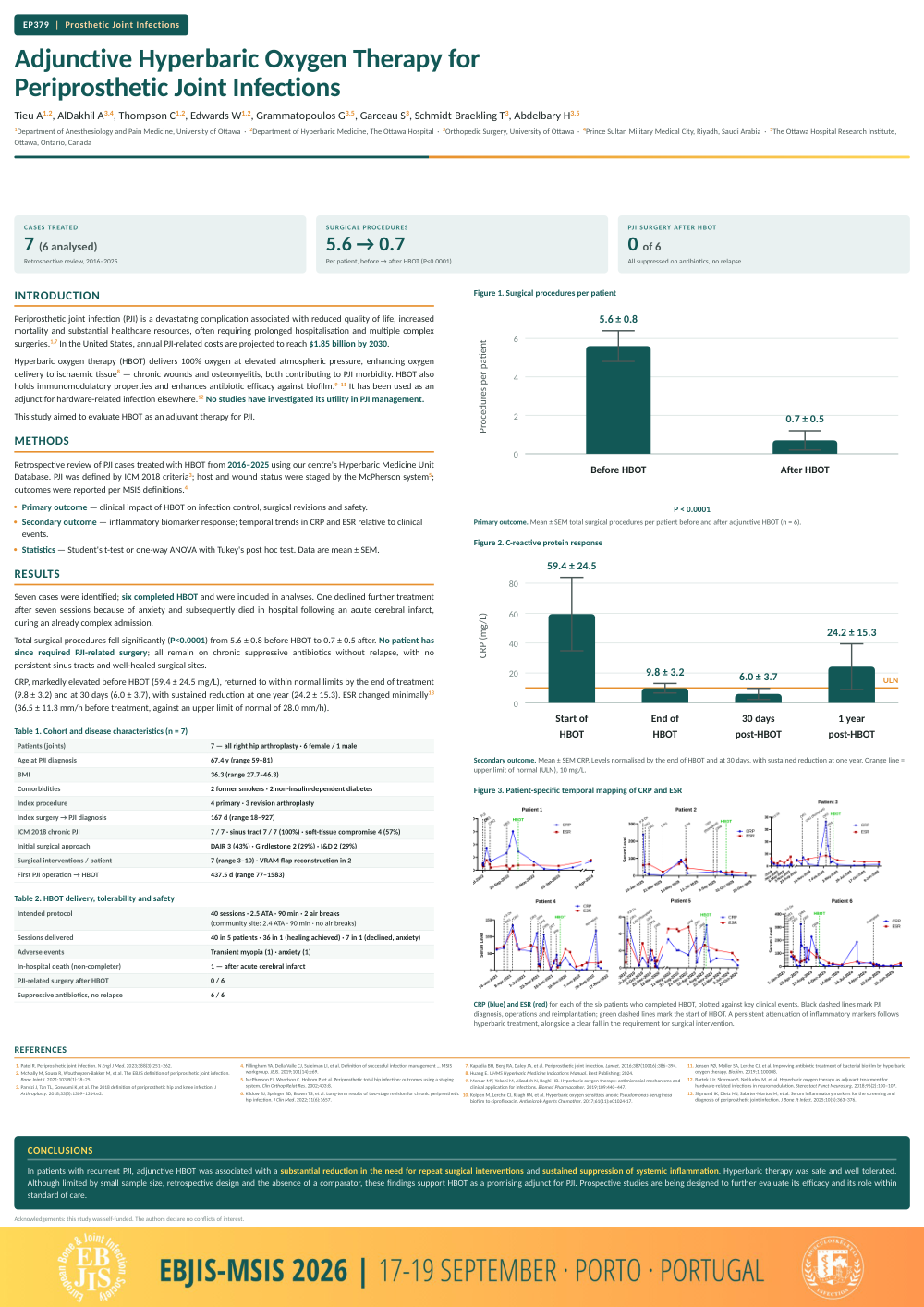
RESULTS. Seven cases were identified; six completed HBOT and were included in analyses. One declined further treatment after seven sessions because of anxiety and subsequently died in hospital following an acute cerebral infarct, during an already complex admission. Total surgical procedures fell significantly (P<0.0001) from 5.6 +/- 0.8 before HBOT to 0.7 +/- 0.5 after. No patient has since required PJI-related surgery; all remain on chronic suppressive antibiotics without relapse, with no persistent sinus tracts and well-healed surgical sites. CRP, markedly elevated before HBOT (59.4 +/- 24.5 mg/L), returned to within normal limits by the end of treatment (9.8 +/- 3.2) and at 30 days (6.0 +/- 3.7), with sustained reduction at one year (24.2 +/- 15.3). ESR changed minimally (36.5 +/- 11.3 mm/h before treatment, against an upper limit of normal of 28.0 mm/h). Cohort: 7 patients, all right hip arthroplasty, 6 female / 1 male, mean age 67.4 y, mean BMI 36.3. Intended HBOT protocol 40 sessions at 2.5 ATA for 90 minutes with two air breaks. Adverse events: transient myopia and anxiety.
CONCLUSIONS. In patients with recurrent PJI, adjunctive HBOT was associated with a substantial reduction in the need for repeat surgical interventions and sustained suppression of systemic inflammation. Hyperbaric therapy was safe and well tolerated. Although limited by small sample size, retrospective design and the absence of a comparator, these findings support HBOT as a promising adjunct for PJI. Prospective studies are being designed to further evaluate its efficacy and its role within standard of care.
Keywords: hyperbaric oxygen therapy, hyperbaric medicine, joint arthroplasty, periprosthetic joint infection, PJI, revision hip arthroplasty, biofilm, C-reactive protein.