477 posters, 14 topics, 2,065 authors, 1,055 institutions
ePostersLive by SciGen Technologies S.A. All rights reserved.
The Joint EBJIS-MSIS 2026 Conference
17 - 19 September, 2026 | Porto, Portugal

EP377
Extended oral antibiotics after primary hip or knee arthroplasty alter the microbiology of subsequent periprosthetic joint infections
Poster Presenter
Part of Topic
Prosthetic Joint Infections
Introduction and Aims
The practice of prescribing an extended course of oral antibiotics (EOA) after primary hip or knee arthroplasty (THA, TKA) has become increasingly common, based on observational data that in some high-risk patients this practice may reduce the risk of periprosthetic joint infection (PJI). One potential harm of this practice is that the excess antibiotic exposure will predispose patients to infection with more difficult-to-treat organisms. We sought to determine whether the use of EOA, specifically with a first-generation oral cephalosporin, would be associated with a change in the microbiology of subsequent PJI within one year.
Results
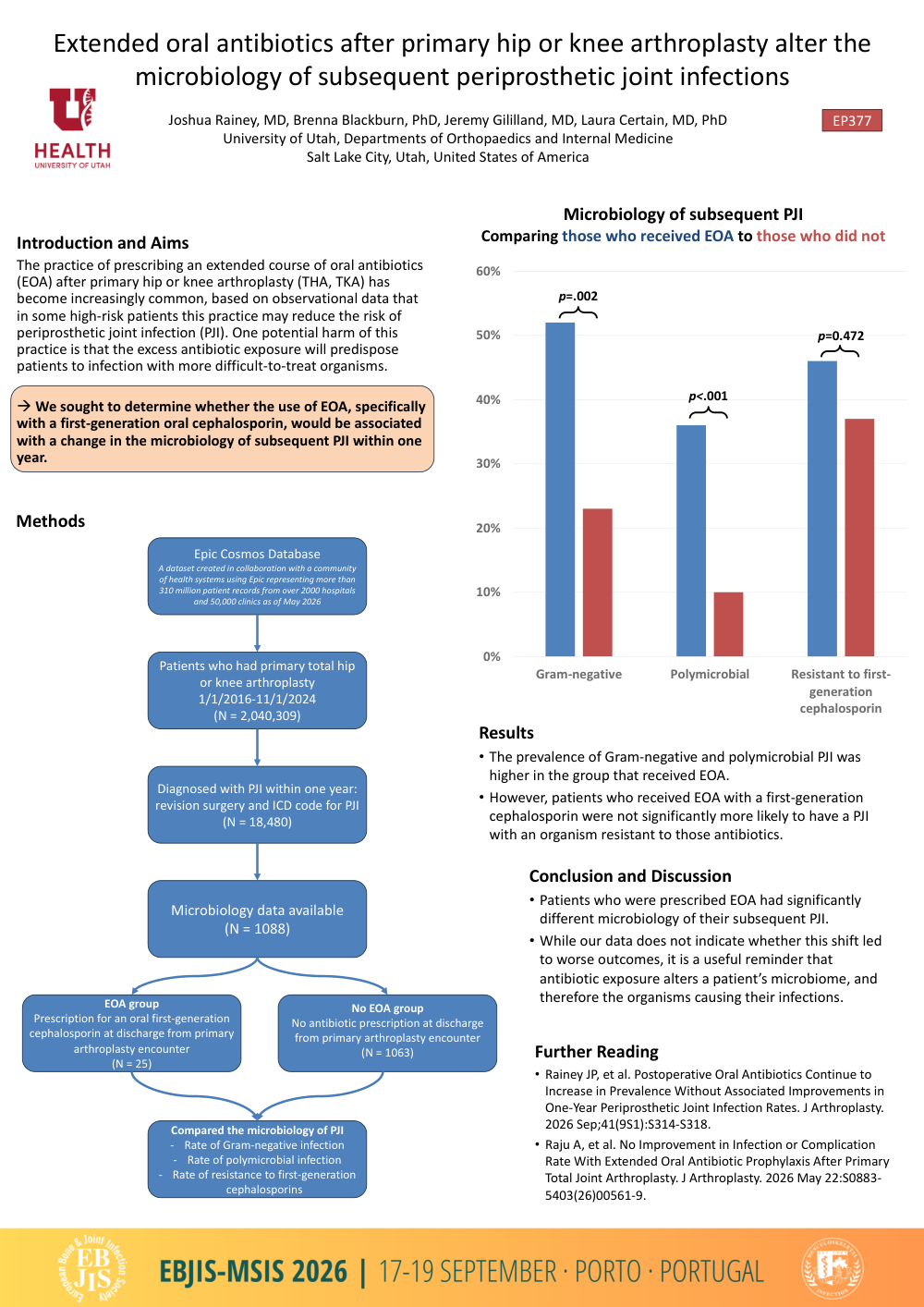
The prevalence of Gram-negative and polymicrobial PJI was higher in the group that received EOA. However, patients who received EOA with a first-generation cephalosporin were not significantly more likely to have a PJI with an organism resistant to those antibiotics.
Conclusion and Discussion
Patients who were prescribed EOA had significantly different microbiology of their subsequent PJI. While our data does not indicate whether this shift led to worse outcomes, it is a useful reminder that antibiotic exposure alters a patient’s microbiome, and therefore the organisms causing their infections.