477 posters, 14 topics, 2,065 authors, 1,055 institutions
ePostersLive by SciGen Technologies S.A. All rights reserved.
The Joint EBJIS-MSIS 2026 Conference
17 - 19 September, 2026 | Porto, Portugal

EP282
Initial Treatment at a Local Hospital Does Not Compromise Hip and Knee Periprosthetic Joint Infection Treatment Outcomes at Tertiary Centers.
Part of Topic
Prosthetic Joint Infections
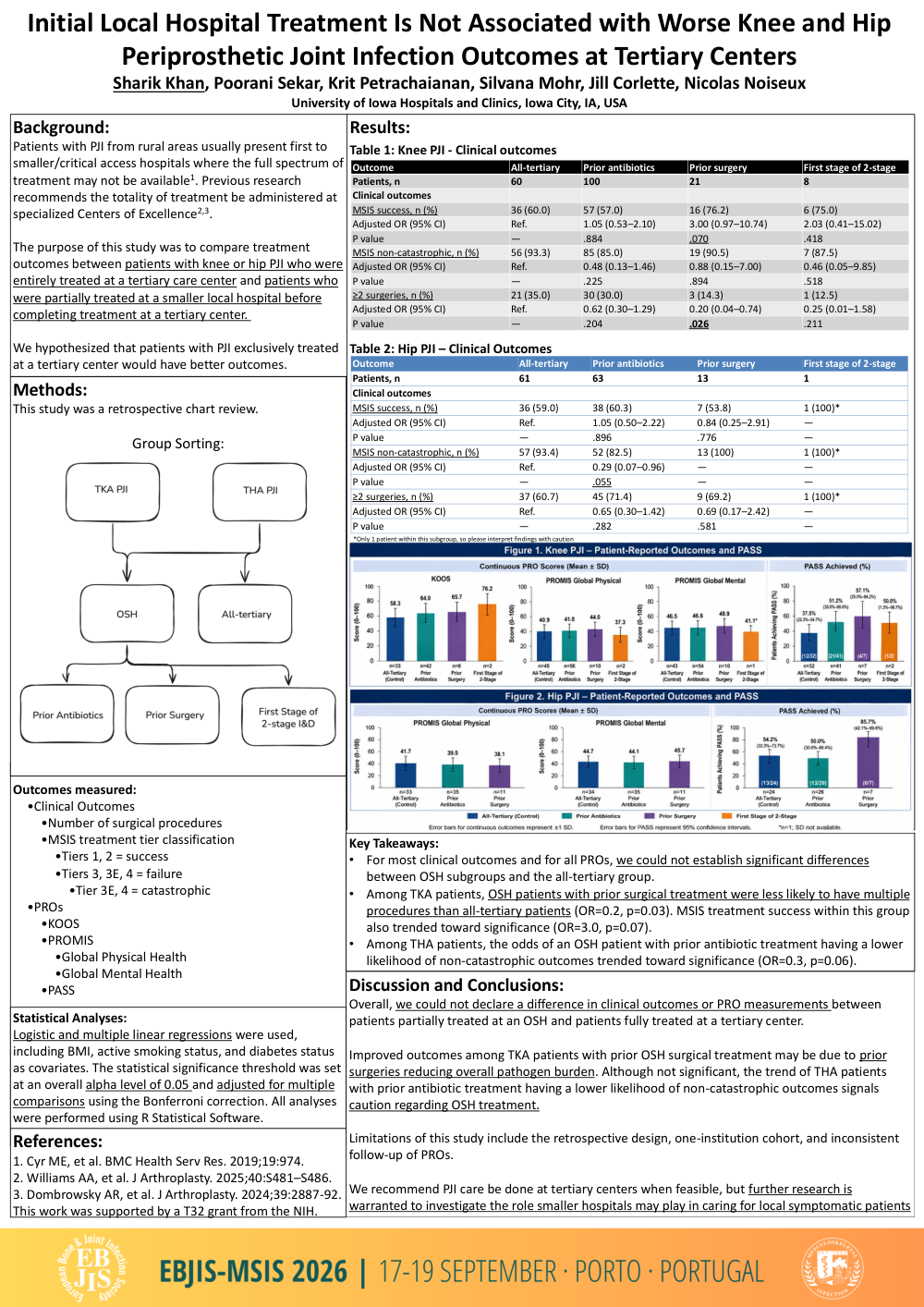
Initial Local Hospital Treatment Is Not Associated with Worse Knee and Hip Periprosthetic Joint Infection Outcomes at Tertiary Centers
Sharik Khan, Poorani Sekar, Krit Petrachaianan, Silvana Mohr, Jill Corlette, Nicolas Noiseux
University of Iowa Hospitals and Clinics, Iowa City, IA, USA
Background:
Patients with PJI from rural areas usually present first to smaller/critical access hospitals where the full spectrum of treatment may not be available1. Previous research recommends the totality of treatment be administered at specialized Centers of Excellence2,3.
The purpose of this study was to compare treatment outcomes between patients with knee or hip PJI who were entirely treated at a tertiary care center and patients who were partially treated at a smaller local hospital before completing treatment at a tertiary center.
We hypothesized that patients with PJI exclusively treated at a tertiary center would have better outcomes.
Methods:
This study was a retrospective chart review.
Group Sorting:
Outcomes measured:
Statistical Analyses:
Logistic and multiple linear regressions were used, including BMI, active smoking status, and diabetes status as covariates. The statistical significance threshold was set at an overall alpha level of 0.05 and adjusted for multiple comparisons using the Bonferroni correction. All analyses were performed using R Statistical Software.
Results:
Table 1: Knee PJI - Clinical outcomes
Table 2: Hip PJI - Clinical outcomes
Key Takeaways:
Discussion and Conclusions:
Overall, we could not declare a difference in clinical outcomes or PRO measurements between patients partially treated at an OSH and patients fully treated at a tertiary center.
Improved outcomes among TKA patients with prior OSH surgical treatment may be due to prior surgeries reducing overall pathogen burden. Although not significant, the trend of THA patients with prior antibiotic treatment having a lower likelihood of non-catastrophic outcomes signals caution regarding OSH treatment.
Limitations of this study include the retrospective design, one-institution cohort, and inconsistent follow-up of PROs.
We recommend PJI care be done at tertiary centers when feasible, but further research is warranted to investigate the role smaller hospitals may play in caring for local symptomatic patients
References:
1. Cyr ME, et al. BMC Health Serv Res. 2019;19:974.
2. Williams AA, et al. J Arthroplasty. 2025;40:S481–S486.
3. Dombrowsky AR, et al. J Arthroplasty. 2024;39:2887-92.
This work was supported by a T32 grant from the NIH.