99 posters, 2 videos, 5 audios, 13 topics, 7 sessions, 416 authors, 181 institutions
ePostersLive by SciGen Technologies S.A. All rights reserved.
The 21st Meeting of the Diabetic Foot Study Group 2026
24-26 September, 2026 | Florence, Italy

EP28
A Novel Dual-Sensor Method Demonstrates Near-Zero Pressure at Plantar Diabetic Foot Ulcer Sites Offloaded by Standardized Felt Padding
Poster Presenter
Authors
Affiliations
Part of Topic
Biomechanics
Background
Felt-based distant padding is widely used to offload plantar diabetic foot ulcers, yet heterogeneity in material, thickness, and layering hampers evaluation and guideline development. The Pro-3F working group has standardized the method, including manual verification of the cavity by digital palpation under weight-bearing. However, instrumental proof of pressure elimination remains challenging, as sensors under dynamic conditions register bending and tensile forces as pressure artifacts.
Methods
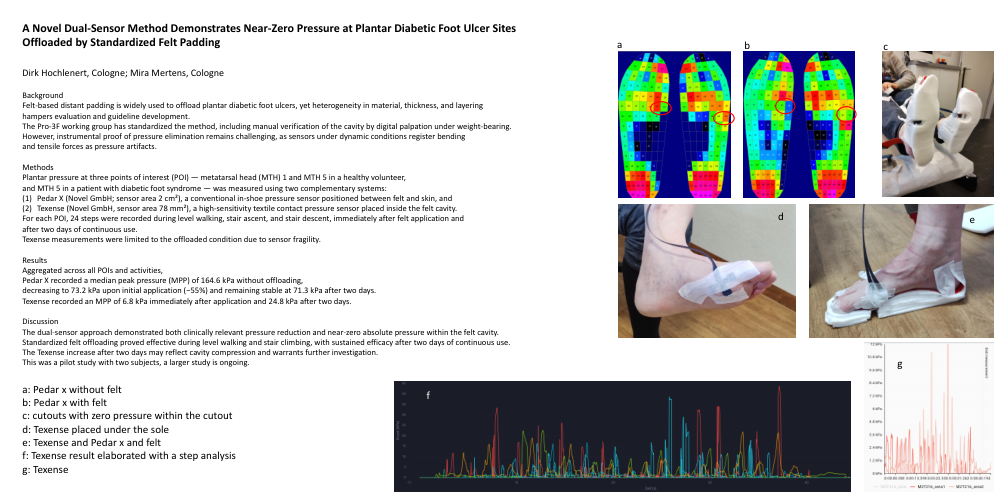
Plantar pressure at three points of interest (POI) — metatarsal head (MTH) 1 and MTH 5 in a healthy volunteer, and MTH 5 in a patient with diabetic foot syndrome — was measured using two complementary systems: (1) Pedar X (Novel GmbH; sensor area 2 cm²), a conventional in-shoe pressure sensor positioned between felt and skin, and (2) TexSense (Novel GmbH, sensor area 78 mm²), a high-sensitivity textile contact pressure sensor placed inside the felt cavity. For each POI, 24 steps were recorded during level walking, stair ascent, and stair descent, immediately after felt application and after two days of continuous use. TexSense measurements were limited to the offloaded condition due to sensor fragility.
Results
Aggregated across all POIs and activities, Pedar X recorded a median peak pressure (MPP) of 164.6 kPa without offloading, decreasing to 73.2 kPa upon initial application (−55%) and remaining stable at 71.3 kPa after two days. TexSense recorded an MPP of 6.8 kPa immediately after application and 24.8 kPa after two days.
Discussion
The dual-sensor approach demonstrated both clinically relevant pressure reduction and near-zero absolute pressure within the felt cavity. Standardized felt offloading proved effective during level walking and stair climbing, with sustained efficacy after two days of continuous use. The TexSense increase after two days may reflect cavity compression and warrants further investigation. This was a pilot study with two subjects, a larger study is ongoing.