99 posters, 2 videos, 5 audios, 13 topics, 7 sessions, 416 authors, 181 institutions
ePostersLive by SciGen Technologies S.A. All rights reserved.
The 21st Meeting of the Diabetic Foot Study Group 2026
24-26 September, 2026 | Florence, Italy

EP101
There is a Promising use of Nitric Oxide-Generating Multimodal Wound Dressing in highly Ischaemic Diabetic Foot Ulcers: A Single Centre Case Series
Poster Presenter
Authors
Sandra Woolcock, Wegin Tang, Stephanie Tang, Maureen Bates, Oluwatoyin Akinjola, Mercy Laryae, Christina Martin, Ben So, Sarah Curtis, Bonnie Chow, Patricia Lee, Erika Vainieri, Michael Edmonds, Chris Manu
Affiliations
Mike Edmonds Foot Unit, King'S College Hospital NHS Foundation Trust, London, London, United Kingdom
Part of Topic
Wound healing and outcome
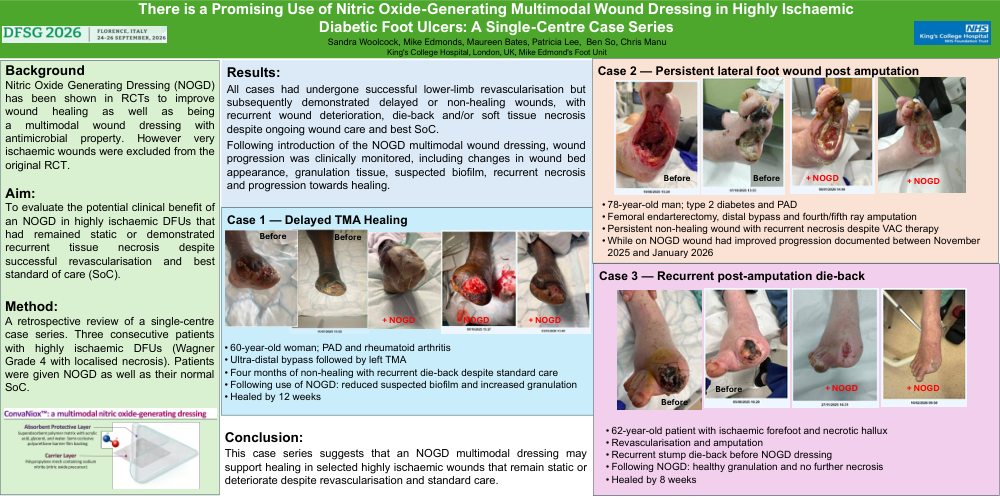
Background Nitric Oxide Generating Dressing (NOGD) has been shown in RCTs to improve wound healing as well as being a multimodal wound dressing with antimicrobial property. However very ischaemic wounds were excluded from the originalRCT
Aim: To evaluate the potential clinical benefit of an NOGD in highly ischaemic DFUs that had remained static or demonstrated recurrent tissue necrosis despite successful revascularisation and best standard of care (SoC)
Method: A retrospective review of a single-centre case series. Three consecutive patients with highly ischaemic DFUs (Wagner Grade 4 with localised necrosis). Patients were given NOGD as well as their normal SoC
Conclusion: This case series suggests that an NOGD multimodal dressing may support healing in selected highly ischaemic wounds that remain static or deteriorate despite revascularisation and standard care.