180 posters, 53 videos, 29 audios, 5 topics, 304 authors, 182 institutions
ePostersLive by SciGen Technologies S.A. All rights reserved.
7th Commonwealth Chemistry Posters
24-25 June, 2026 | Online

P69
Chemical Composition and Antioxidant Activity of Essential Oils and Cannabinoid Extracts from Cannabis sativa L. Cultivated in Trinidad and Tobago
Poster Presenter
Part of Topic
Good Health and Wellbeing (SDG 3)
Keywords
Trinidad and Tobago, Jamaica, Cannabis sativa, cannabinoid, terpene, essential oil, GC-MS, Analytical Chemistry
Abstract
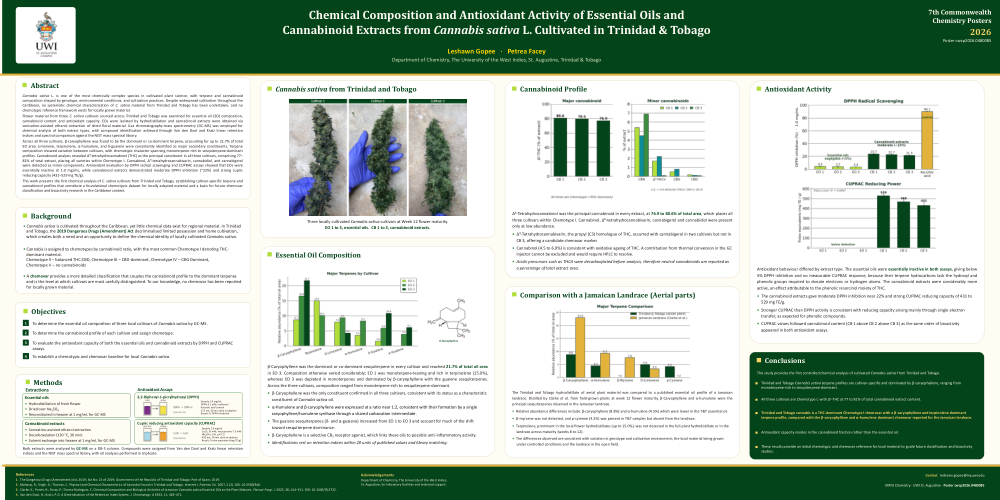
Cannabis sativa L. is one of the most chemically complex species in cultivated plant science, with terpene and cannabinoid composition shaped by genotype, environmental conditions, and cultivation practices. Despite widespread cultivation throughout the Caribbean, no systematic chemical characterisation of C. sativa material from Trinidad and Tobago has been undertaken, and no chemotypic reference framework exists for locally grown material.
Flower material from three C. sativa cultivars sourced across Trinidad and Tobago was examined for essential oil (EO) composition, cannabinoid content and antioxidant capacity. EOs were isolated by hydrodistillation and cannabinoid extracts were obtained via sonication-assisted ethanol extraction of dried floral material. Gas chromatography-mass spectrometry (GC-MS) was employed for chemical analysis of both extract types, with compound identification achieved through Van den Dool and Kratz linear retention indices and spectral comparison against the NIST mass spectral library.
Across all three cultivars, β-caryophyllene was found to be the dominant or co-dominant terpene, accounting for up to 21.7% of total EO area. Limonene, terpinolene, α-humulene, and δ-guaiene were consistently identified as major secondary constituents. Terpene composition showed variation between cultivars, with chemotypic character spanning monoterpene-rich to sesquiterpene-dominant profiles. Cannabinoid analysis revealed Δ9-tetrahydrocannabinol (THC) as the principal constituent in all three cultivars, comprising 77–81% of total extract, placing all varieties within Chemotype I. Cannabinol, Δ9-tetrahydrocannabivarin, cannabidiol, and cannabigerol were detected as minor components. Antioxidant evaluation by DPPH radical scavenging and CUPRAC assays showed that EOs were essentially inactive at 1.0 mg/mL, while cannabinoid extracts demonstrated moderate DPPH inhibition (~22%) and strong cupric reducing capacity (431–529 mg TE/g).
This work presents the first chemical analysis of C. sativa cultivars from Trinidad and Tobago, establishing cultivar-specific terpene and cannabinoid profiles that constitute a foundational chemotypic dataset for locally adapted material and a basis for future chemovar classification and bioactivity research in the Caribbean context.
Background
• Cannabis sativa is cultivated throughout the Caribbean, yet little chemical data exist for regional material. In Trinidad
and Tobago, the 2019 Dangerous Drugs (Amendment) Act decriminalisedlimited possession and home cultivation,
which creates both a need and an opportunity to define the chemical identity of locally cultivated Cannabis sativa.
• Cannabis is assigned to chemotypes by cannabinoid ratio, with the most common Chemotype I denoting THC-
dominant material.
Chemotype II – balanced THC:CBD, Chemotype III – CBD-dominant, Chemotype IV – CBG Dominant,
Chemotype V – no cannabinoids
• A chemovar provides a more detailed classification that couples the cannabinoid profile to the dominant terpenes
and is the level at which cultivars are most usefully distinguished. To our knowledge, no chemovar has been reported
for locally grown material.
Objectives
1. To determine the essential oil composition of three local cultivars of Cannabis sativa by GC-MS.
2. To determine the cannabinoid profile of each cultivar and assign chemotype.
3. To evaluate the antioxidant capacity of both the essential oils and cannabinoid extracts by DPPH and CUPRAC assays.
4. To establish a chemotypic and chemovar baseline for local Cannabis sativa.
Essential Oil Composition
β-Caryophyllene was the dominant or co-dominant sesquiterpene in every cultivar and reached 21.7% of total oil area in EO 3. Composition otherwise varied considerably: EO 1 was monoterpene-leaning and rich in terpinolene (15.0%), whereas EO 3 was depleted in monoterpenes and dominated by β-caryophyllene with the guaiene sesquiterpenes. Across the three cultivars, composition ranged from monoterpene-rich to sesquiterpene-dominant.
• β-Caryophyllene was the only constituent confirmed in all three cultivars, consistent with its status as a characteristic constituent of Cannabis sativa oil.
• α-Humulene and β-caryophyllene were expressed at a ratio near 1:2, consistent with their formation by a single caryophyllene/humulene synthase through a shared carbocation intermediate.
• The guaiane sesquiterpenes (δ- and α-guaiene) increased from EO 1 to EO 3 and account for much of the shift toward sesquiterpene dominance.
• β-Caryophyllene is a selective CB2 receptor agonist, which links these oils to possible anti-inflammatory activity.
• Identifications rest on retention indices within 20 units of published values and library matching.
Cannabinoid Profile
Δ9-Tetrahydrocannabinol was the principal cannabinoid in every extract, at 76.9 to 80.6% of total area, which places all three cultivars within Chemotype I. Cannabinol, Δ9-tetrahydrocannabivarin, cannabigerol and cannabidiol were present only at low abundance.
• Δ9-Tetrahydrocannabivarin, the propyl (C3) homologue of THC, occurred with cannabigerol in two cultivars but not in CB 3, offering a candidate chemovar marker.
• Cannabinol (4.5 to 6.9%) is consistent with oxidative ageing of THC. A contribution from thermal conversion in the GC injector cannot be excluded and would require HPLC to resolve.
• Acidic precursors such as THCA were decarboxylated before analysis, therefore neutral cannabinoids are reported as a percentage of total extract area.
Comparison with a Jamaican Landrace (Aerial parts)
The Trinidad and Tobago hydrodistillate of aerial plant material was compared to a published essential oil profile of a Jamaican landrace. Distilled by Clarke et al. from field-grown plants at week 12 flower maturity, β-Caryophyllene and α-humulene were the principal sesquiterpenes observed in the Jamaican landrace.
• Relative abundance differences include: β-caryophyllene (8.8%) and α-humulene (4.5%) which were lower in the T&T essential oil.
• β-myrcene was not detected, and p-cymene (4.2%) was present in T&T samples but absent from the landrace.
• Terpinolene, prominent in the local flower hydrodistillates (up to 15.0%), was not detected in the full-plant hydrodistillate or in the landrace across maturity (weeks 8 to 12).
• The differences observed are consistent with variation in genotype and cultivation environment; the local material being grown under controlled conditions and the landrace in the open field.
Antioxidant Activity
Antioxidant behaviour differed by extract type. The essential oils were essentially inactive in both assays, giving below 5% DPPH inhibition and no measurable CUPRAC response, because their terpene hydrocarbons lack the hydroxyl and phenolic groups required to donate electrons or hydrogen atoms. The cannabinoid extracts were considerably more active, an effect attributable to the phenolic resorcinol moiety of THC.
• The cannabinoid extracts gave moderate DPPH inhibition near 22% and strong CUPRAC reducing capacity of 431 to 529 mg TE/g.
• Stronger CUPRAC than DPPH activity is consistent with reducing capacity arising mainly through single electron transfer, as expected for phenolic compounds.
• CUPRAC values followed cannabinoid content (CB 1 above CB 2 above CB 3) as the same order of bioactivity appeared in both antioxidant assays.
Conclusions
Trinidad and Tobago Cannabis sativa terpene profiles are cultivar-specific and dominatedby β-caryophyllene, ranging from monoterpene-rich to sesquiterpene-dominant.
All three cultivars are Chemotype I, with Δ9-THC at 77 to 81% of total cannabinoid extractcontent.
Trinidad and Tobago cannabis is a THC-dominant Chemotype I chemovar with a β-caryophyllene and terpinolene dominant terpene profile, compared with the β-caryophyllene and α-humulene dominant chemovar reported for the Jamaican landrace.
Antioxidant capacity resides in the cannabinoid fraction rather than the essential oil.
These results provide an initial chemotypic and chemovar reference for local material to guide future classification and bioactivity studies.