180 posters, 53 videos, 29 audios, 5 topics, 304 authors, 182 institutions
ePostersLive by SciGen Technologies S.A. All rights reserved.
7th Commonwealth Chemistry Posters
24-25 June, 2026 | Online

P42
Preparation and evaluation of alginate scaffolds enriched with Kigelia africana
Poster Presenter
Authors
Affiliations
Part of Topic
Good Health and Wellbeing (SDG 3)
Introduction
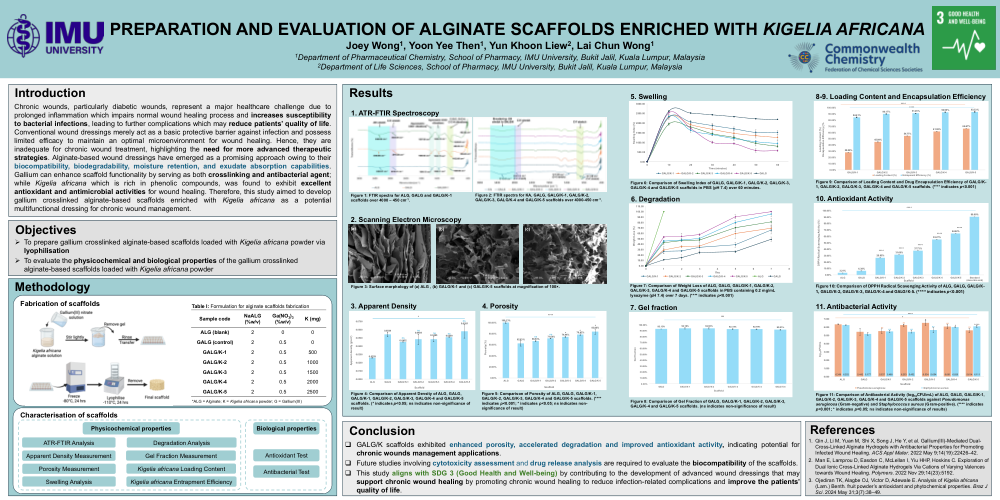
Chronic wounds, particularly diabetic wounds, represent a major healthcare challenge due to prolonged inflammation which impairs normal wound healing process and increases susceptibility to bacterial infections, leading to further complications which may reduce patients’ quality of life. Conventional wound dressings merely act as a basic protective barrier against infection and possess limited efficacy to maintain an optimal microenvironment for wound healing. Hence, they are inadequate for chronic wound treatment, highlighting the need for more advanced therapeutic strategies. Alginate-based wound dressings have emerged as a promising approach owing to their biocompatibility, biodegradability, moisture retention, and exudate absorption capabilities. Gallium can enhance scaffold functionality by serving as both crosslinking and antibacterial agent; while Kigelia africana which is rich in phenolic compounds, was found to exhibit excellent antioxidant and antimicrobial activities for wound healing. Therefore, this study aimed to develop gallium crosslinked alginate-based scaffolds enriched with Kigelia africana as a potential multifunctional dressing for chronic wound management.
Objectives
1. To prepare gallium crosslinked alginate-based scaffolds loaded with Kigelia africana powder via lyophilisation
2. To evaluate the physicochemical and biological properties of the gallium crosslinked alginate-based scaffolds loaded with Kigelia africana powder
Conclusion
• GALG/K scaffolds exhibited enhanced porosity, accelerated degradation and improved antioxidant activity, indicating potential for chronic wound management applications.
• Future studies involving cytotoxicity assessment and drug release analysis are required to evaluate the biocompatibility of the scaffolds.
• This study aligns with SDG 3 (Good Health and Well-being) by contributing to the development of advanced wound dressings that may support chronic wound healing by promoting chronic wound healing to reduce infection-related complications and improve the patients’ quality of life.