180 posters, 53 videos, 29 audios, 5 topics, 304 authors, 182 institutions
ePostersLive by SciGen Technologies S.A. All rights reserved.
7th Commonwealth Chemistry Posters
24-25 June, 2026 | Online

P48
Role of Neuroinflammation in Brain Tumor Progression: Microglia-Astrocyte Crosstalk as a Therapeutic Target
Poster Presenter
Authors
Abdullah Al Rafi, Kashefatun Nur Orni, Shoaib Uddin Yeaser, Mohammad Shahangir Biswas
Affiliations
University of science and technology Chittagong, Department of Biochemistry and Biotechnology, University of Science and Technology Chittagong (USTC), Chattogram-4202, Bangladesh, Department of Pharmacy, University of Chittagong, Chattagram-4331, Bangladesh.
Part of Topic
Good Health and Wellbeing (SDG 3)
Video
Role of Neuroinflammation in Brain Tumor Progression: Microglia–Astrocyte Crosstalk as a Therapeutic Target
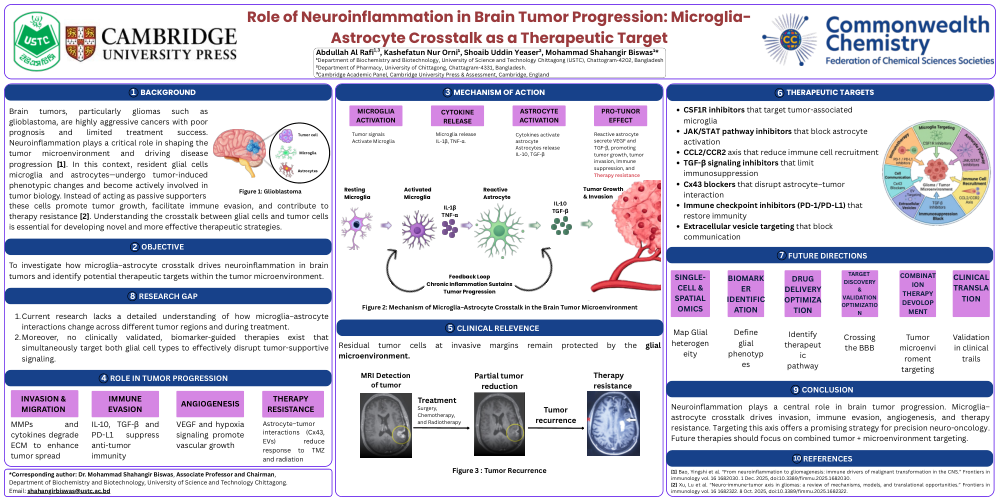
Background: Glioblastoma is one of the most aggressive primary brain tumors, characterized by poor prognosis, high recurrence rates, and limited therapeutic success. Increasing evidence indicates that neuroinflammation plays a crucial role in shaping the tumor microenvironment and promoting disease progression. Microglia and astrocytes, the principal glial cells of the central nervous system, undergo tumor-induced activation and contribute to tumor growth, immune evasion, angiogenesis, and therapy resistance.
Objective: To investigate the role of microglia–astrocyte crosstalk in driving neuroinflammation during brain tumor progression and to identify potential therapeutic targets within the tumor microenvironment.
Methods: A literature-based analysis was conducted focusing on recent findings regarding glial cell interactions, inflammatory signaling pathways, and their contribution to glioma progression.
Results: Tumor-derived signals activate microglia, leading to the release of pro-inflammatory cytokines such as IL-1β and TNF-α. These cytokines stimulate astrocyte activation, resulting in the secretion of IL-10, TGF-β, and VEGF. This feedback loop sustains chronic neuroinflammation, promotes tumor invasion and migration, suppresses anti-tumor immunity, enhances angiogenesis, and contributes to resistance against chemotherapy and radiotherapy. Several therapeutic strategies targeting this axis, including CSF1R inhibitors, JAK/STAT inhibitors, TGF-β pathway inhibitors, CCL2/CCR2 blockade, Connexin-43 inhibitors, extracellular vesicle targeting, and immune checkpoint inhibitors, show promising potential.
Conclusion: Microglia–astrocyte crosstalk is a critical driver of neuroinflammation and glioblastoma progression. Targeting both tumor cells and the surrounding neuroinflammatory microenvironment may provide a more effective therapeutic strategy for precision neuro-oncology. Future research should focus on biomarker-guided therapies, single-cell and spatial omics approaches, and improved blood–brain barrier drug delivery systems.
Keywords: Glioblastoma, Neuroinflammation, Microglia, Astrocytes, Tumor Microenvironment, Cytokines, Immune Evasion, Therapy Resistance, Neuro-Oncology.