180 posters, 53 videos, 29 audios, 5 topics, 304 authors, 182 institutions
ePostersLive by SciGen Technologies S.A. All rights reserved.
7th Commonwealth Chemistry Posters
24-25 June, 2026 | Online

P156
Occurrence, Transport, Fate, and Regulation of Microplastics Across Canadian Environments
Poster Presenter
Part of Topic
Sustainable Planet (SDGs 2, 11, 13, 14 and 15)
Background:
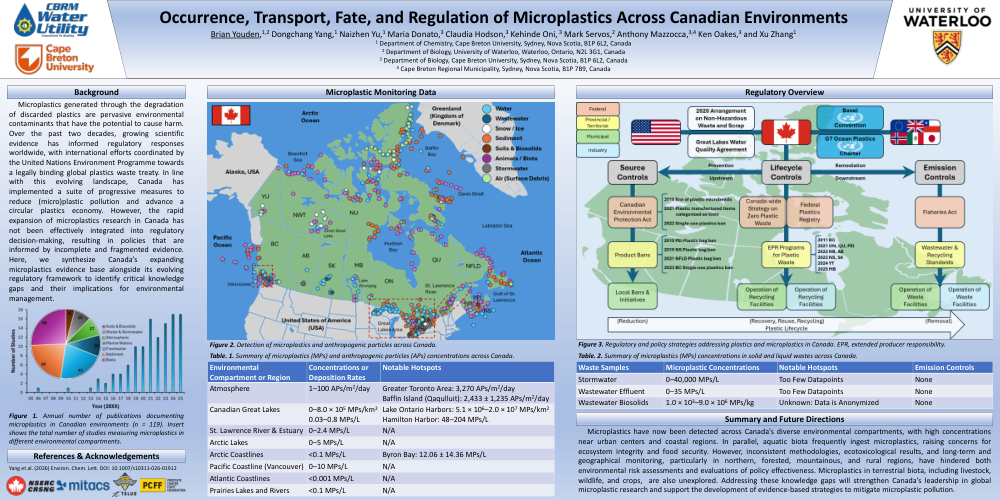
Microplastics generated through the degradation of discarded plastics are pervasive environmental contaminants that have the potential to cause harm. Over the past two decades, growing scientific evidence has informed regulatory responses worldwide, with international efforts coordinated by the United Nations Environment Programme towards a legally binding global plastics waste treaty. In line with this evolving landscape, Canada has implemented a suite of progressive measures to reduce (micro)plastic pollution and advance a circular plastics economy. However, the rapid expansion of microplastics research in Canada has not been effectively integrated into regulatory decision-making, resulting in policies that are informed by incomplete and fragmented evidence. Here, we synthesize Canada’s expanding microplastics evidence base alongside its evolving regulatory framework to identify critical knowledge gaps and their implications for environmental management.
Summary & Future Directions:
Microplastics have now been detected across Canada’s diverse environmental compartments, with high concentrations near urban centers and coastal regions. In parallel, aquatic biota frequently ingest microplastics, raising concerns for ecosystem integrity and food security. However, inconsistent methodologies, ecotoxicological results, and long-term and geographical monitoring, particularly in northern, forested, mountainous, and rural regions, have hindered both environmental risk assessments and evaluations of policy effectiveness. Microplastics in terrestrial biota, including livestock, wildlife, and crops, are also unexplored. Addressing these knowledge gaps will strengthen Canada’s leadership in global microplastic research and support the development of evidence-based strategies to mitigate microplastic pollution.