180 posters, 53 videos, 29 audios, 5 topics, 304 authors, 182 institutions
ePostersLive by SciGen Technologies S.A. All rights reserved.
7th Commonwealth Chemistry Posters
24-25 June, 2026 | Online

P124
Catalyst Design for Net-Zero Hydrogen Production
Poster Presenter
Authors
Affiliations
Part of Topic
Responsible Energy (SDGs 7 and 12)
Title: Catalyst Design for Net-Zero Hydrogen Production
Xiuxiu Han,1 and Sara Walker 1
1 Birmingham Energy Institute, Department of Chemical Engineering, University of Birmingham
Email: x.han.3@bham.ac.uk
Abstract:
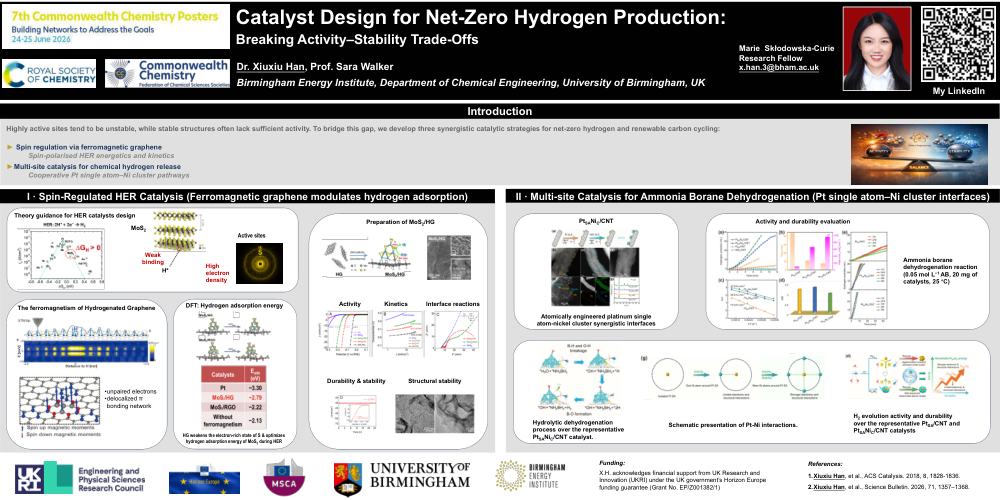
Achieving both high catalytic activity and long-term stability remains a central challenge in catalyst design, as highly active sites tend to be unstable, while stable structures often lack sufficient activity. To address this activity–stability trade-off, this presentation introduces two synergistic catalytic strategies for net-zero hydrogen production: spin regulation via ferromagnetic graphene and multi-site catalysis for chemical hydrogen release.
The first study focuses on spin-regulated hydrogen evolution reaction catalysis using a MoS₂/hydrogenated graphene catalyst. Ferromagnetic graphene modulates the electronic structure of MoS₂, weakens the electron-rich state of sulfur sites, and optimises hydrogen adsorption. This spin-polarised regulation improves hydrogen evolution energetics and kinetics, providing a strategy for catalytic hydrogen production through magnetic and electronic modulation1.
The second study presents multi-site catalysis for ammonia borane dehydrogenation using atomically engineered Pt single atom–Ni cluster interfaces. Pt single atoms and neighbouring Ni clusters provide cooperative pathways for water activation, B–H bond cleavage, and hydrogen desorption, thereby accelerating chemical hydrogen release while improving catalyst durability2.
Overall, these studies show that rational catalyst design through spin regulation and multi-site interfacial catalysis can provide effective strategies for breaking activity–stability trade-offs. The results offer mechanistic understanding and design principles for high-performance catalysts in net-zero hydrogen production.
References
- Xiuxiu Han, et al., ACS Catalysis. 2018, 8, 1828-1836.
- Xiuxiu Han, et al., Science Bulletin. 2026, 71, 1357–1368.