180 posters, 53 videos, 29 audios, 5 topics, 304 authors, 182 institutions
ePostersLive by SciGen Technologies S.A. All rights reserved.
7th Commonwealth Chemistry Posters
24-25 June, 2026 | Online

P73
Characterization, Fabrication and Application of Aluminium doped Fresh Water Snail Shell Biochars for Efficient Fluoride Removal.
Poster Presenter
Authors
Winstone Otieno, okoth kevin, Gerald Mbugua, Daniel Muvengei
Affiliations
Part of Topic
Clean Water and Sanitation (SDG 6)
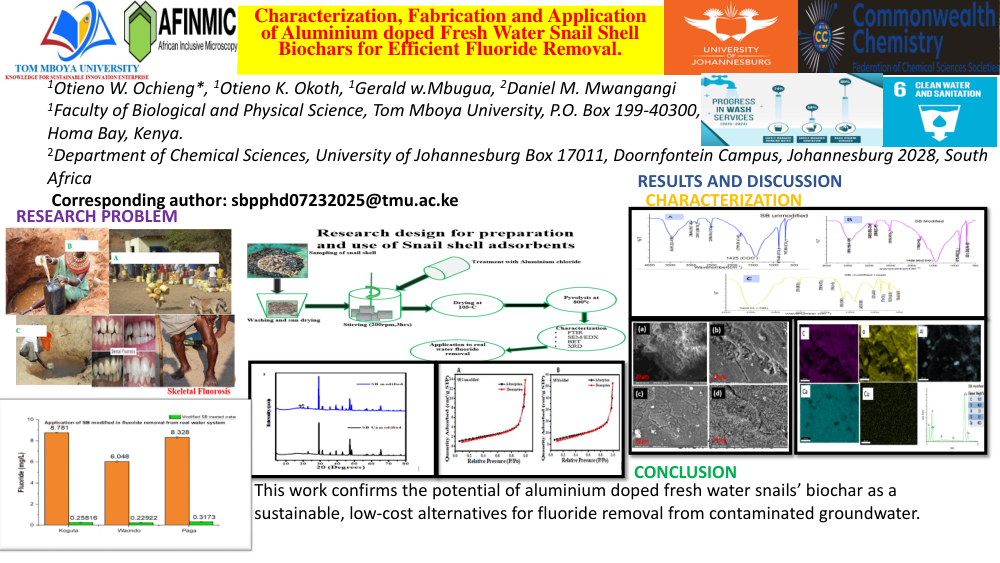
This study presents the characterization and application of aluminum chloride modified snail shell biochar in fluoride remediation of contaminated drinking water. Characterization techniques including Fourier Transform Infrared Spectroscopy (FTIR), Scanning Electron Microscopy (SEM), Energy-Dispersive X-ray Spectroscopy (EDS), Brunauer-Emmett-Teller (BET) surface area analysis, and X-ray Diffraction (XRD) were employed to assess functional groups, morphology, surface area, mineral composition and phase transformations. The modified biochars exhibited Al-O and Al-OH functional groups, increased porosity, and higher surface area compared to unmodified biochars. SEM confirmed structural transformation, while EDS validated aluminum incorporation and fluoride binding. BET analysis showed notable improvements in porosity. The optimal experimental studies conditions for defluoridation were determined to be a pH of 7, sorbent dose of 8 g and a 50 oC temperature. Under combined optimum conditions, the maximum adsorption capacity was found to be 1.230 mg/g at 298k for the modified snail shell biosorbent. This study showed that fluoride adsorption fitted the Freundlich's isotherm model, indicating multilayer fluoride adsorption on a heterogeneous surface, whereas defluoridation followed pseudo second-order kinetics. Application to natural water from Lambwe Valley, Kenya, demonstrated effective fluoride removal to below WHO limits (1.5 mg/L). The study concludes that modified snail shell biochar is sustainable, low-cost adsorbent suitable for community-level water treatment.