180 posters, 53 videos, 29 audios, 5 topics, 304 authors, 182 institutions
ePostersLive by SciGen Technologies S.A. All rights reserved.
7th Commonwealth Chemistry Posters
24-25 June, 2026 | Online

P17
Newly Synthesized 2-Cyclopentylidenehydrazinylthiazoles as Potential Therapeutic Agents against Peptic UlcerSehrish, Uzma salar
Poster Presenter
Authors
Affiliations
Part of Topic
Good Health and Wellbeing (SDG 3)
Video
Audio
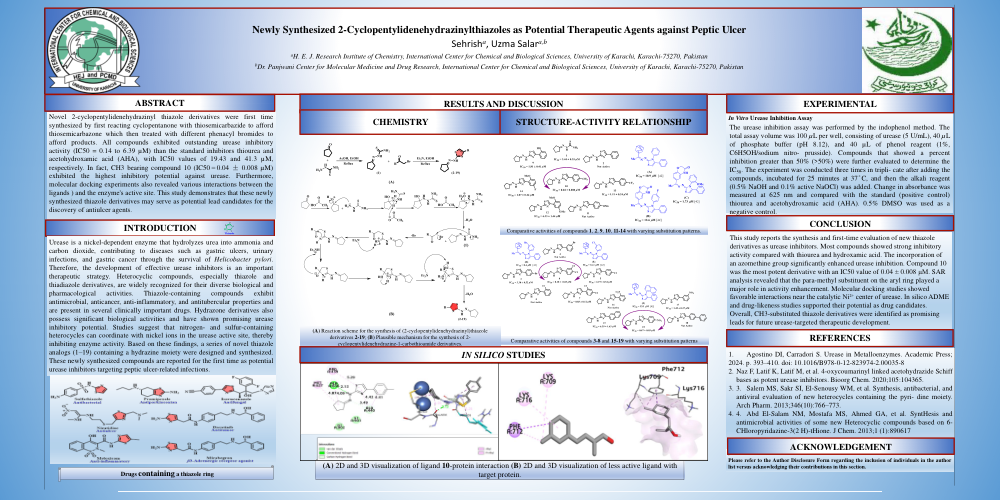
Novel 2-cyclopentylidenehydrazinyl thiazole derivatives were first time synthesized by first reacting cyclopentanone with thiosemicarbazide to afford thiosemicarbazone which then treated with different phenacyl bromides to afford products. All compounds exhibited outstanding urease inhibitory activity (IC50 = 0.14 to 6.39 µM) than the standard inhibitors thiourea and acetohydroxamic acid (AHA), with IC50 values of 19.43 and 41.3 µM, respectively. In fact, CH3 bearing compound 10 (IC50 = 0.04 ± 0.008 µM) exhibited the highest inhibitory potential against urease. Furthermore, molecular docking experiments also revealed various interactions between the ligands ) and the enzyme's active site. This study demonstrates that these newly synthesized thiazole derivatives may serve as potential lead candidates for the discovery of antiulcer agents.
Urease is a nickel-dependent enzyme that hydrolyzes urea into ammonia and carbon dioxide, contributing to diseases such as gastric ulcers, urinary infections, and gastric cancer through the survival of Helicobacter pylori. Therefore, the development of effective urease inhibitors is an important therapeutic strategy. Heterocyclic compounds, especially thiazole and thiadiazole derivatives, are widely recognized for their diverse biological and pharmacological activities. Thiazole-containing compounds exhibit antimicrobial, anticancer, anti-inflammatory, and antitubercular properties and are present in several clinically important drugs. Hydrazone derivatives also possess significant biological activities and have shown promising urease inhibitory potential. Studies suggest that nitrogen- and sulfur-containing heterocycles can coordinate with nickel ions in the urease active site, thereby inhibiting enzyme activity. Based on these findings, a series of novel thiazole analogs (1–19) containing a hydrazine moiety were designed and synthesized. These newly synthesized compounds are reported for the first time as potential urease inhibitors targeting peptic ulcer-related infections.
The urease inhibition assay was performed by the indophenol method. The total assay volume was 100 µL per well, consisting of urease (5 U/mL), 40 µL of phosphate buffer (pH 8.12), and 40 µL of phenol reagent (1%, C6H5OH/sodium nitro- prusside). Compounds that showed a percent inhibition greater than 50% (>50%) were further evaluated to determine the IC50. The experiment was conducted three times in tripli- cate after adding the compounds, incubated for 25 minutes at 37°C, and then the alkali reagent (0.5% NaOH and 0.1% active NaOCl) was added. Change in absorbance was measured at 625 nm and compared with the standard (positive control) thiourea and acetohydroxamic acid (AHA). 0.5% DMSO was used as a negative control.
This study reports the synthesis and first-time evaluation of new thiazole derivatives as urease inhibitors. Most compounds showed strong inhibitory activity compared with thiourea and hydroxamic acid. The incorporation of an azomethine group significantly enhanced urease inhibition. Compound 10 was the most potent derivative with an IC50 value of 0.04 ± 0.008 μM. SAR analysis revealed that the para-methyl substituent on the aryl ring played a major role in activity enhancement. Molecular docking studies showed favorable interactions near the catalytic Ni²⁺ center of urease. In silico ADME and drug-likeness studies supported their potential as drug candidates. Overall, CH3-substituted thiazole derivatives were identified as promising leads for future urease-targeted therapeutic development.