92 posters, 1 audios, 1 topics, 567 authors, 81 institutions
ePostersLive by SciGen Technologies S.A. All rights reserved.
Data-driven Cancer Research Conference 2026
24-26 February 2026 | Edinburgh, Scotland

P83
Big Data for Complex Disease Programme – A National Population-level Resource for Exploring Data-Driven Cancer Research Questions
Poster Presenter
Authors
Alexis Webb, Sally Boylan, Amy Hodgkinson, Ali Timmons, Fiona Taggart, Eva Morris, Gary Abel, Angela Wood, Mark Lawler
Affiliations
Part of Topic
Big Data for Complex Disease Programme – ANational Population-level Resource for Exploring Data-Driven Cancer Research Questions
Authors: Alexis Webb, Sally Boylan, Amy Hodgkinson, Ali Timmons, Fiona Taggart, Eva Morris, Gary Abel, Angela Wood, and Mark Lawler
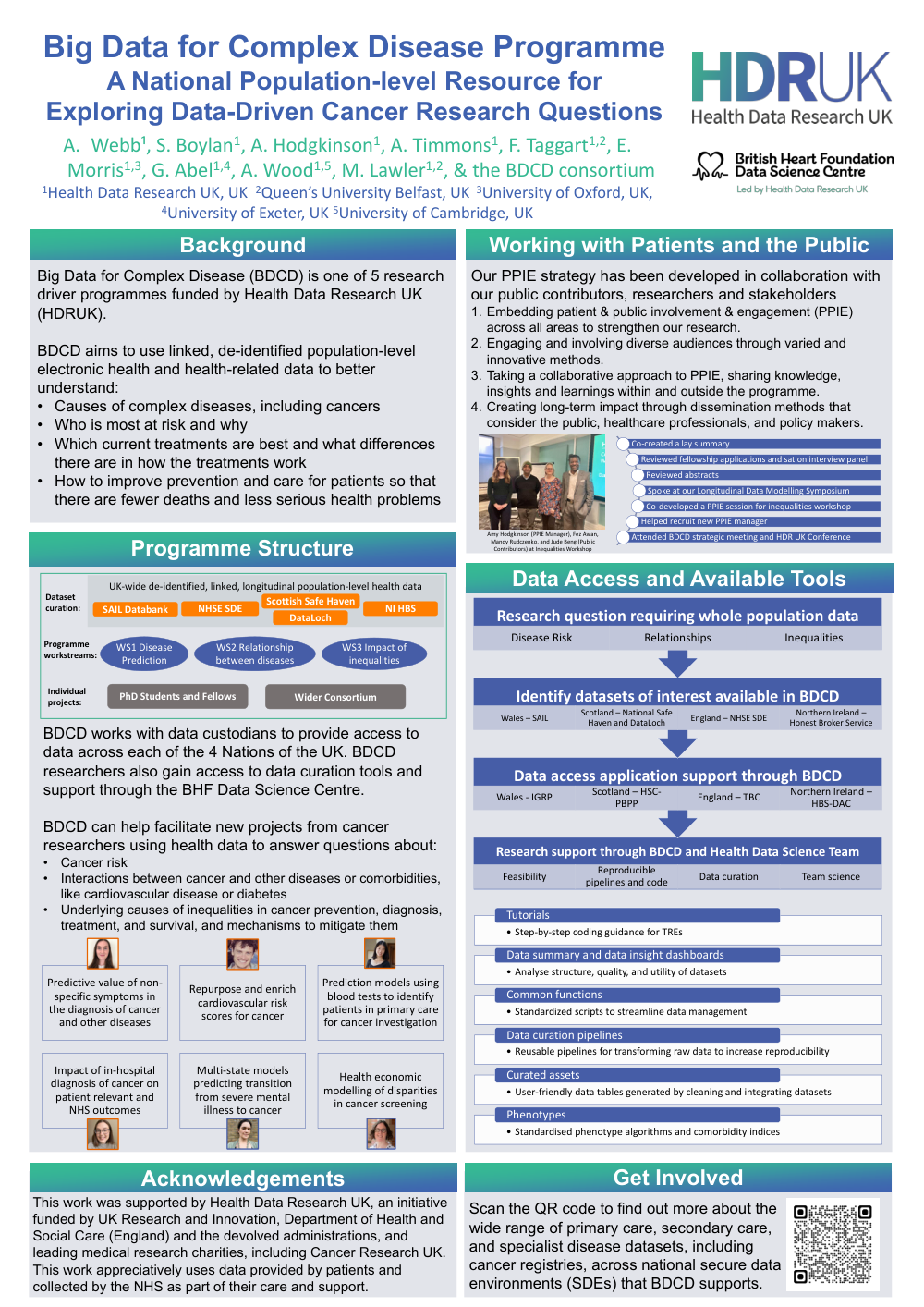
Big Data for Complex Disease (BDCD) is one of 5 research driver programmes funded by Health Data Research UK (HDRUK). BDCD aims to use linked, de-identified population-level electronic health and health-related data to better understand:
-
Causes of complex diseases, including cancers
-
Who is most at risk and why
-
Which current treatments are best and what differences there are in how the treatments work
-
How to improve prevention and care for patients so that there are fewer deaths and less serious health problems
As a programme, BDCD works with data custodians to provide access to data across each of the 4 Nations of the UK. This facilitates research by providing a single front door for projects to source a wide range of primary care, secondary care, and specialist disease datasets, including cancer registries, acrossnational secure data environments (SDEs). BDCD researchers also gain access to data curation tools and support through the BHF Data Science Centre, whose health data scientists enable the creation of research ready datasets and reusable code.Our programme has an active Patient and Public Contributor Network who is involved in deciding on the most important research topics, working together with project teams, and ensuring that clear benefit is at the heart of how health data is being used.
Through the BDCD programme, we can facilitate data access for new projects from cancer researchers looking to use whole population health data to answer questions about
-
Cancer risk
-
Interactions between cancer and other diseases or comorbidities, like cardiovascular disease or diabetes
-
Underlying causes of inequalities in cancer prevention, diagnosis, treatment, and survival, and mechanisms to mitigate them
This poster provides more information about the datasets and curation resources available, the application process, the types of projects we are currently supporting, and how researchers can join and get more involved in the BDCD programme.