92 posters, 1 audios, 1 topics, 567 authors, 81 institutions
ePostersLive by SciGen Technologies S.A. All rights reserved.
Data-driven Cancer Research Conference 2026
24-26 February 2026 | Edinburgh, Scotland

P71
Deciphering the Prognostic Landscape of Regulated Cell Death in Colorectal Cancer using a Two-Step Machine Learning Framework
Poster Presenter
Authors
Affiliations
Part of Topic
Title
Deciphering the Prognostic Landscape of Regulated Cell Death in Colorectal Cancer using a Two-Step Machine Learning Framework
Introduction
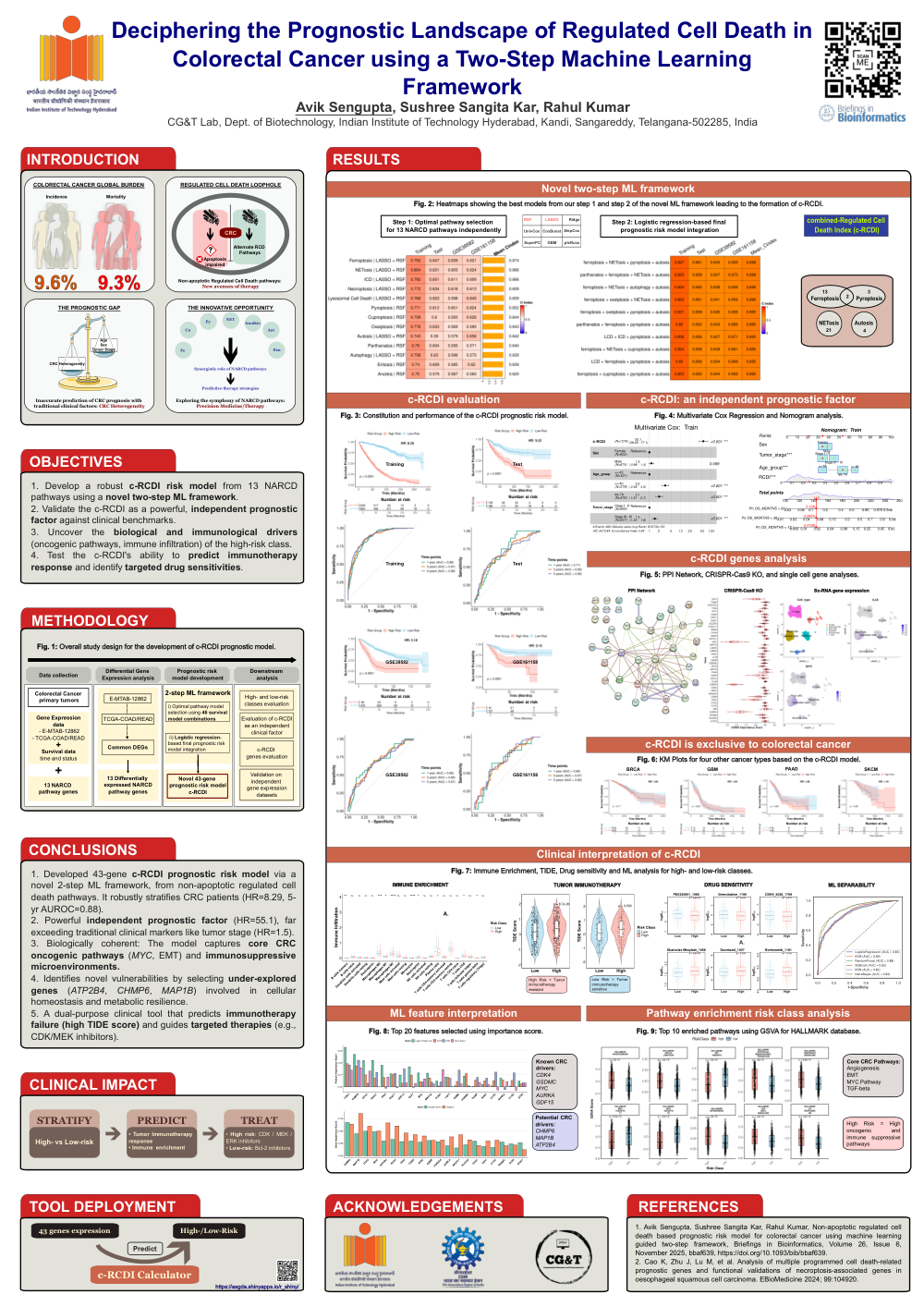
Colorectal cancer (CRC) remains a leading cause of global cancer mortality, with a 9.3% death rate. Current clinical staging (TNM) often fails to account for the intense molecular heterogeneity of tumors. While apoptosis evasion is a hallmark of CRC, alternative non-apoptotic regulated cell death (NARCD) pathways offer a "loophole" for therapeutic and prognostic innovation. We aimed to integrate the biological symphony of 13 NARCD pathways—including ferroptosis, pyroptosis, and necroptosis—to develop a superior prognostic engine.
Methodology
We employed a novel two-step machine learning (ML) framework:
Step 1: Systematically evaluated 46 survival model combinations (e.g., RSF, Lasso, CoxBoost) across 13 NARCD pathways independently to identify optimal gene features.
Step 2: Utilized a logistic regression-based integration to develop the combined-Regulated Cell Death Index (c-RCDI), a 43-gene signature.
The model was trained on TCGA-COAD/READ and E-MTAB-12862 data and rigorously validated across multiple independent datasets (GSE161158, GSE39582).
Results
Prognostic Power: The c-RCDI robustly stratified patients into high- and low-risk groups with a Hazard Ratio (HR) of 55.1 in multivariate analysis, far exceeding traditional clinical markers like tumor stage (HR = 1.5).
Accuracy: The model achieved high predictive accuracy with a 5-year AUROC of 0.88.
Biological Drivers: High-risk tumors showed enrichment in oncogenic pathways such as EMT, Myogenesis, and Angiogenesis, while low-risk tumors exhibited active immune signatures.
Therapeutic Insight: The c-RCDI successfully predicted immunotherapy failure (High TIDE scores in high-risk groups) and identified specific sensitivities to targeted drugs like CDK and MEK inhibitors.
Conclusions
Our study provides a dual-purpose clinical tool that bridges the gap between high-dimensional multi-omics and precision oncology. The c-RCDI framework not only offers superior survival stratification but also serves as a roadmap for identifying novel therapeutic vulnerabilities and guiding immunotherapy decisions in colorectal cancer.
Keywords:
Colorectal Cancer, Machine Learning, Regulated Cell Death (NARCD), Prognostic Signature, Immunotherapy.
Comments
Email is required but is not shown publicly.
No comments yet. Be the first to comment.