92 posters, 1 audios, 1 topics, 567 authors, 81 institutions
ePostersLive by SciGen Technologies S.A. All rights reserved.
Data-driven Cancer Research Conference 2026
24-26 February 2026 | Edinburgh, Scotland

P43
Independent contributions of specific Magnetic Resonance Imaging-quantified fat deposits to cancer incidence (UK Biobank): an expert consensus DAG-informed analysis
Poster Presenter
Authors
Lee Malcomson, Michelle Harvie, Matthew Sperrin, Emma J Crosbie, Andrew G Renehan
Affiliations
Part of Topic
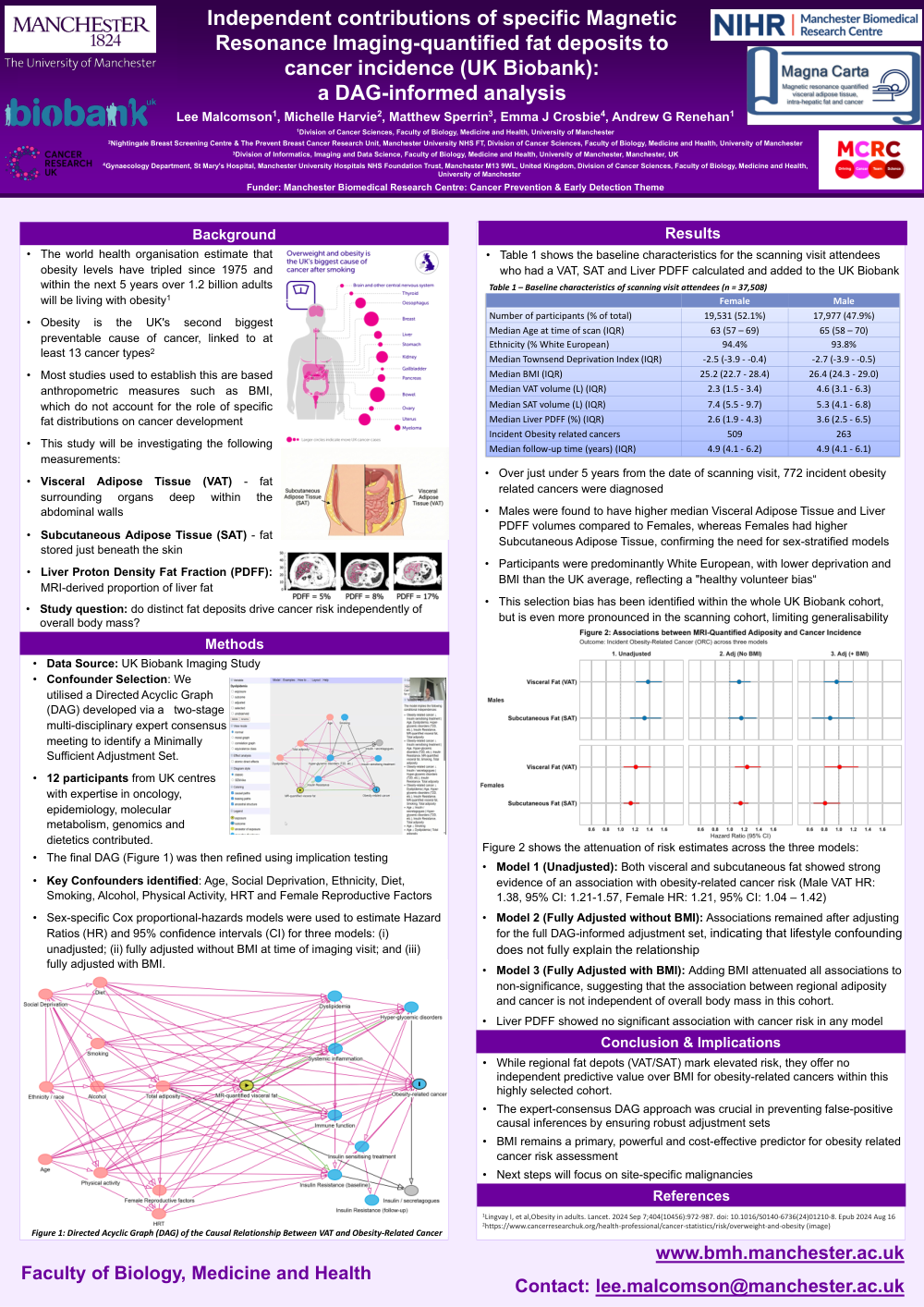
Independent contributions of specific Magnetic Resonance Imaging-quantified fat deposits to cancer incidence (UK Biobank):
a DAG-informed analysis
Background
•The world health organisation estimate that obesity levels have tripled since 1975 and within the next 5 years over 1.2 billion adults will be living with obesity1
•Obesity is the UK's second biggest preventable cause of cancer, linked to at least 13 cancer types2
•Most studies used to establish this are based anthropometric measures such as BMI, which do not account for the role of specific fat distributions on cancer development
•This study will be investigating the following measurements:
•Visceral Adipose Tissue (VAT) - fat surrounding organs deep within the abdominal walls
•Subcutaneous Adipose Tissue (SAT) - fat stored just beneath the skin
•Liver Proton Density Fat Fraction (PDFF): MRI-derived proportion of liver fat
•Study question: do distinct fat deposits drive cancer risk independently of overall body mass?
Methods
•Data Source: UK Biobank Imaging Study
•Confounder Selection: We utilised a Directed Acyclic Graph (DAG) developed via a two-stage multi-disciplinary expert consensus meeting to identify a Minimally Sufficient Adjustment Set.
12 participants from UK centres with expertise in oncology, epidemiology, molecular metabolism, genomics and
•The final DAG (Figure 1) was then refined using implication testing
•Key Confounders identified: Age, Social Deprivation, Ethnicity, Diet, Smoking, Alcohol, Physical Activity, HRT and Female Reproductive Factors
•Sex-specific Cox proportional-hazards models were used to estimate Hazard Ratios (HR) and 95% confidence intervals (CI) for three models: (i) unadjusted; (ii) fully adjusted without BMI at time of imaging visit; and (iii) fully adjusted with BMI.
Results
•Table 1 shows the baseline characteristics for the scanning visit attendees who had a VAT, SAT and Liver PDFF calculated and added to the UK Biobank
•Over just under 5 years from the date of scanning visit, 772 incident obesity related cancers were diagnosed
•Males were found to have higher median Visceral Adipose Tissue and Liver PDFF volumes compared to Females, whereas Females had higher Subcutaneous Adipose Tissue, confirming the need for sex-stratified models
•Participants were predominantly White European, with lower deprivation and BMI than the UK average, reflecting a "healthy volunteer bias“
•This selection bias has been identified within the whole UK Biobank cohort, but is even more pronounced in the scanning cohort, limiting generalisability
Figure 2 shows the attenuation of risk estimates across the three models:
•Model 1 (Unadjusted): Both visceral and subcutaneous fat showed strong evidence of an association with obesity-related cancer risk (Male VAT HR: 1.38, 95% CI: 1.21-1.57, Female HR: 1.21, 95% CI: 1.04 – 1.42)
•Model 2 (Fully Adjusted without BMI): Associations remained after adjusting for the full DAG-informed adjustment set, indicating that lifestyle confounding does not fully explain the relationship
•Model 3 (Fully Adjusted with BMI): Adding BMI attenuated all associations to non-significance, suggesting that the association between regional adiposity and cancer is not independent of overall body mass in this cohort.
•Liver PDFF showed no significant association with cancer risk in any model
Conclusion & Implications
•While regional fat depots (VAT/SAT) mark elevated risk, they offer no independent predictive value over BMI for obesity-related cancers within this highly selected cohort.
•The expert-consensus DAG approach was crucial in preventing false-positive causal inferences by ensuring robust adjustment sets
•BMI remains a primary, powerful and cost-effective predictor for obesity related cancer risk assessment
•Next steps will focus on site-specific malignancies