92 posters, 1 audios, 1 topics, 567 authors, 81 institutions
ePostersLive by SciGen Technologies S.A. All rights reserved.
Data-driven Cancer Research Conference 2026
24-26 February 2026 | Edinburgh, Scotland

P19
Harnessing health data for personalized prevention: Developing a human-centered symptom tracking tool to advance early detection among young adults
Poster Presenter
Part of Topic
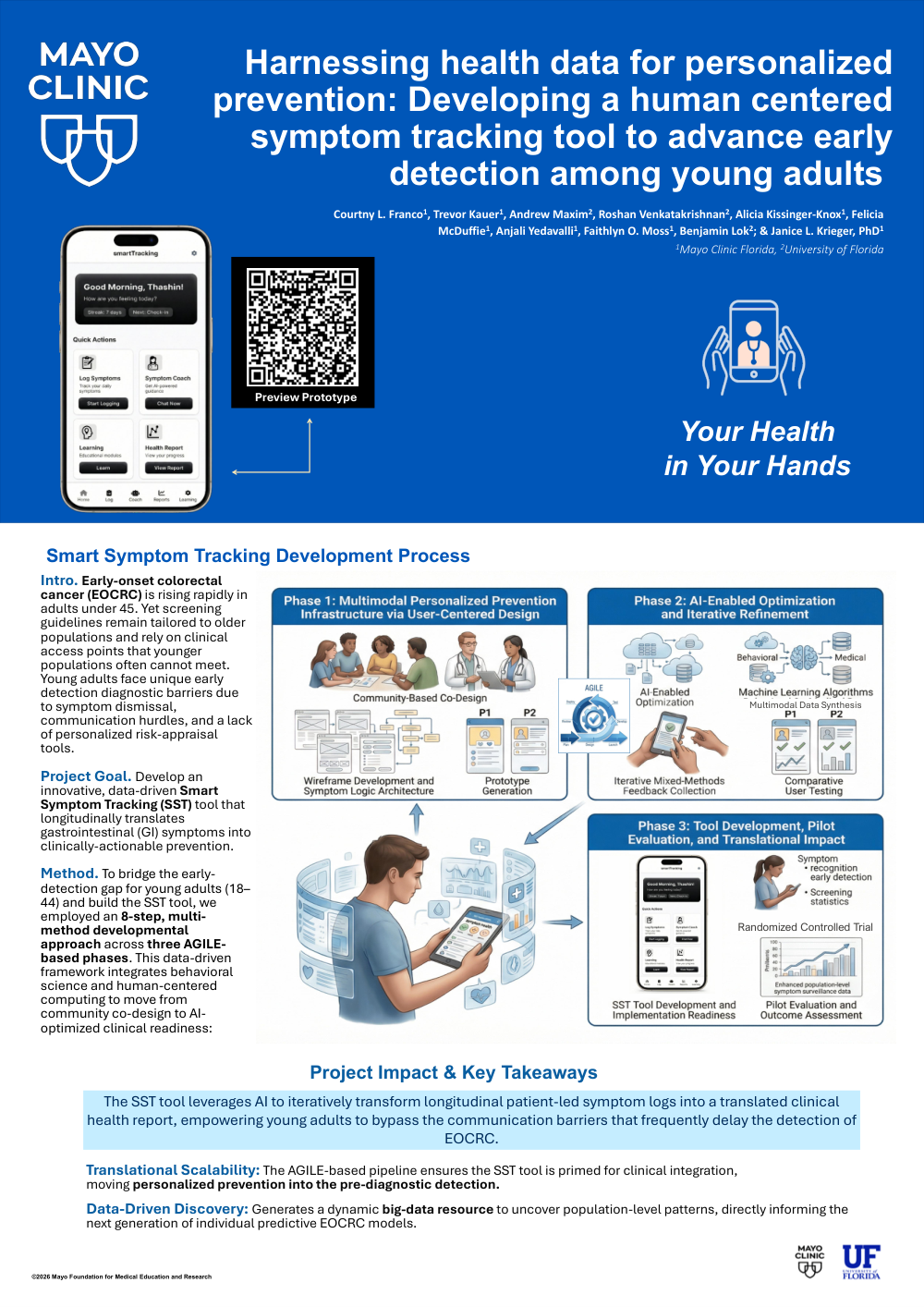
Smart Symptom Tracking (SST) Development Process. This project outlines the user-centered, iterative, and data-driven development process to design, optimize, and evaluate a SmartSymptom Tracking (SST) intervention aimed at improving early detection and screening engagementamong young adults (ages 18–44) at risk for early-onset colorectal cancer (EOCRC). Guidedby principles of human-centered computing, health communication, psychology, public health, andbehavioral data science, the 8-step SST development pipeline progresses across three integratedphases, each incorporating multimodal structured community-based co-design, optimization, andevaluation.
Phase 1: Multimodal Infrastructure & User-Centered Design
Step 1. Community Co-Design: Young adults and clinicians identify symptom interpretation gaps to ensure real-world relevance.
Step 2. Logic Architecture: Insights translated into a rule-based symptom logic framework linking patterns with evidence-based risk indicators.
Step 3. Prototyping: Development of two interactive high-fidelity Figma prototypes (P1, P2) for comparative testing.
Phase 2: AI-Enabled Optimization & Iterative Refinement
Step 4. Machine Learning: AI-supported pattern recognition integrates behavioral and medical data to refine adaptive feedback algorithms.
Step 5. Mixed-Methods Feedback: Usability metrics from surveys and interviews assess trust, cultural relevance, and ease of use.
Step 6. A/B Testing: Comparative evaluation of P1 and P2 based on performance and user engagement metrics to select the final tool.
Phase 3: Implementation Readiness & Translational Impact
Step 7. Tool Development: Finalized prototype expanded into a functional, secure intervention ready for research and clinical deployment.
Step 8. Pilot Evaluation: Accessibility and feasibility assessment of early detection outcomes, care-seeking behavior, and population-level symptom surveillance data.
Comments
Email is required but is not shown publicly.
No comments yet. Be the first to comment.