395 posters, 1 audios, 13 topics, 29 sessions, 1,056 authors, 461 institutions
ePostersLive by SciGen Technologies S.A. All rights reserved.
51st Annual Regional Anesthesiology and Acute Pain Medicine Meeting
April 16 - 18, 2026 | Phoenix, Arizona

2311224
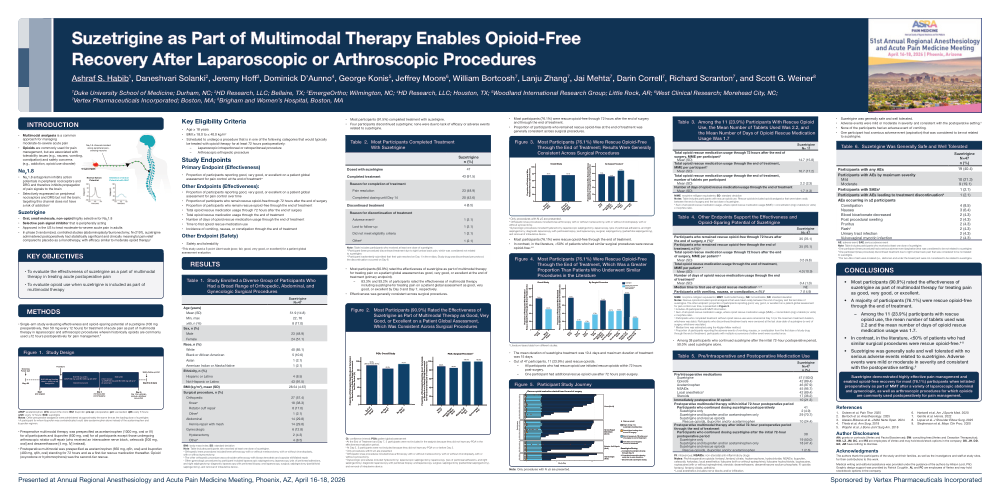
Suzetrigine as Part of Multimodal Therapy Enables Opioid-free Recovery After Laparoscopic or Arthroscopic Procedures
Poster Presenter
Authors
Ashraf Habib, Daneshvari Solanki, Jeremy Hoff, Dominick D'Aunno, George Konis, Jeffrey Moore, William Bortcosh, Lanju Zhang, Jai Mehta, Darin Correll, Richard Scranton, Scott Weiner
Affiliations
Vertex Pharmaceuticals, Brigham and Women's Hospital, HD Research, Duke University School of Medicine,
Part of Topic
Scientific Abstracts > Acute Pain
Introduction
Suzetrigine is approved in the US for treatment of moderate-to-severe acute pain in adults. As a highly selective NaV1.8 inhibitor, suzetrigine does not have addiction potential.1In randomized, controlled phase 3 trials (abdominoplasty/bunionectomy; N=2191), suzetrigine (oral) monotherapy administered postoperatively had statistically significant, clinically meaningful pain relief compared to placebo, with efficacy similar to moderate-opioid therapy.2We describe suzetrigine’s effectiveness and opioid-sparing potential in laparoscopic/arthroscopic procedures when initiated preoperatively as part of multimodal therapy (MMT).
Methods
In this phase 4, single-arm study, suzetrigine (100 mg preoperatively, then 50 mg every 12 hours) was administered as part of MMT for treatment of acute pain. Participants (N=47) had laparoscopic abdominal (i.e., hernia repair with mesh) or gynecologic (e.g., hysterectomy), or arthroscopic orthopedic (e.g., meniscectomy, rotator cuff repair) procedures for which opioids are commonly used ≥72 hours postoperatively for pain management.3 The protocol was reviewed and approved by an IRB (Advarra, Inc.). Pre- and postoperative MMT was prespecified as suzetrigine, acetaminophen, and ibuprofen, and administered according to standard-of-care. Participants were permitted to take either oxycodone or hydromorphone as opioid rescue medication. The primary endpoint was the proportion of participants reporting good/very good/excellent on a patient global assessment for pain control at the end of treatment (up to 14 days). Safety and rescue opioid use were also assessed.
Results
Participants had a variety of surgeries, the most common being meniscectomy (38.3%), laparoscopic hernia repair with mesh (29.8%), and rotator cuff repair (17.0%). Most participants (90.9%) rated the effectiveness of suzetrigine as part of MMT as good, very good, or excellent; effectiveness was consistent across surgery types. A majority of participants (76.1%; N=46) did not require any opioids after surgery; those who needed opioid rescue received a mean of 2.2 tablets (mean duration: 1.7 days). All participants who had rescue opioid initiated within 72 hours post-surgery; one participant continued rescue opioids more than 72 hours after the end of surgery (Figure 1). Data from the literature on the proportion of patients who are opioid-free after similar procedures will be provided in the presentation, providing context for these results. Suzetrigine was generally safe and well tolerated. One participant had a serious adverse event (aspiration) that was considered to be not related to suzetrigine. Adverse events were generally consistent with postoperative settings.
Discussion
Suzetrigine demonstrated highly effective pain management and enabled opioid-free recovery for most participants (76.1%) when initiated preoperatively and as part of MMT after a variety of laparoscopic abdominal and gynecologic, as well as arthroscopic orthopedic surgical procedures for which opioids are commonly used postoperatively for pain management.