395 posters, 1 audios, 13 topics, 29 sessions, 1,056 authors, 461 institutions
ePostersLive by SciGen Technologies S.A. All rights reserved.
51st Annual Regional Anesthesiology and Acute Pain Medicine Meeting
April 16 - 18, 2026 | Phoenix, Arizona

2360182
Intrathecal Migration, Subdural Placement, or No-Man's Land? Challenging Thoracic Epidurals in the Trauma Patient
Poster Presenter
Part of Topic
Late Breaking Medically Challenging Cases
Intrathecal Migration, Subdural Placement, or No-Man’s Land?
Challenging Thoracic Epidurals in the Trauma Patient
Sierra Mastrantonio MD, Alastair Moody MD, Jacob Pollard MD,
University of Utah Health, Department of Anesthesiology
Background
•Thoracic epidurals are commonly used for analgesia following surgery or acute trauma1-3
•A well-placed epidural can reduce the risk of pneumonia, atelectasis, and improve rehabilitation1-3
•Extensive injuries can complicate both placement and troubleshooting of epidural complications2-4
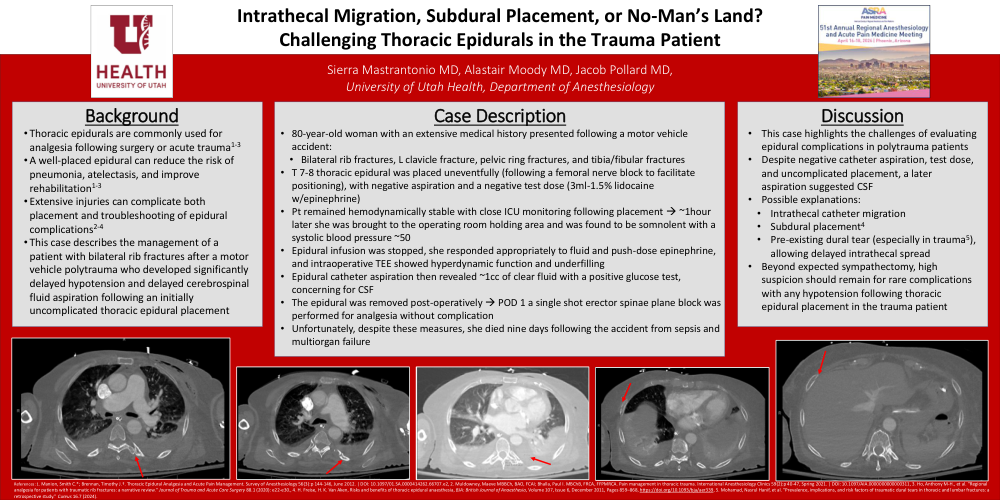
•This case describes the management of a patient with bilateral rib fractures after a motor vehicle polytrauma who developed significantly delayed hypotension and delayed cerebrospinal fluid aspiration following an initially uncomplicated thoracic epidural placement
Case Description
•80-year-old woman with an extensive medical history presented following a motor vehicle accident:
•Bilateral rib fractures, L clavicle fracture, pelvic ring fractures, and tibia/fibular fractures
•T 7-8 thoracic epidural was placed uneventfully (following a femoral nerve block to facilitate positioning), with negative aspiration and a negative test dose (3ml-1.5% lidocaine w/epinephrine)
•Pt remained hemodynamically stable with close ICU monitoring following placement à ~1hour later she was brought to the operating room holding area and was found to be somnolent with a systolic blood pressure ~50
•Epidural infusion was stopped, she responded appropriately to fluid and push-dose epinephrine, and intraoperative TEE showed hyperdynamic function and underfilling
•Epidural catheter aspiration then revealed ~1cc of clear fluid with a positive glucose test, concerning for CSF
•The epidural was removed post-operatively à POD 1 a single shot erector spinae plane block was performed for analgesia without complication
•Unfortunately, despite these measures, she died nine days following the accident from sepsis and multiorgan failure
Discussion
•This case highlights the challenges of evaluating epidural complications in polytrauma patients
•Despite negative catheter aspiration, test dose, and uncomplicated placement, a later aspiration suggested CSF
•Possible explanations:
•Intrathecal catheter migration
•Subdural placement4
•Pre-existing dural tear (especially in trauma5), allowing delayed intrathecal spread
•Beyond expected sympathectomy, high suspicion should remain for rare complications with any hypotension following thoracic epidural placement in the trauma patient