395 posters, 1 audios, 13 topics, 29 sessions, 1,056 authors, 461 institutions
ePostersLive by SciGen Technologies S.A. All rights reserved.
51st Annual Regional Anesthesiology and Acute Pain Medicine Meeting
April 16 - 18, 2026 | Phoenix, Arizona

2318627
Interprovider Variability and Efficacy of Paravertebral Blocks with Liposomal Bupivacaine for Minimally-Invasive Cardiac Surgery
Poster Presenter
Authors
Affiliations
Part of Topic
Safety/QA/QI Projects
Introduction
At our academic hospital, patients undergoing off-pump robotically-assisted minimally-invasive direct coronary artery bypass (MID-CAB) surgery receive pre-induction paravertebral blocks (PVB) containing bupivacaine and liposomal bupivacaine (LB) for postoperative analgesia. Although we previously demonstrated PVBs decreased intraoperative opioid usage compared to intercostal blocks, we now present a quality improvement project to investigate technique variability and patient outcomes (pain scores, opioid usage, length of stay, respiratory complications) prior to establishing standardized protocols.
Methods
A retrospective review of the EMR of patients undergoing MID-CAB surgery at Duke University Hospital from 1/2025 to 12/2025 was conducted. Patient demographics including age, sex, BMI, and chronic opioid usage were reported with descriptive statistics., Block technique characteristics including concomitant interpectoral plane block, PVB levels performed, bupivacaine dosing, administration of LB, and provider anesthesia division (regional vs cardiothoracic) were reported with descriptive statistics. Outcome data including patient-reported pain scores every four hours for the first postoperative day (POD 0, 0-24 hours) and POD 1 (24-48 hours); intraoperative, POD 0 and POD 1 opioid usage (oral morphine equivalents, OME); ICU length of stay (days); time to discharge from ICU (days); and presence of respiratory distress (escalation to high-flow nasal cannula, BiPAP, or re-intubation) were represented with descriptive statistics, box-and-whisker plots, or line plots. Descriptive statistics included median with interquartile ranges for continuous data and frequencies for categorical data.
Results
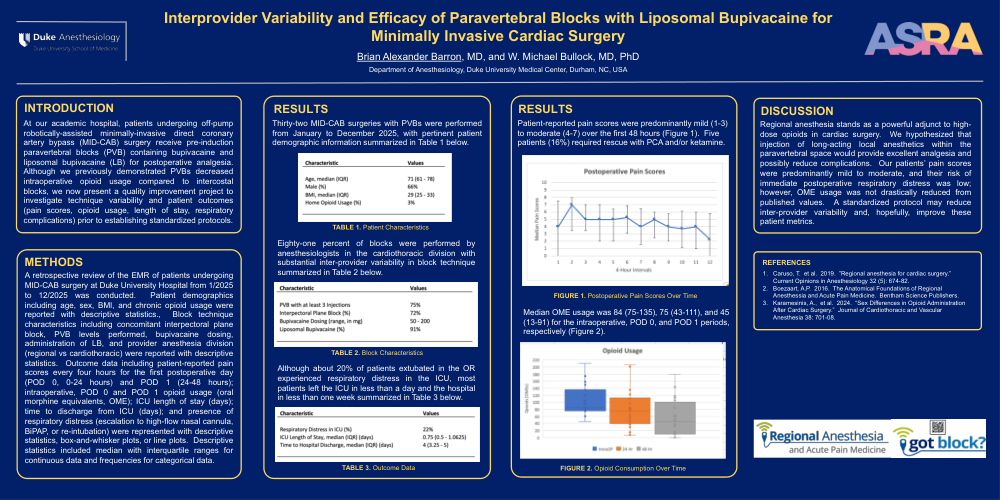
Thirty-two MID-CAB surgeries with PVBs were performed from January to December 2025, with pertinent patient demographic information summarized in Table 1 below. Eighty-one percent of blocks were performed by anesthesiologists in the cardiothoracic division with substantial inter-provider variability in block technique summarized in Table 2 below. Although about 20% of patients extubated in the OR experienced respiratory distress in the ICU, most patients left the ICU in less than a day and the hospital in less than one week summarized in Table 3 below.
Patient-reported pain scores were predominantly mild (1-3) to moderate (4-7) over the first 48 hours (Figure 1). Five patients (16%) required rescue with PCA and/or ketamine. Median OME usage was 84 (75-135), 75 (43-111), and 45 (13-91) for the intraoperative, POD 0, and POD 1 periods, respectively (Figure 2).
Discussion
Regional anesthesia stands as a powerful adjunct to high-dose opioids in cardiac surgery. We hypothesized that injection of long-acting local anesthetics within the paravertebral space would provide excellent analgesia and possibly reduce complications. Our patients’ pain scores were predominantly mild to moderate, and their risk of immediate postoperative respiratory distress was low; however, OME usage was not drastically reduced from published values. A standardized protocol may reduce inter-provider variability and, hopefully, improve these patient metrics.