395 posters, 1 audios, 13 topics, 29 sessions, 1,056 authors, 461 institutions
ePostersLive by SciGen Technologies S.A. All rights reserved.
51st Annual Regional Anesthesiology and Acute Pain Medicine Meeting
April 16 - 18, 2026 | Phoenix, Arizona

2318552
Anticoagulation and Blocks: Always a Dilemma
Poster Presenter
Part of Topic
Medically Challenging Cases
Anticoagulation and Blocks: Always a Dilemma
Makala Blakely, Jyoti Dangle, M.D.
Intro
•Acute coronary syndrome can often result in ventricular arrythmias.
•Treatments include antiarrhythmic medications, defibrillation, and ablation.
•Stellate ganglion blocks are indicated for refractory ventricular arrythmias via blockade of sympathetic input to the hearts electrical conducting system.
•Concerns arise with concurrent placement of blocks and anticoagulant use.
Methods
•This case report is devoid of patient identifiable information.
•Research was conducted in an established or commonly accepted educational setting.
•This research is exempt from IRB review requirements per IUSM’s HRPP Exempt Research Policy.
•Consent was obtained from the patients next of kin.
Case Report
•A 58-year-old male with PMH of diabetes mellitus and hypertension presented with acute decompensated heart failure complicated by ventricular arrest.
•ROSC was achieved. He was intubated, received an intra-aortic balloon, placed on ECMO, and given antiarrhythmic medication due to escalating ventricular arrythmias.
•Anticoagulation was switched from heparin to bivalirudin due to ECMO.
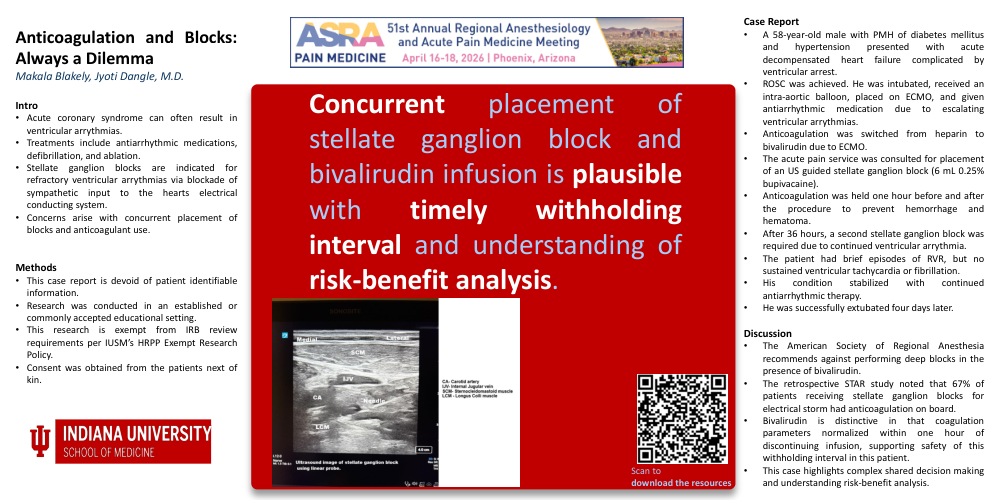
•The acute pain service was consulted for placement of an US guided stellate ganglion block (6 mL 0.25% bupivacaine).
•Anticoagulation was held one hour before and after the procedure to prevent hemorrhage and hematoma.
•After 36 hours, a second stellate ganglion block was required due to continued ventricular arrythmia.
•The patient had brief episodes of RVR, but no sustained ventricular tachycardia or fibrillation.
•His condition stabilized with continued antiarrhythmic therapy.
•He was successfully extubated four days later.
Discussion
•The American Society of Regional Anesthesia recommends against performing deep blocks in the presence of bivalirudin.
•The retrospective STAR study noted that 67% of patients receiving stellate ganglion blocks for electrical storm had anticoagulation on board.
•Bivalirudin is distinctive in that coagulation parameters normalized within one hour of discontinuing infusion, supporting safety of this withholding interval in this patient.
•This case highlights complex shared decision making and understanding risk-benefit analysis.