395 posters, 1 audios, 13 topics, 29 sessions, 1,056 authors, 461 institutions
ePostersLive by SciGen Technologies S.A. All rights reserved.
51st Annual Regional Anesthesiology and Acute Pain Medicine Meeting
April 16 - 18, 2026 | Phoenix, Arizona

2318428
A novel puzzle-based assessment of spatial awareness for ultrasound-guided regional anesthesia sonoanatomy.
Poster Presenter
Part of Topic
Scientific Abstracts > Education
Background:
•Ultrasound-guided regional anesthesia (UGRA) requires rapid recognition of relevant sonoanatomy
•Serious games have been utilized to educate learners with a combination of entertainment and education
•Puzzles require mental segmentation and reconstruction of visual information to create a final image
Study Aim:
•Develop and pilot test a web-based puzzle assessment tool for measuring sonographic anatomy recognition
Methods - Puzzle Development:
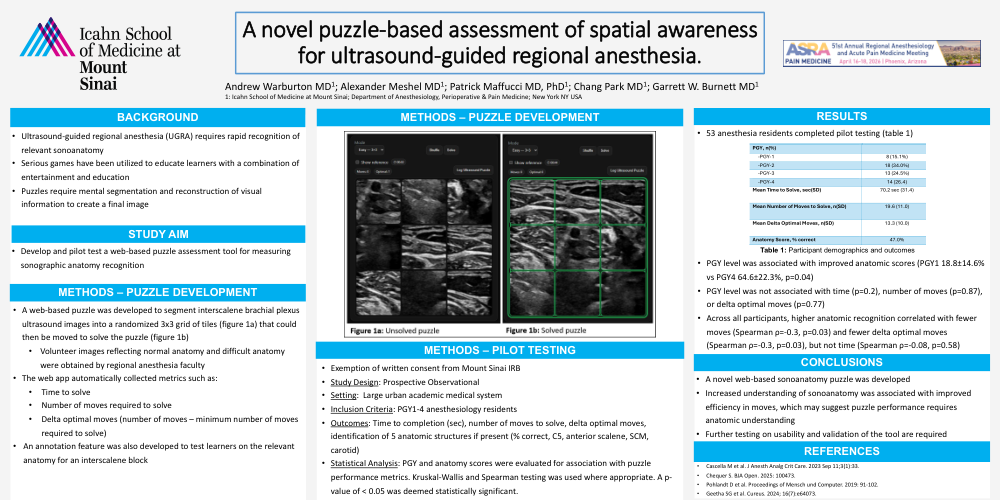
•A web-based puzzle was developed to segment interscalene brachial plexus ultrasound images into a randomized 3x3 grid of tiles (figure 1a) that could then be moved to solve the puzzle (figure 1b)
•Volunteer images reflecting normal anatomy and difficult anatomy were obtained by regional anesthesia faculty
•The web app automatically collected metrics such as:
•Time to solve
•Number of moves required to solve
•Delta optimal moves (number of moves – minimum number of moves required to solve)
•An annotation feature was also developed to test learners on the relevant anatomy for an interscalene block
Methods - Pilot Testing:
•Exemption of written consent from Mount Sinai IRB
•Study Design: Prospective Observational
•Setting: Large urban academic medical system
•Inclusion Criteria: PGY1-4 anesthesiology residents
•Outcomes: Time to completion (sec), number of moves to solve, delta optimal moves, identification of 5 anatomic structures if present (% correct, C5, anterior scalene, SCM, carotid)
•Statistical Analysis: PGY and anatomy scores were evaluated for association with puzzle performance metrics. Kruskal-Wallis and Spearman testing was used where appropriate. A p-value of < 0.05 was deemed statistically significant.
Results:
•53 anesthesia residents completed pilot testing (table 1)
•PGY level was associated with improved anatomic scores (PGY1 18.8±14.6% vs PGY4 64.6±22.3%, p=0.04)
•PGY level was not associated with time (p=0.2), number of moves (p=0.87), or delta optimal moves (p=0.77)
•Across all participants, higher anatomic recognition correlated with fewer moves (Spearman ρ=-0.3, p=0.03) and fewer delta optimal moves (Spearman ρ=-0.3, p=0.03), but not time (Spearman ρ=-0.08, p=0.58)
Conclusion:
•A novel web-based sonoanatomy puzzle was developed
•Increased understanding of sonoanatomy was associated with improved efficiency in moves, which may suggest puzzle performance requires anatomic understanding
•Further testing on usability and validation of the tool are required
References:
•Cascella M et al. J Anesth Analg Crit Care. 2023 Sep 11;3(1):33.
•Chequer S. BJA Open. 2025: 100473.
•Pohlandt D et al. Proceedings of Mensch und Computer. 2019: 91-102.
•Geetha SG et al. Cureus. 2024; 16(7):e64073.