395 posters, 1 audios, 13 topics, 29 sessions, 1,056 authors, 461 institutions
ePostersLive by SciGen Technologies S.A. All rights reserved.
51st Annual Regional Anesthesiology and Acute Pain Medicine Meeting
April 16 - 18, 2026 | Phoenix, Arizona

2318221
Continuous thoracic ESP catheter for revision T5—T6 paraganglioma resection with neuromonitoring constraints: a case
Poster Presenter
Authors
Affiliations
Part of Topic
Medically Challenging Cases
Introduction
Revision thoracic tumor surgery in adolescents is associated with severe postoperative pain and high opioid requirements. Neuraxial analgesia may be avoided when prior instrumentation and possible epidural involvement raise concern for neurologic injury or tumor-related complications. When motor-evoked potential monitoring limits systemic adjuncts, a continuous thoracic erector spinae plane (ESP) catheter may provide an opioid-sparing alternative. We report a challenging case of revision T5–T6 paraganglioma resection managed with a thoracic ESP catheter.
Materials and Methods
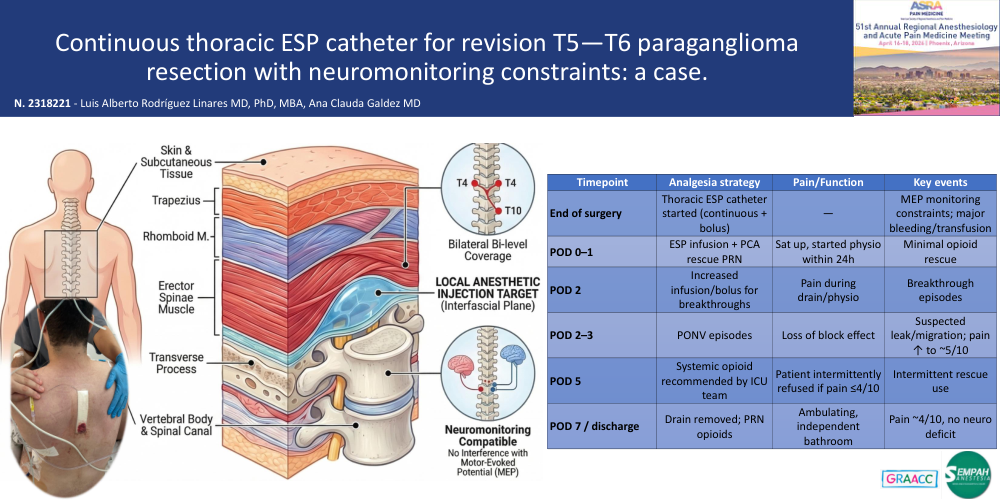
A 17-year-old with paraganglioma underwent revision T5–T6 vertebral tumor resection/corpectomy after prior scoliosis instrumentation. Written guardian consent for abstract submission was obtained, all protected health information was removed, and the case was classified as IRB-exempt per institutional policy. Because of vertebral body invasion, possible epidural compromise, and the need for motor-evoked potential monitoring, thoracic epidural analgesia was avoided. At the end of surgery, an ultrasound-guided ESP catheter was placed at T5–T6 with sonographic confirmation of spread. Postoperatively, ropivacaine was administered as a continuous infusion with patient-controlled bolus. Outcomes included pain scores, opioid use, mobilization, PONV, and complications.
Results/Case Report
Despite major intraoperative bleeding and restricted use of adjunct analgesics, the ESP catheter provided effective analgesia during the first 24 hours, allowing early sitting and physiotherapy with low opioid consumption. On postoperative day 2, infusion settings were increased because of breakthrough pain during drain care and mobilization. Recurrent vomiting was followed by suspected catheter leakage or migration, with partial loss of block effect and increased pain, requiring escalation of systemic analgesia. No neurologic deficit, local anesthetic systemic toxicity, or infectious complication occurred. After drain removal, pain improved, and at discharge the patient was ambulatory and requiring opioids only as needed.
Discussion
Continuous thoracic ESP analgesia may be a useful option when neuraxial techniques are contraindicated or avoided in revision vertebral tumor surgery. This case highlights its potential opioid-sparing benefit, while also emphasizing the importance of catheter securement and PONV prevention to preserve block efficacy. Further experience is needed to better define safety and effectiveness in oncologic spine surgery.