395 posters, 1 audios, 13 topics, 29 sessions, 1,056 authors, 461 institutions
ePostersLive by SciGen Technologies S.A. All rights reserved.
51st Annual Regional Anesthesiology and Acute Pain Medicine Meeting
April 16 - 18, 2026 | Phoenix, Arizona

2318182
Defining the Role of the Serratus Anterior Plane Catheter in a Trauma Patient
Poster Presenter
Authors
Affiliations
Part of Topic
Medically Challenging Cases
Introduction
The critical importance of rib fracture pain control cannot be overstated, as splinting directly results in issues with oxygenation and lung clearance, ultimately leading to respiratory failure and intubation. While epidural catheters have long been the gold standard, literature supports the efficacy of serratus anterior plane (SAP) blocks for rib fracture pain. SAP catheters have been used in niche situations, as for patients on anticoagulants who struggle with rib fracture pain but cannot receive an epidural. We describe our use of an SAP catheter for a trauma patient with C-spine precautions who was unable to position for an epidural.
Methods
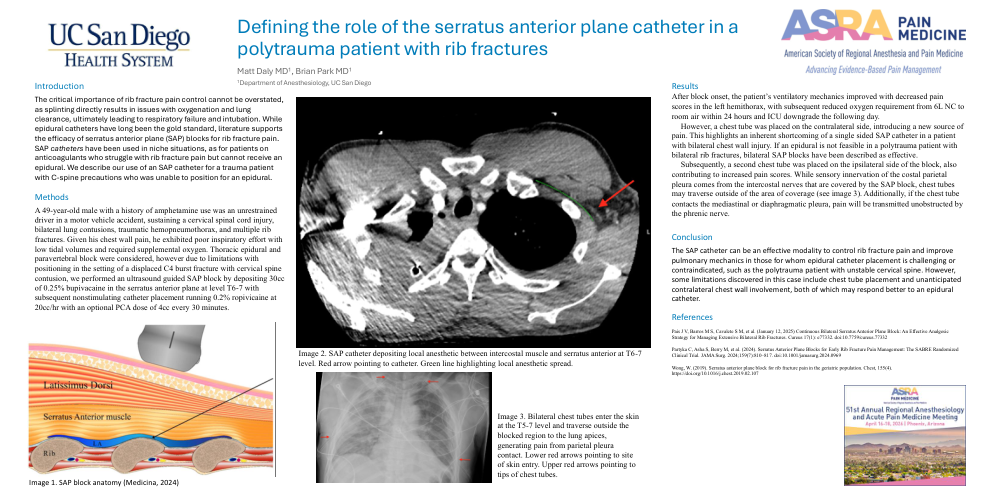
A 49-year-old male with a history of amphetamine use was an unrestrained driver in a motor vehicle accident, sustaining a cervical spinal cord injury, bilateral lung contusions, traumatic hemopneumothorax, and multiple rib fractures. Given his chest wall pain, he exhibited poor inspiratory effort with low tidal volumes and required supplemental oxygen. Thoracic epidural and paravertebral block were considered, however due to limitations with positioning in the setting of a displaced C4 burst fracture with cervical spine contusion, we performed an ultrasound guided SAP block by depositing 30cc of 0.25% bupivacaine in the serratus anterior plane at level T6-7 with subsequent nonstimulating catheter placement running 0.2% ropivicaine at 20cc/hr with an optional PCA dose of 4cc every 30 minutes.
Results
After block onset, the patient’s ventilatory mechanics improved with decreased pain scores in the left hemithorax, with subsequent reduced oxygen requirement from 6L NC to room air within 24 hours and ICU downgrade the following day.
However, a chest tube was placed on the contralateral side, introducing a new source of pain. This highlights an inherent shortcoming of a single sided SAP catheter in a patient with bilateral chest wall injury. If an epidural is not feasible in a polytrauma patient with bilateral rib fractures, bilateral SAP blocks have been described as effective.
Subsequently, a second chest tube was placed on the ipsilateral side of the block, also contributing to increased pain scores. While sensory innervation of the costal parietal pleura comes from the intercostal nerves that are covered by the SAP block, chest tubes may traverse outside of the area of coverage (see image 3). Additionally, if the chest tube contacts the mediastinal or diaphragmatic pleura, pain will be transmitted unobstructed by the phrenic nerve.
Conclusion
The SAP catheter can be an effective modality to control rib fracture pain and improve pulmonary mechanics in those for whom epidural catheter placement is challenging or contraindicated, such as the polytrauma patient with unstable cervical spine. However, some limitations discovered in this case include chest tube placement and unanticipated contralateral chest wall involvement, both of which may respond better to an epidural catheter.
References
Pais J V, Barros M S, Cavalete S M, et al. (January 12, 2025) Continuous Bilateral Serratus Anterior Plane Block: An Effective Analgesic Strategy for Managing Extensive Bilateral Rib Fractures. Cureus 17(1): e77332. doi:10.7759/cureus.77332
Partyka C, Asha S, Berry M, et al. (2024). Serratus Anterior Plane Blocks for Early Rib Fracture Pain Management: The SABRE Randomized Clinical Trial. JAMA Surg. 2024;159(7):810–817. doi:10.1001/jamasurg.2024.0969
Wong, W. (2019). Serratus anterior plane block for rib fracture pain in the geriatric population. Chest, 155(4). https://doi.org/10.1016/j.chest.2019.02.107