395 posters, 1 audios, 13 topics, 29 sessions, 1,056 authors, 461 institutions
ePostersLive by SciGen Technologies S.A. All rights reserved.
51st Annual Regional Anesthesiology and Acute Pain Medicine Meeting
April 16 - 18, 2026 | Phoenix, Arizona

2318171
Continuous costoclavicular brachial plexus catheter for pediatric oncologic shoulder disarticulation: two cases
Poster Presenter
Authors
Affiliations
Part of Topic
Medically Challenging Cases
Introduction
Major upper-limb ablative surgery in pediatric oncology is associated with substantial acute pain and risk of persistent postsurgical pain. Continuous brachial plexus analgesia may be challenging when peri-clavicular devices or postoperative soft-tissue distortion limit conventional approaches. An ipsilateral Port-a-Cath may preclude standard infraclavicular catheter placement, while supraclavicular techniques may raise concerns regarding hemidiaphragmatic paresis and catheter instability. We report two pediatric shoulder disarticulation cases successfully managed with ultrasound-guided continuous costoclavicular blockade.
Materials and Methods
Two pediatric oncology patients underwent shoulder disarticulation requiring prolonged postoperative analgesia. Written informed consent for case-report submission was obtained, all health information was de-identified, and the project was considered IRB-exempt according to institutional policy.
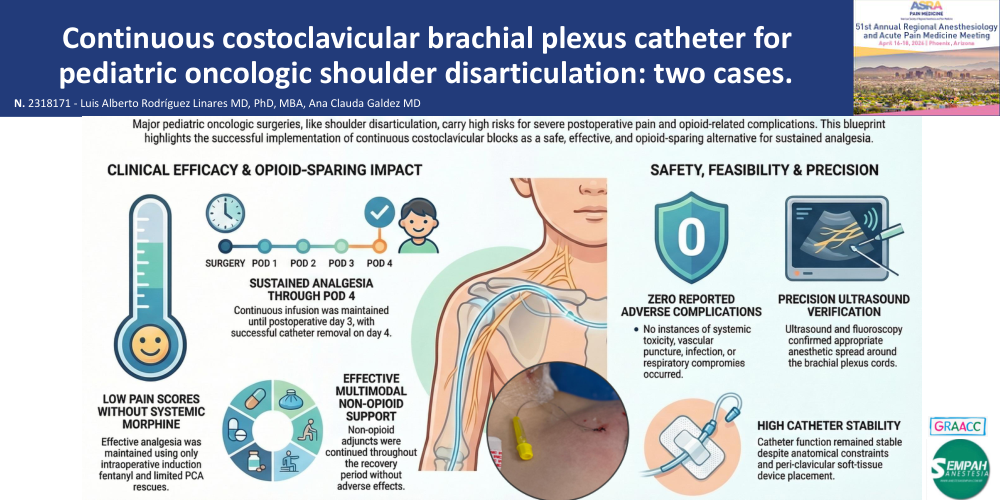
In both cases, an ultrasound-guided costoclavicular brachial plexus catheter was placed, and local anesthetic spread was confirmed sonographically. In Case 1, an ipsilateral Port-a-Cath limited standard infraclavicular catheter positioning. In Case 2, the costoclavicular approach was selected to minimize interference from peri-clavicular soft-tissue disruption and dressings while favoring a diaphragm-sparing strategy. In Case 1, fluoroscopy with iodinated contrast injected through the perineural catheter further corroborated perineural spread. Postoperatively, both patients received continuous ropivacaine infusion with patient-controlled boluses plus multimodal analgesia, including ketamine, magnesium sulfate, ketorolac, and dipyrone/metamizole. Outcomes included pain scores, opioid rescue, catheter duration, and complications.
Results/Case Report
Both patients achieved effective analgesia with stable catheter function despite peri-clavicular anatomic and device-related constraints. Pain scores remained low, and no systemic morphine was required; only intraoperative fentanyl at induction and limited PCA rescue doses were used. Continuous infusion was maintained through postoperative day 3, followed by bolus-only administration, and catheters were removed on postoperative day 4 after sustained analgesic adequacy.
No local anesthetic systemic toxicity, vascular puncture, neurologic deficit, catheter dislodgement, infection, or respiratory compromise occurred. Ultrasound confirmed appropriate spread around the brachial plexus cords in both cases, and fluoroscopic contrast in Case 1 supported perineural distribution. These rare cases are being prospectively archived to further assess feasibility, opioid-sparing effect, and potential complications of continuous costoclavicular analgesia in pediatric oncologic shoulder disarticulation.
Discussion
Continuous costoclavicular catheterization was a pragmatic alternative when an ipsilateral Port-a-Cath restricted infraclavicular access and when peri-clavicular soft-tissue disruption made other approaches less favorable. Compared with supraclavicular techniques, adult studies suggest lower rates of hemidiaphragmatic paresis with costoclavicular blockade while preserving block efficacy, and emerging pediatric experience supports its feasibility. Systematic collection of similar pediatric oncology cases is needed to better define safety, technical performance, and clinical benefit in this high-risk population.