395 posters, 1 audios, 13 topics, 29 sessions, 1,056 authors, 461 institutions
ePostersLive by SciGen Technologies S.A. All rights reserved.
51st Annual Regional Anesthesiology and Acute Pain Medicine Meeting
April 16 - 18, 2026 | Phoenix, Arizona

2317632
Fentanyl-Only Thoracic Epidural as a Bridge After Exparel Use: A Strategy for Acute Thoracotomy Pain Management
Poster Presenter
Part of Topic
Scientific Abstracts > Regional Anesthesia
Introduction: Thoracotomy is associated with severe postoperative pain driven by factors such as nerve injury, myofascial disruption, and chest tube irritation.1 Effective analgesia is essential to support respiratory mechanics, reduce pulmonary complications, and enable early mobilization.2 Regional techniques such as thoracic epidural analgesia, paravertebral blocks, and intercostal nerve blocks are routinely used.3 Liposomal bupivacaine (Exparel) has gained popularity for surgical infiltration and peripheral nerve blocks due to its prolonged duration of action. 4 However, its use creates a 96-hour restriction on additional local anesthetic administration because of the risk of systemic toxicity. 5 This limitation poses unique challenges when patients experience severe breakthrough pain before the window elapses. We present a case demonstrating an effective alternative strategy for managing acute thoracotomy pain after recent Exparel administration, during which epidural infusions with local anesthetics were contraindicated.
Materials and Methods: This is a single-patient case report. Per institutional policy, it was considered exempt from IRB review because it contains no identifiable information. Written informed consent for procedures and publication was obtained from the patient.
Case Report: A 64-year-old man with esophageal adenocarcinoma underwent robotic-assisted three-hole esophagectomy, thoracoscopic mediastinal lymphadenectomy, jejunostomy, and partial thyroidectomy. For postoperative analgesia, the acute pain service placed bilateral ultrasound-guided rectus sheath catheters infusing 0.1% ropivacaine at 10 mL/hr, which were removed on postoperative day five. He was also managed with a hydromorphone PCA.
On postoperative day six, he developed an anastomotic leak with a reactive right pleural effusion. He returned to the operating room for diagnostic VATS, thoracotomy, chest washout, and intercostal rotational muscle flap repair. At surgical closure, Exparel was infiltrated into the thoracotomy site.
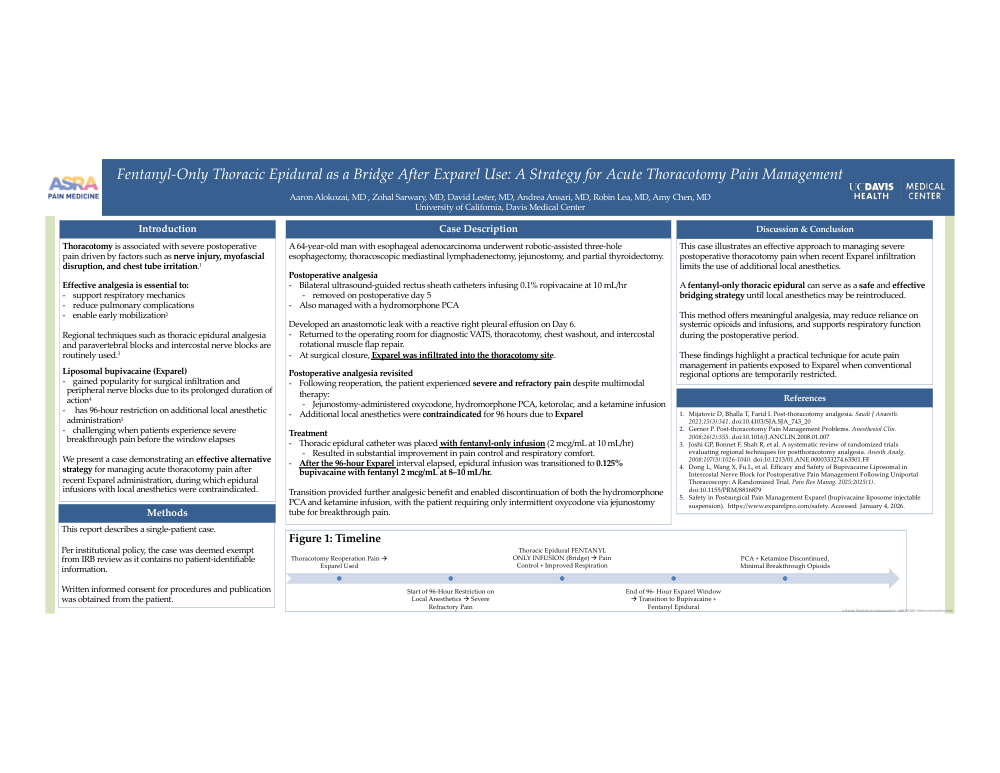
Following reoperation, the patient experienced severe and refractory pain despite multimodal therapy, including jejunostomy-administered oxycodone, hydromorphone PCA, ketorolac, and a ketamine infusion. The acute pain service was reconsulted. Because the patient had received Exparel, additional local anesthetics, either neuraxial or peripheral, were contraindicated for 96 hours. A thoracic epidural catheter was therefore placed and initiated with a fentanyl-only infusion (2 mcg/mL at 10 mL/hr), resulting in substantial improvement in pain control and respiratory comfort.
After the 96-hour Exparel interval elapsed, the epidural infusion was transitioned to 0.125% bupivacaine with fentanyl 2 mcg/mL at 8–10 mL/hr. This transition provided further analgesic benefit and enabled discontinuation of both the hydromorphone PCA and ketamine infusion, with the patient requiring only intermittent oxycodone via jejunostomy tube for breakthrough pain.
Discussion: This case illustrates an effective approach to managing severe postoperative thoracotomy pain when recent Exparel infiltration limits the use of additional local anesthetics. A fentanyl-only thoracic epidural can serve as a safe and effective bridging strategy until local anesthetics may be reintroduced. This method offers meaningful analgesia, may reduce reliance on systemic opioids and infusions, and supports respiratory function during the postoperative period. These findings highlight a practical technique for acute pain management in patients exposed to Exparel when conventional regional options are temporarily restricted.