395 posters, 1 audios, 13 topics, 29 sessions, 1,056 authors, 461 institutions
ePostersLive by SciGen Technologies S.A. All rights reserved.
51st Annual Regional Anesthesiology and Acute Pain Medicine Meeting
April 16 - 18, 2026 | Phoenix, Arizona

2317589
Intraoperative Auricular Acupuncture for Total Hip Arthroplasty is Associated with Reduced Opioid Use in Opioid-Tolerant Patients
Poster Presenter
Part of Topic
Scientific Abstracts > Regional Anesthesia
Introduction
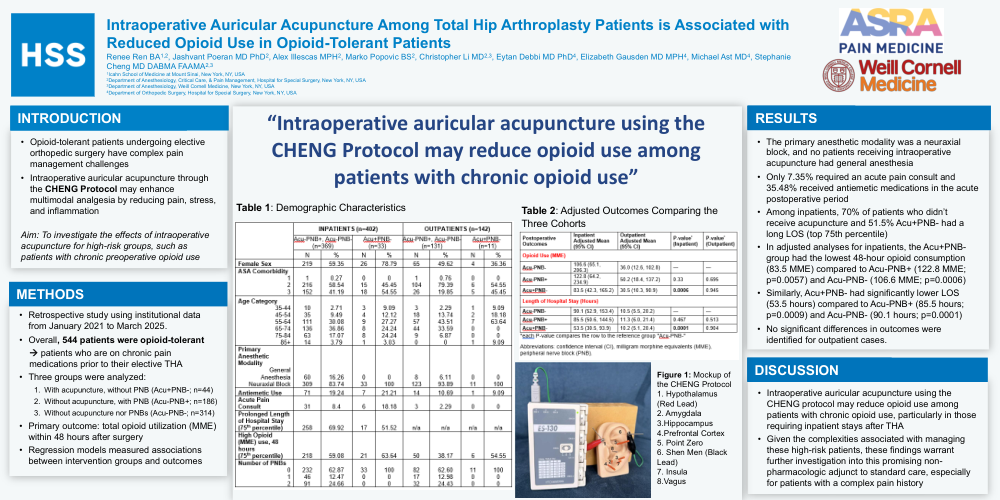
Opioid-tolerant patients undergoing elective orthopedic surgery have increased risks and complex pain management challenges.1 At our high-volume orthopedic hospital, we pioneered intraoperative auricular acupuncture through the CHENG Protocol, which may enhance multimodal analgesia by reducing pain, stress, and inflammation.2 However, it is unclear to what extent these effects benefit high-risk groups, such as patients with chronic preoperative opioid use. As such, we aimed to assess the effects of acupuncture in patients with chronic opioid use.
Materials and Methods
After IRB approval (#2022-1218), we conducted a retrospective study using institutional data from January 2021 to March 2025. Overall, 544 patients were opioid-tolerant, which was defined using our electronic health record system which identifies patients who are on chronic pain medications prior to their elective THA. Three groups were analyzed: those with acupuncture and without PNB (Acu+PNB-; n=44), without acupuncture but with PNB (Acu-PNB+; n=186), and without acupuncture nor PNBs (Acu-PNB-; n=314). The primary outcome was total opioid utilization in milligram morphine equivalents (MME) within 48 hours after surgery. Descriptive statistics analyzed baseline characteristics. Regression models measured associations between intervention groups and outcomes. Models are adjusted for year, race, ethnicity, age category, sex, BMI, history of PTSD, ASA status. All models include primary surgeon as the random intercept. Amount of opioid use (MME) and LOS are assessed using glimmix, dist=gamma, link=log.
Results/Case Report
The primary anesthetic modality was a neuraxial block, and no patients receiving intraoperative acupuncture had general anesthesia (Table 1). Few patients required an acute pain consult (7.35%) and 35.48% received antiemetic medications in the acute postoperative period. Patients receiving PNBs typically had two PNBs (n=123) rather than one PNB (n=63). Among inpatients, up to 70% of patients who didn’t receive acupuncture and 51.5% Acu+PNB- had a long LOS, defined as a LOS in the top 75th percentile. High opioid use was present in 59.1% of non-acupuncture patients and 63.6% of Acu+PNB- patients (Table 1).
In adjusted analyses for inpatients, the Acu+PNB- group had the lowest 48-hour opioid consumption (83.5 MME) compared to Acu-PNB+ (122.8 MME; p=0.0057) and Acu-PNB- (106.6 MME; p=0.0006). Similarly, Acu+PNB- had significantly lower LOS (53.5 hours) compared to Acu-PNB+ (85.5 hours; p=0.0009) and Acu-PNB- (90.1 hours; p=0.0001). No significant differences in outcomes were identified for outpatient cases.
Discussion
Intraoperative auricular acupuncture using the CHENG protocol may reduce opioid use among patients with chronic opioid use, particularly in those requiring inpatient stay after THA. Given the complexities associated with managing these high-risk patients, these findings warrant further investigation into this promising non-pharmacologic adjunct to standard care, especially for patients with a complex pain management history.
References
1. Huxtable CA, Roberts LJ, Somogyi AA, MacIntyre PE. Acute pain management in opioid-tolerant patients: a growing challenge. Anaesth Intensive Care. 2011;39(5):804-823. doi:10.1177/0310057X1103900505
2. Cheng SI, Kelleher DC, DeMeo D, Zhong H, Birch G, Ast MP. Intraoperative Acupuncture as Part of a Multimodal Analgesic Regimen to Reduce Opioid Usage After Total Knee Arthroplasty: A Prospective Cohort Trial. Med Acupunct. 2022;34(1):49-57. doi:10.1089/acu.2021.0072
2. Cheng SI, Kelleher DC, DeMeo D, Zhong H, Birch G, Ast MP. Intraoperative Acupuncture as Part of a Multimodal Analgesic Regimen to Reduce Opioid Usage After Total Knee Arthroplasty: A Prospective Cohort Trial. Med Acupunct. 2022;34(1):49-57. doi:10.1089/acu.2021.0072